Batburged Narantuya, Bae Gui-Seck, Damdinsuren Gurbazar, Kim Sang-Yoon, Lee Hye-An, Jung Soo-Yeon, Kang In-Ki, Choi Da-Hyun, Kim Chang-Hyun
School of Animal Life Convergence Science, Hankyong National University, Anseong 17579, Republic of Korea.
Biogas Research Center, Hankyong National University, Anseong 17579, Republic of Korea.
Animals (Basel). 2025 May 9;15(10):1372. doi: 10.3390/ani15101372.
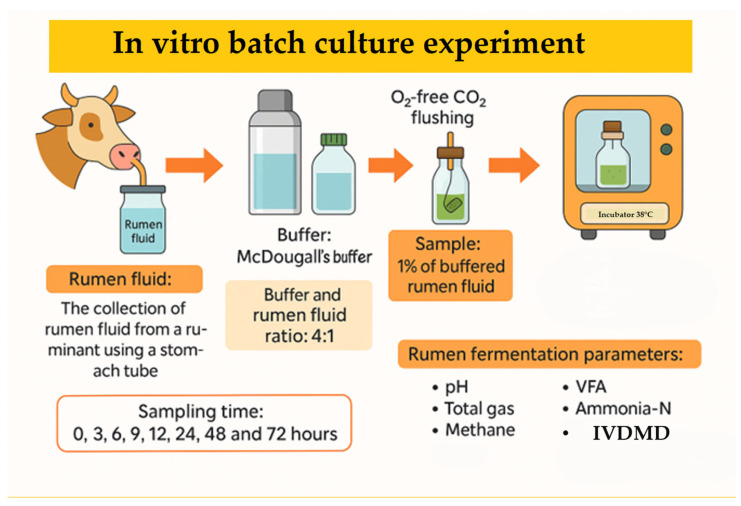
This study investigated the feasibility of incorporating L. (CAL) into ruminant feed ingredients through evaluating the effects of harvest time and substitution levels on in vitro rumen fermentation. In the first phase, a sole-substrate experiment was conducted using CAL harvested from June to August, analyzing its chemical composition and total saponins content. The impact of harvest time on fermentation parameters was assessed with CAL as the sole substrate. The second phase involved a mixed-substrate experiment using an early-fattening Hanwoo diet (30% rice straw and 70% concentrate), where increasing proportions of CAL (control: 0%, T1: 5%, T2: 10%, T3: 15%, and T4: 20%) replaced rice straw. Seasonal variations in CAL composition influenced the fermentation characteristics. CAL harvested in July exhibited higher fermentability, with total volatile fatty acids (TVFAs) reaching 103.87 mM at 72 h. In contrast, CAL harvested in August showed lower fermentability and digestibility. However, August-harvested CAL was selected for the subsequent experiment, as it provided a more practical balance of sufficient biomass yield and a higher saponins concentration, aligned with the study's methane mitigation objectives, while also exhibiting a fiber composition comparable to that of rice straw. We hypothesized that the saponins in CAL contribute to methane reductions. Supplementation with 15% of CAL significantly reduced methane production per gram of inoculated and digested dry matter ( < 0.05), likely due to differences in crude protein (CP), neutral detergent fiber (NDF), acid detergent fiber (ADF), and saponins content. However, despite having the lowest fiber content, T4 (20% CAL) exhibited the lowest in vitro dry matter digestibility (IVDMD), suggesting that factors such as saponins, CAL's chemical composition, or microbial shifts may have hindered digestibility. Ammonia-nitrogen production increased from 0 to 3 h, but it continuously decreased between 3 and 9 h due to microbial growth and nitrogen assimilation, as microbes incorporate ammonia into their biomass ( < 0.05). Fermentation characteristics further revealed that the acetate-to-propionate (A/P) ratio decreased with increasing CAL levels, with T4 showing the lowest ratio (1.55 at 72 h), confirming a shift toward propionate-based fermentation. Notably, T2 (10% CAL) showed an optimized fermentation efficiency, producing the highest TVFA concentration at 24 h (98.28 mM). These findings highlight the potential for using CAL as a functional feed ingredient, with moderate substitution levels (10-15%) enhancing fermentation efficiency while reducing methane production.
本研究通过评估收获时间和替代水平对体外瘤胃发酵的影响,探讨了将朝鲜苍术(CAL)纳入反刍动物饲料成分的可行性。在第一阶段,进行了一项单一底物实验,使用6月至8月收获的CAL,分析其化学成分和总皂苷含量。以CAL作为单一底物评估收获时间对发酵参数的影响。第二阶段涉及一项混合底物实验,使用育肥初期的韩牛日粮(30%稻草和70%精料),用比例递增的CAL(对照:0%,T1:5%,T2:10%,T3:15%,T4:20%)替代稻草。CAL成分的季节性变化影响了发酵特性。7月收获的CAL表现出更高的发酵能力,72小时时总挥发性脂肪酸(TVFAs)达到103.87 mM。相比之下,8月收获的CAL发酵能力和消化率较低。然而,选择8月收获的CAL用于后续实验,因为它在足够的生物量产量和更高的皂苷浓度之间提供了更实际的平衡,符合该研究的甲烷减排目标,同时其纤维组成与稻草相当。我们假设CAL中的皂苷有助于减少甲烷排放。添加15%的CAL显著降低了每克接种和消化干物质的甲烷产量(<0.05),这可能是由于粗蛋白(CP)、中性洗涤纤维(NDF)、酸性洗涤纤维(ADF)和皂苷含量的差异。然而,尽管T4组(20% CAL)的纤维含量最低,但其体外干物质消化率(IVDMD)却是最低的,这表明皂苷、CAL的化学成分或微生物变化等因素可能阻碍了消化率。氨氮产量在0至3小时增加,但在3至9小时之间由于微生物生长和氮同化而持续下降,因为微生物将氨纳入其生物量中(<0.05)。发酵特性进一步表明,随着CAL水平的增加,乙酸与丙酸(A/P)比值降低,T4组在72小时时比值最低(1.55),证实了向基于丙酸的发酵转变。值得注意的是,T2组(10% CAL)表现出最佳的发酵效率,在24小时时产生了最高的TVFA浓度(98.28 mM)。这些发现凸显了将CAL用作功能性饲料成分的潜力,适度的替代水平(10 - 15%)可提高发酵效率同时减少甲烷产量。