Yordanov Yordan, Tzankova Virginia, Stefanova Denitsa, Georgieva Maya, Tzankova Diana
Department of Pharmacology, Pharmacotherapy and Toxicology, Faculty of Pharmacy, Medical University-Sofia, 2 Dunav Str., 1000 Sofia, Bulgaria.
Department of Pharmaceutical Chemistry, Faculty of Pharmacy, Medical University-Sofia, 2 Dunav Str., 1000 Sofia, Bulgaria.
Antioxidants (Basel). 2025 May 8;14(5):566. doi: 10.3390/antiox14050566.
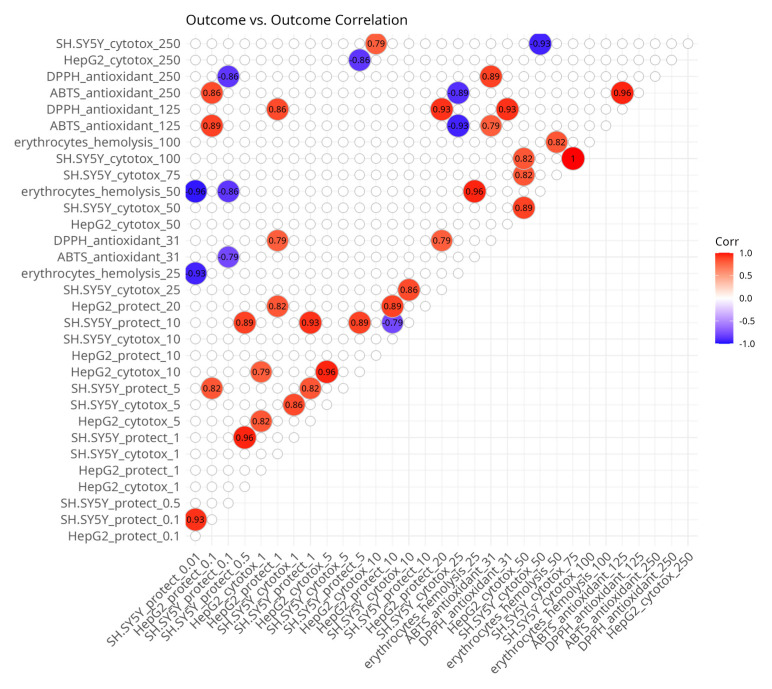
Substantial in vitro experimental data have been produced about the safety, antioxidant, neuro- and hepatoprotective effects of a series of recently synthesized N-pyrrolyl hydrazide-hydrazones (compounds , -). However, compound activity across multiple assays varies and it is challenging to elucidate the favorable physicochemical characteristics of the studied compounds and guide further lead optimization. The aim of the current study is to apply exploratory data analysis in order to profile the biological effects of the novel hydrazide-hydrazones, gain insights related to their mechanisms of action in the context of in silico predictions and identify key predictor-outcome relationships. We collected a dataset from available in vitro studies of compounds , -. It included cytotoxicity values, protection against hydrogen peroxide-induced damage in HepG2 and SH-SY5Y cells, two radical scavenging assays and a hemolysis assay across a range of treatment concentrations. SwissADME-based predictions of chemometric and ADME parameters and pro-oxidant enzyme docking data were generated to provide context for the interpretation of in vitro outcome patterns and identify causal relationships. Multiple factor analysis (MFA), followed by hierarchical clustering on principal components (HCPC), was applied to profile compounds' biological behavior. This revealed that differences in the number of H-bond donors, in the permeability coefficient and in the docking scores to two pro-oxidant enzymes could aid in explaining the effects of compounds with similar in vitro profiles. HCPC differentiated as mostly neuroprotective, and as hepatoprotective radical scavengers, with higher docking affinity to 5-lipoxygenase (5-LOX) and myeloperoxidase (MPO) and , and as having less H-bond donors and variable in vitro activity. The consensus application of three variable selection approaches based on standard lasso regression, robust penalized regression and random forest confirmed the relationships between some in vitro outcomes and LogP, pan-assay interference (PAINS) alerts, 5-LOX allosteric site docking and H-bond donor numbers. The exploratory analysis of the combined in vitro and in silico dataset provides useful insights which could help explain the major drivers behind the experimental results. It can be informative in the design of new, improved members of the series of novel N-pyrrolyl hydrazide-hydrazones with better neuroprotective potential and less side effects.
关于一系列最近合成的N-吡咯基酰肼腙(化合物 、 、 )的安全性、抗氧化、神经保护和肝脏保护作用,已经产生了大量的体外实验数据。然而,化合物在多种检测中的活性各不相同,阐明所研究化合物的有利物理化学特性并指导进一步的先导化合物优化具有挑战性。本研究的目的是应用探索性数据分析,以描述新型酰肼腙的生物学效应,在计算机预测的背景下深入了解其作用机制,并确定关键的预测因子-结果关系。我们从化合物 、 、 的现有体外研究中收集了一个数据集。它包括细胞毒性值、对HepG2和SH-SY5Y细胞中过氧化氢诱导损伤的保护作用、两种自由基清除检测以及一系列处理浓度下的溶血检测。生成了基于SwissADME的化学计量学和ADME参数预测以及前氧化酶对接数据,以提供解释体外结果模式的背景并确定因果关系。应用多因素分析(MFA),随后进行主成分层次聚类(HCPC),以描述化合物的生物学行为。这表明氢键供体数量、渗透系数以及与两种前氧化酶的对接分数的差异有助于解释具有相似体外特征的化合物的效应。HCPC将 区分为主要具有神经保护作用, 、 区分为具有肝脏保护作用的自由基清除剂, 对5-脂氧合酶(5-LOX)和髓过氧化物酶(MPO)具有更高的对接亲和力, 、 、 区分为氢键供体较少且体外活性可变。基于标准套索回归、稳健惩罚回归和随机森林的三种变量选择方法的共识应用证实了一些体外结果与LogP、全检测干扰(PAINS)警报、5-LOX变构位点对接和氢键供体数量之间的关系。对体外和计算机数据集的联合探索性分析提供了有用的见解,这有助于解释实验结果背后的主要驱动因素。它对于设计具有更好神经保护潜力和更少副作用的新型N-吡咯基酰肼腙系列的新的、改进的成员可能具有参考价值。