Li Caijiao, Li Jun, Zhang Wengang, Dang Bin, Yang Xijuan
Academy of Agriculture and Forestry Sciences, Qinghai University, Xining 810016, China.
Key Laboratory of Qinghai Province Tibetan Plateau Agric-Product Processing, Qinghai University, Xining 810016, China.
Foods. 2025 May 10;14(10):1690. doi: 10.3390/foods14101690.
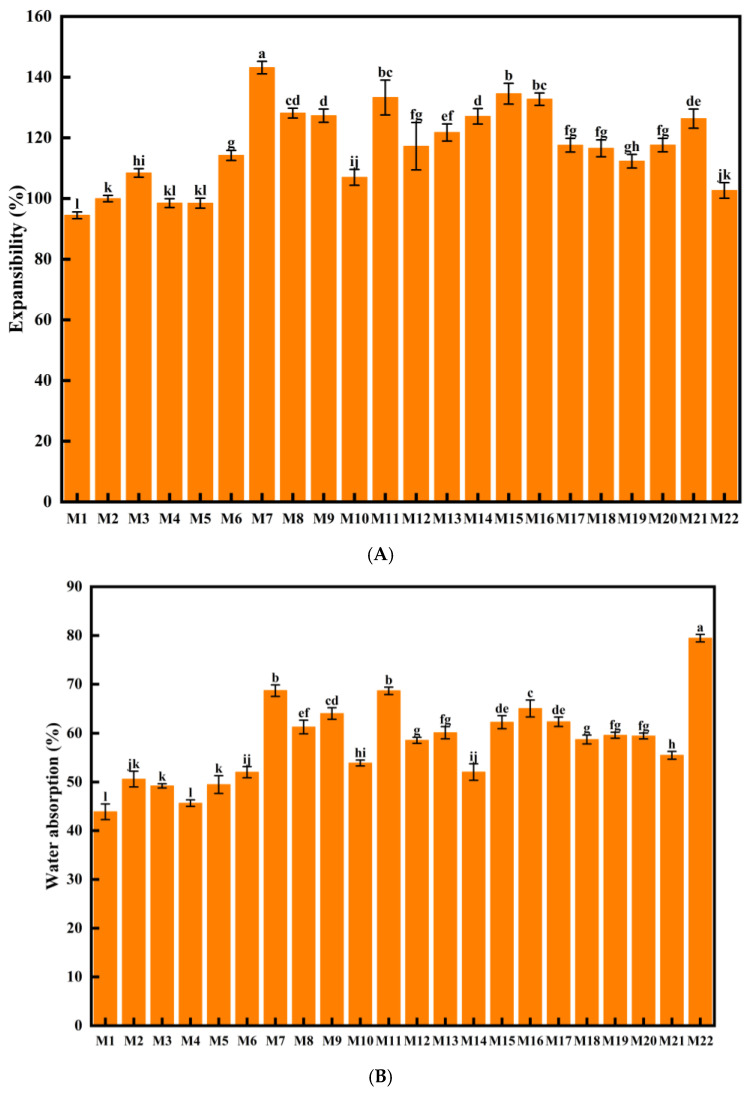
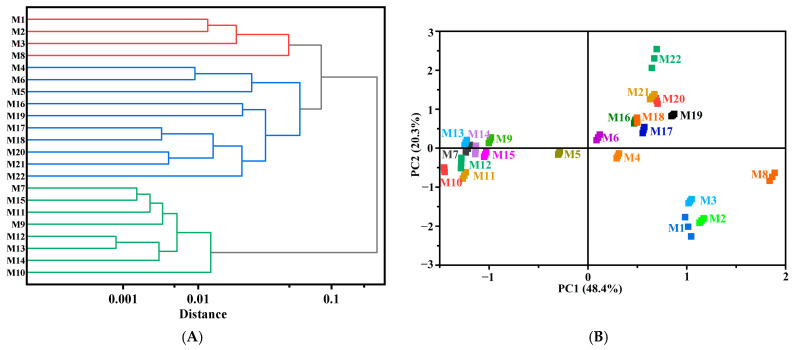
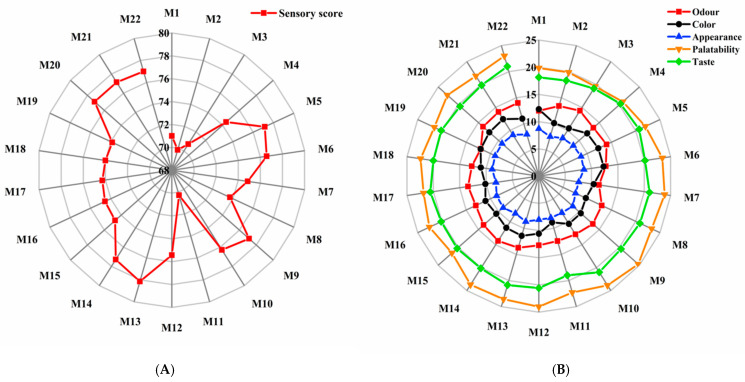
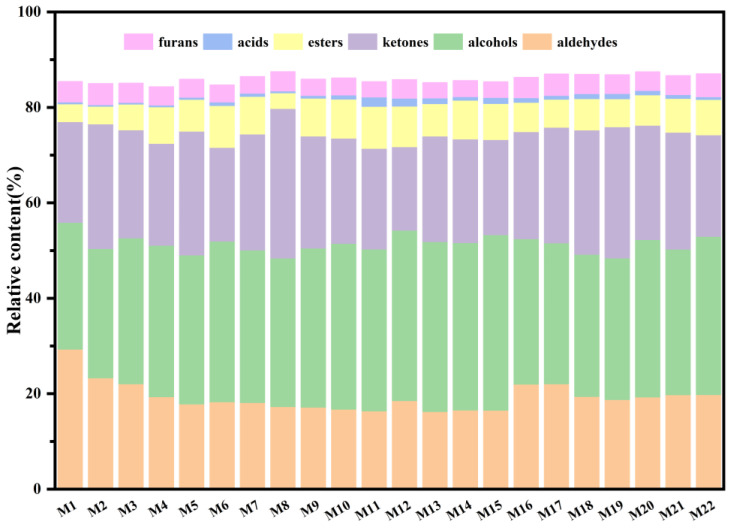
Twenty-two types of highland barley (HB) raw materials (including 10 common varieties and 5 main planting regions in the Qinghai province) were selected as the experimental materials to investigate their differences in the cooking characteristics, sensory quality, and characteristic flavor of cooked HB. The key volatile flavor components were identified using Gas Chromatography-Ion Mobility Spectroscopy (GC-IMS) combined with relative odor activity value (ROAV) analysis. The results indicated that the highland barley raw materials of Kunlun 15 (M5), Kunlun 14 (M9), Chaiqing 1 (M13) and Kunlun 14 (M14), and Chaiqing 1 (M20) and Kunlun 15 (M21) showed superior cooking quality, texture, and sensory scores. A total of 44 volatile flavor compounds were identified, including 16 aldehydes, 10 alcohols, 9 ketones, 7 esters, 1 acid, and 1 furan. Among these, 13 aldehydes, 4 alcohols, 4 ketones, 7 esters, and 1 furan were found across different cooked HB samples. Notably, ethyl, ethyl 2-methylbutanoate dimer, 2-methylbutanoic acid methyl ester, 2-butanone, 1-octen-3-ol, 1-pentanol dimer, and 2-pentyl furan contributed more significantly to the overall volatile profile. Cluster analysis combining principal component analysis revealed that Kunlun 16 (M16), Kunlun 17 (M17), Kunlun 14 (M18), Kunlun 15 (M19), as well as Chaiqing 1 (M20) and Kunlun 15 (M21), were the most suitable raw materials for cooking due to their better cooking quality, sensory attributes, and flavors, followed by Kunlun 15 (M10) and Kunlun 18 (M12), and Chaiqing 1 (M13) and Kunlun 14 (M14). These findings could help us identify specific HB varieties in corresponding regions with advantages, thus providing a theoretical basis for cooking HB.
选取22种青稞(HB)原料(包括10个常见品种以及青海省5个主要种植地区的青稞)作为实验材料,研究它们在青稞烹饪特性、感官品质和熟青稞特征风味方面的差异。采用气相色谱-离子迁移谱(GC-IMS)结合相对气味活度值(ROAV)分析来鉴定关键挥发性风味成分。结果表明,昆仑15(M5)、昆仑14(M9)、柴青1(M13)以及昆仑14(M14)、柴青1(M20)和昆仑15(M21)这些青稞原料在烹饪品质、质地和感官评分方面表现优异。共鉴定出44种挥发性风味化合物,包括16种醛类、10种醇类、9种酮类、7种酯类、1种酸类和1种呋喃类。其中,13种醛类、4种醇类、4种酮类、7种酯类和1种呋喃类在不同的熟青稞样品中均有发现。值得注意的是,乙酸乙酯、2-甲基丁酸乙酯二聚体、2-甲基丁酸甲酯、2-丁酮、1-辛烯-3-醇、1-戊醇二聚体和2-戊基呋喃对整体挥发性特征的贡献更为显著。结合主成分分析的聚类分析表明,昆仑16(M16)、昆仑17(M17)、昆仑14(M18)、昆仑15(M19)以及柴青1(M20)和昆仑15(M21)因其较好的烹饪品质、感官属性和风味,是最适合烹饪的原料,其次是昆仑15(M10)和昆仑18(M12),以及柴青1(M13)和昆仑14(M14)。这些研究结果有助于我们识别相应地区具有优势的特定青稞品种,从而为青稞烹饪提供理论依据。