Li Daobo, Zheng Xiaodan, Yang Yonggang, Xu Meiying
Guangdong Provincial Key Laboratory of Microbial Culture Collection and Application, State Key Laboratory of Applied Microbiology Southern China, Institute of Microbiology, Guangdong Academy of Sciences, Guangzhou 510070, China.
Guangdong Provincial Key Laboratory of Environmental Protection Microbiology and Regional Ecological Security, Guangzhou 510070, China.
Microorganisms. 2025 May 16;13(5):1144. doi: 10.3390/microorganisms13051144.
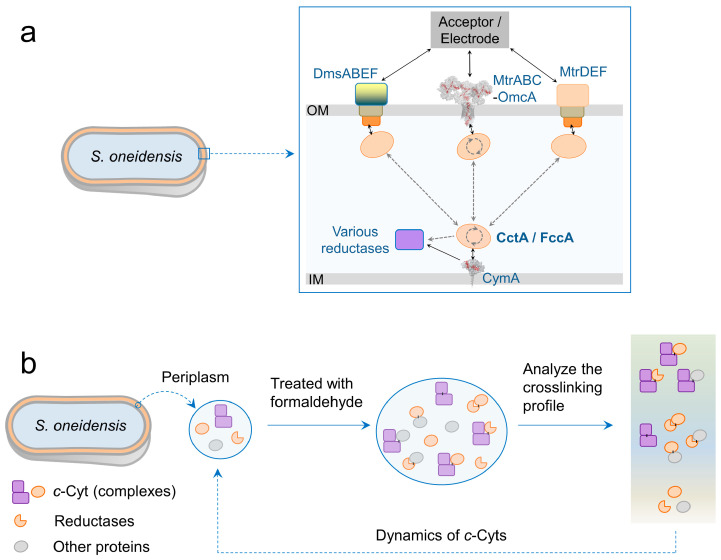
Extracellular electron transport (EET) supports the survival of specific microorganisms on the Earth's surface by facilitating microbial respiration with diverse electron acceptors. A key aspect of EET is the organization of electron relays, i.e., multi-heme c-type cytochromes (MHCs), within the periplasmic space of microbial cells. In this study, we investigated the mobility of periplasmic electron relays in MR-1, a model strain capable of EET, using in vivo protein crosslinking to the MHCs. First, we established that crosslinking efficiency correlates with the spatial proximity and diffusion coefficient of protein molecules through in vitro tests. Based on these findings, we identified distinct molecular behaviors of periplasmic MHCs, showing that the tetraheme flavocytochrome FccA, which also serves as a periplasmic fumarate reductase, forms protein complexes with limited motility, while the small tetraheme c-type cytochrome CctA remains discrete and mobile. Both MHCs contribute to EET for bioelectrochemical nitrate and nitrite reduction. These findings reveal dual mechanisms for organizing periplasmic electron relays in EET, advancing our understanding of microbial extracellular respiration.
细胞外电子传递(EET)通过促进微生物与多种电子受体的呼吸作用,支持特定微生物在地球表面的生存。EET的一个关键方面是在微生物细胞周质空间内组织电子传递体,即多血红素c型细胞色素(MHCs)。在本研究中,我们使用对MHCs进行体内蛋白质交联的方法,研究了能够进行EET的模式菌株MR-1中周质电子传递体的流动性。首先,我们通过体外试验确定交联效率与蛋白质分子的空间接近度和扩散系数相关。基于这些发现,我们确定了周质MHCs的不同分子行为,表明同时作为周质延胡索酸还原酶的四血红素黄素细胞色素FccA形成了运动性有限的蛋白质复合物,而小四血红素c型细胞色素CctA则保持离散且可移动。这两种MHCs都有助于生物电化学硝酸盐和亚硝酸盐还原的EET过程。这些发现揭示了EET中组织周质电子传递体的双重机制,增进了我们对微生物细胞外呼吸的理解。