School of Biological Sciences, University of East Anglia, Norwich NR4 7TJ, UK.
School of Biological Sciences, University of East Anglia, Norwich NR4 7TJ, UK; School of Chemistry, University of East Anglia, Norwich NR4 7TJ, UK.
Cell. 2020 Apr 30;181(3):665-673.e10. doi: 10.1016/j.cell.2020.03.032. Epub 2020 Apr 13.
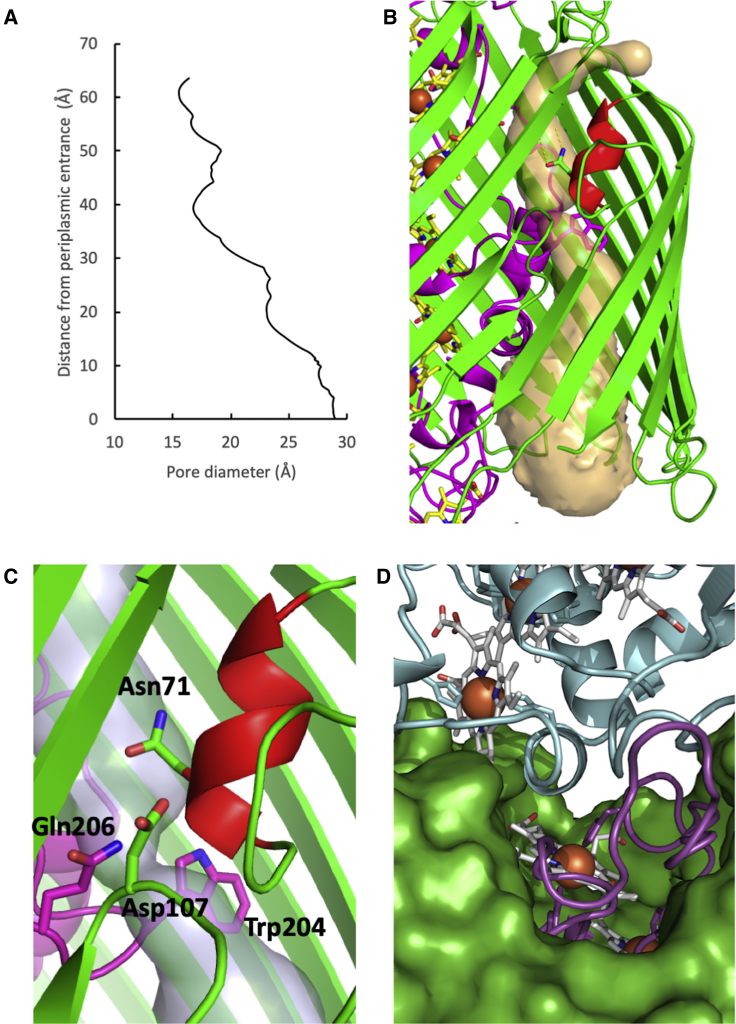
A growing number of bacteria are recognized to conduct electrons across their cell envelope, and yet molecular details of the mechanisms supporting this process remain unknown. Here, we report the atomic structure of an outer membrane spanning protein complex, MtrAB, that is representative of a protein family known to transport electrons between the interior and exterior environments of phylogenetically and metabolically diverse microorganisms. The structure is revealed as a naturally insulated biomolecular wire possessing a 10-heme cytochrome, MtrA, insulated from the membrane lipidic environment by embedding within a 26 strand β-barrel formed by MtrB. MtrAB forms an intimate connection with an extracellular 10-heme cytochrome, MtrC, which presents its hemes across a large surface area for electrical contact with extracellular redox partners, including transition metals and electrodes.
越来越多的细菌被认为能够在其细胞膜上传递电子,但支持这一过程的分子机制细节仍不清楚。在这里,我们报告了一种跨外膜蛋白复合物 MtrAB 的原子结构,该复合物代表了一类已知在不同进化和代谢微生物的内外环境之间传递电子的蛋白质家族。该结构被揭示为一种天然绝缘的生物分子线,具有一个 10 个血红素细胞色素 MtrA,通过嵌入由 MtrB 形成的 26 个β-桶而与膜脂环境绝缘。MtrAB 与细胞外的 10 个血红素细胞色素 MtrC 形成紧密连接,MtrC 将其血红素暴露在一个大的表面上,以便与细胞外的氧化还原伴侣(包括过渡金属和电极)进行电接触。