Kamal Fatima Zahra, Ciobica Alin, Dascalescu Gabriel, Rammali Said, Aalaoui Mohamed El, Lefter Radu, Vata Ioana, Burlui Vasile, Novac Bogdan
Higher Institute of Nursing Professions and Health Technical (ISPITS), Marrakech 40000, Morocco.
Department of Biology, Faculty of Biology, Alexandru Ioan Cuza University of Iasi, 20th Carol I Avenue, 700506 Iasi, Romania.
Microorganisms. 2025 May 16;13(5):1148. doi: 10.3390/microorganisms13051148.
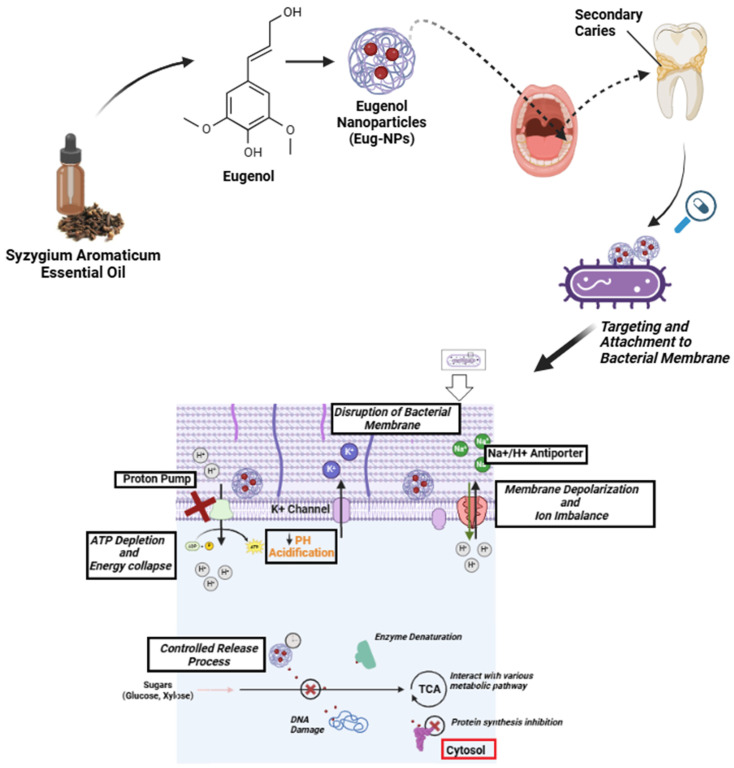
The formation of microbial colonies and biofilms are common on dental restorations. This can lead to secondary caries. Another common complication is the post-operative inflammation noted in patients. The traditionally used dental composites are designed without the inherent components having antimicrobial and inflammatory properties. This has become a major challenge in current restorative dentistry applications. In order to address these challenges, a possible approach is to incorporate eugenol nanoparticles (NPs) into dental composites. This approach can offer dual therapeutic benefits since eugenol possess both antimicrobial and inflammatory properties. In fact, compared to synthetic antimicrobial agents, eugenol exhibits antibacterial activity not only against but also against a range of oral pathogens. It also exhibits anti-inflammatory effects that can promote healing by reducing post-operative sensitivity. In spite of the above benefits, eugenol cannot be incorporated directly into dental materials. This is because eugenol is highly volatile and has poor water solubility. The encapsulation of eugenol in suitable nano-materials can overcome these limitations. In addition, it can enable the controlled and sustained release of desirable agents for long-term therapeutic action. In this review, we explore the mechanisms, advantages and potential clinical applications of dental composites containing NP integrated with eugenol. We highlight the advantages of having antimicrobial and anti-inflammatory functions in a single restorative material. At the same time, we acknowledge the need for more in-depth research to optimize NP formulations with eugenol that does not compromise the mechanical properties of dental materials. Based on a thorough literature review, we believe that this approach has much potential in restorative dentistry procedures that will aid therapeutic outcomes in the future.
微生物菌落和生物膜在牙科修复体上的形成很常见。这会导致继发龋。另一个常见的并发症是患者术后出现炎症。传统使用的牙科复合材料在设计时,其固有成分不具备抗菌和抗炎特性。这已成为当前口腔修复学应用中的一大挑战。为应对这些挑战,一种可能的方法是将丁香酚纳米颗粒(NPs)掺入牙科复合材料中。这种方法可提供双重治疗益处,因为丁香酚兼具抗菌和抗炎特性。事实上,与合成抗菌剂相比,丁香酚不仅对……具有抗菌活性,而且对一系列口腔病原体也有抗菌活性。它还具有抗炎作用,可通过降低术后敏感性促进愈合。尽管有上述益处,但丁香酚不能直接掺入牙科材料中。这是因为丁香酚挥发性高且水溶性差。将丁香酚封装在合适的纳米材料中可克服这些限制。此外,它能够实现所需药剂的可控和持续释放,以实现长期治疗作用。在本综述中,我们探讨了含有与丁香酚整合的纳米颗粒的牙科复合材料的作用机制、优势及潜在临床应用。我们强调了在单一修复材料中兼具抗菌和抗炎功能的优势。同时,我们认识到需要进行更深入的研究,以优化含丁香酚的纳米颗粒配方,使其不影响牙科材料的机械性能。基于全面的文献综述,我们认为这种方法在口腔修复学程序中具有很大潜力,将有助于未来的治疗效果。