Gong Zhichao, Gao Yinyan, Liu Wenqi, Li Wu, Wu Xinyin, Li Jiangshan
Department of Acupuncture and Massage, The Second Affiliated Hospital of Hunan University of Chinese Medicine, Changsha, Hunan, 410005, People's Republic of China.
Department of Epidemiology and Biostatistics, Xiangya School of Public Health, Central South University, Changsha, Hunan, 410013, People's Republic of China.
J Pain Res. 2025 May 23;18:2631-2642. doi: 10.2147/JPR.S515232. eCollection 2025.
To evaluate whether Jingjin therapy, a distal manual intervention, could accelerate extension dysfunction for non-specific chronic neck pain (NCNP).
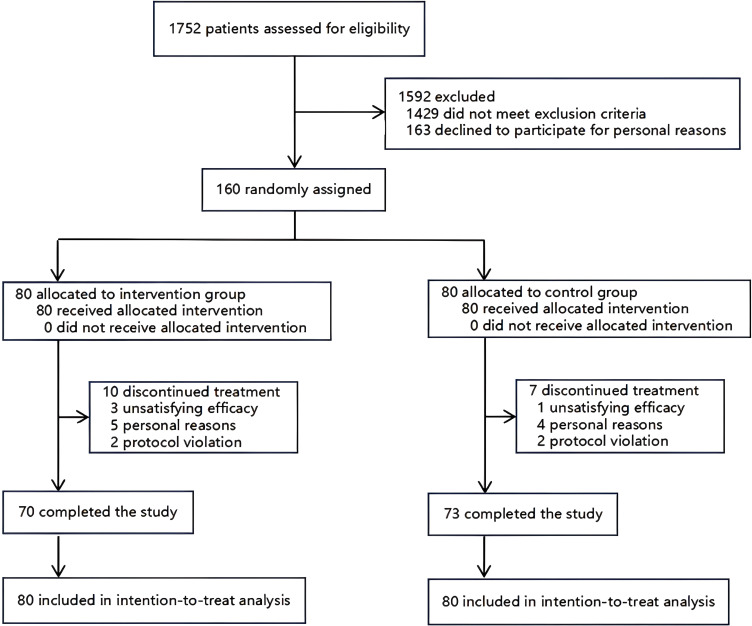
In this single-centre, two-arm randomised controlled trial, we enrolled Chinese patients aged 20-60 years with active neck extension disorder, regardless of prior exposure to manual therapy. We randomly assigned 160 patients to one of the following two arms: Jingjin therapy or general manual therapy. Both groups underwent six treatment sessions: the first three sessions were administered daily, and the last three sessions were administered every other day. The primary outcome was the between-group difference in the angle of active neck extension after the sixth treatment and 1 week after treatment. A repeated-measures linear mixed-effects model was used to assess between-group differences in outcome indices, with group allocation and treatment time points treated as fixed effects and participants as random effects.
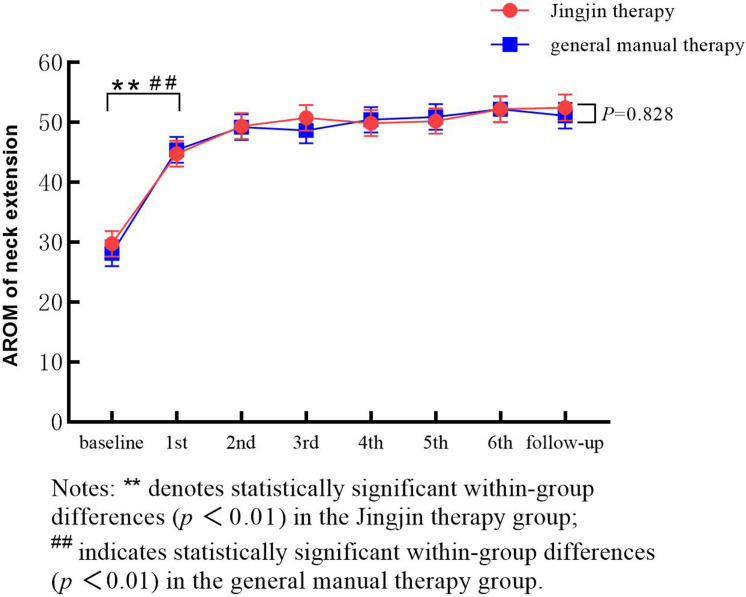
The change in the angle of active neck extension from baseline to the sixth treatment session was significant for Jingjin therapy (mean: 29.75° to 51.97°) and general manual therapy (mean: 28.18° to 52.49°). Further, the between-group difference was minimal (mean -0.26°, 95% confidence interval, -2.62°, 2.09°) and not statistically significant ( = 0.828).
Jingjin therapy for 9 days significantly improved neck extension function in patients with NCNP, with no significant difference compared to general manual therapy.
ChiCTR2300068892.
评估经筋疗法(一种远端手法干预)是否能加速非特异性慢性颈部疼痛(NCNP)患者的伸展功能障碍恢复。
在这项单中心、双臂随机对照试验中,我们纳入了年龄在20至60岁之间、患有活动性颈部伸展障碍的中国患者,无论其既往是否接受过手法治疗。我们将160名患者随机分配至以下两组之一:经筋疗法组或普通手法治疗组。两组均接受6次治疗:前3次每日进行,后3次隔日进行。主要结局是第6次治疗后及治疗后1周时两组间主动颈部伸展角度的差异。采用重复测量线性混合效应模型评估结局指标的组间差异,将分组和治疗时间点视为固定效应,将参与者视为随机效应。
经筋疗法组(平均:从29.75°至51.97°)和普通手法治疗组(平均:从28.18°至52.49°)从基线至第6次治疗时主动颈部伸展角度均有显著变化。此外,组间差异极小(平均-0.26°,95%置信区间,-2.62°,2.09°)且无统计学意义(P = 0.828)。
经筋疗法治疗9天可显著改善NCNP患者的颈部伸展功能,与普通手法治疗相比无显著差异。
ChiCTR2300068892。