
心脏代谢指数与高尿酸血症之间的关联:2011 - 2016年美国国家健康与营养检查调查(NHANES)
The association between the cardiometabolic index and hyperuricemia: 2011-2016 NHANES.
作者信息
Zhou Yishan, Zou Yihong, Cao Yuyu, Gao Yang, Pi Ying, Tang Xiaona, Liu Yang, Zhong Yanghong
机构信息
Seventh Clinical Medical College, Guangzhou University of Chinese Medicine, Shenzhen, China.
出版信息
Front Endocrinol (Lausanne). 2025 May 13;16:1545968. doi: 10.3389/fendo.2025.1545968. eCollection 2025.
BACKGROUND
Central obesity is associated with hyperuricemia. However, the association between the cardiometabolic index (CMI), which incorporates abdominal obesity and lipid metabolism parameters to assess central obesity, and hyperuricemia, is unclear. This study aimed to explore the association between CMI and hyperuricemia.
METHODS
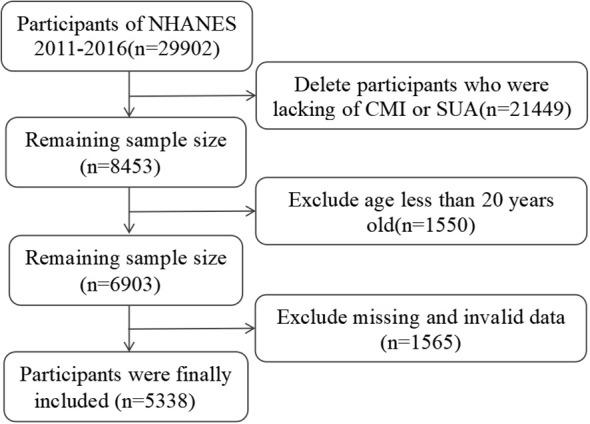
We enrolled 5,338 study participants from the 2011-2016 National Health and Nutrition Examination Survey. The participants were divided into three groups based on tertiles of CMI. We performed linear regression and employed weighted logistic regression models, subgroup analyses, and restricted cubic spline (RCS) regression to investigate the association between CMI and hyperuricemia.
RESULTS
In this study, 20.4% of the participants were diagnosed with hyperuricemia. A higher CMI correlated consistently with increased serum uric acid levels (β: 0.51; 95% confidence interval (CI): 0.38-0.64) and hyperuricemia (odds ratio (OR): 2.62; 95% CI: 1.91-3.61). In the fully corrected model, for each unit increase in CMI, the incidence of hyperuricemia increased by 54% and serum uric acid levels increased by 0.28 mg/dL. Subgroup analyses showed that the association of CMI with hyperuricemia was stably present in all subgroups. Interaction effects were observed for sex and body mass index subgroup ( for interaction: < 0.05). RCS regression highlighted a significant positive nonlinear association ( < 0.001).
CONCLUSION
Our results indicated a significant positive association between CMI levels and hyperuricemia risk among US adults.
背景
中心性肥胖与高尿酸血症相关。然而,结合腹部肥胖和脂质代谢参数以评估中心性肥胖的心脏代谢指数(CMI)与高尿酸血症之间的关联尚不清楚。本研究旨在探讨CMI与高尿酸血症之间的关联。
方法
我们从2011 - 2016年国家健康和营养检查调查中纳入了5338名研究参与者。参与者根据CMI的三分位数分为三组。我们进行了线性回归,并采用加权逻辑回归模型、亚组分析和限制性立方样条(RCS)回归来研究CMI与高尿酸血症之间的关联。
结果
在本研究中,20.4%的参与者被诊断为高尿酸血症。较高的CMI与血清尿酸水平升高(β:0.51;95%置信区间(CI):0.38 - 0.64)和高尿酸血症(优势比(OR):2.62;95% CI:1.91 - 3.61)始终相关。在完全校正模型中,CMI每增加一个单位,高尿酸血症的发病率增加54%,血清尿酸水平增加0.28mg/dL。亚组分析表明,CMI与高尿酸血症的关联在所有亚组中均稳定存在。在性别和体重指数亚组中观察到交互作用(交互作用:<0.05)。RCS回归突出显示了显著的正非线性关联(<0.001)。
结论
我们的结果表明,在美国成年人中,CMI水平与高尿酸血症风险之间存在显著的正相关。


 Zotero 插件