The Second Clinical College of Guangzhou University of Chinese Medicine, Guangzhou, China.
Department of Gynecology, The Second Affiliated Hospital of Guangzhou University of Chinese Medicine, Guangzhou, China.
Front Endocrinol (Lausanne). 2024 Nov 12;15:1450965. doi: 10.3389/fendo.2024.1450965. eCollection 2024.
Endometriosis is an estrogen-dependent gynecological endocrine condition and a systemic inflammatory disease associated to improper lipid metabolism and increased cardiovascular risk. The Cardiometabolic Index (CMI) is a novel indicator representing visceral adipose tissue distribution and metabolic dysfunction, integrating lipid metabolism indicators and the waist-to-height ratio. While anomalies in lipid metabolism are often associated with (BMI) Body Mass Index, literature consistently shows a negative link between endometriosis and female BMI, and some studies have found that endometriosis is one of the few reproductive diseases not persistently positively correlated with obesity. Given the limitations of BMI, a comprehensive index like CMI is crucial for exploring the incidence of endometriosis. Currently, research on the correlation between CMI and endometriosis is lacking, prompting this study to investigate this association.
To investigate the association between the CMI and the risk of having endometriosis in a sample representing the entire U.S. population.
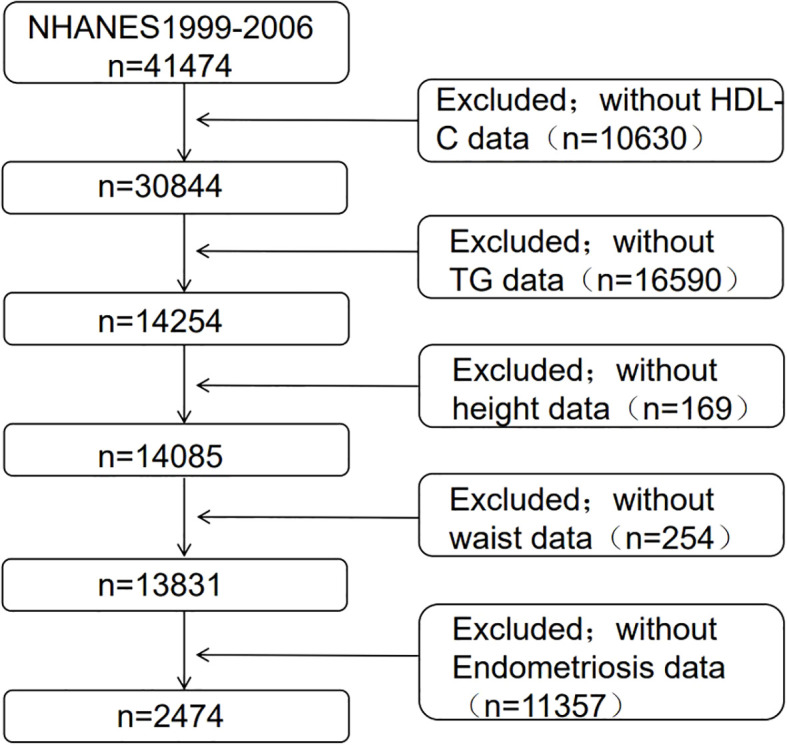
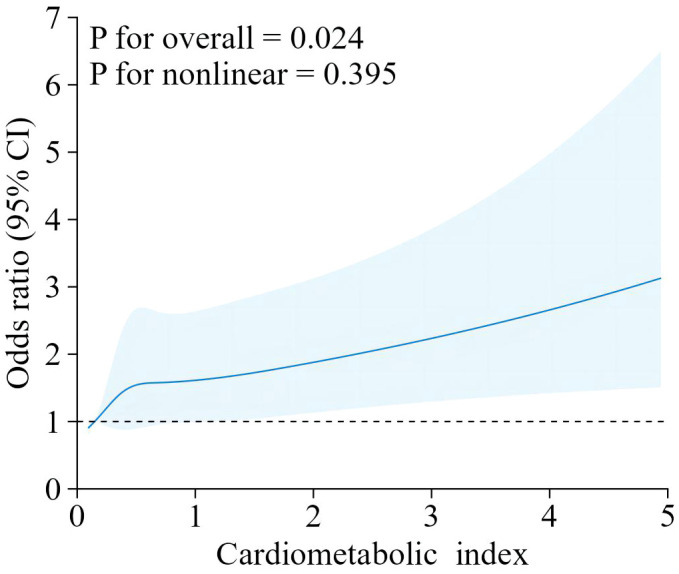
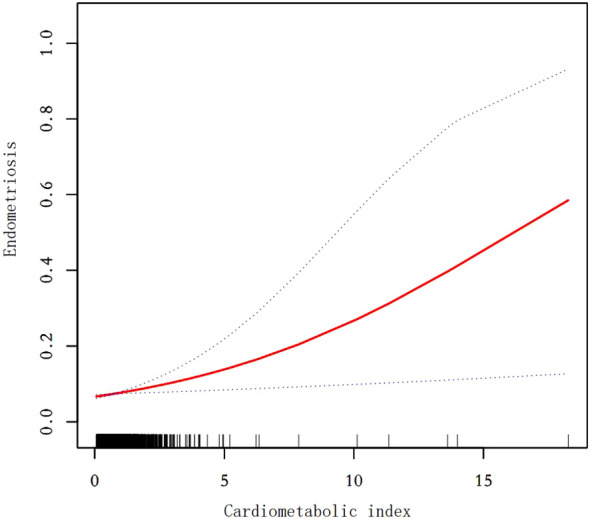
A cross-sectional analysis was conducted using data from four cycles of the National Health and Nutrition Examination Survey (NHANES) spanning the years 1999 to 2006. The study included individuals aged 20 to 54 with a documented history of endometriosis and complete CMI data. Logistic regression analysis, subgroup and interaction analyses, smooth curve fitting, and restricted cubic splines (RCS) were utilized to examine the association between CMI and endometriosis.
The study found that individuals with higher CMI had an increased probability of developing endometriosis. This relationship remained significant after adjusting for potential confounders such as age, ethnicity, Poverty Income Ratio (PIR), drinking, smoking, education level, and marital status. The fully adjusted model revealed a positive correlation between CMI and endometriosis (OR = 1.21; 95% CI, 1.04-1.40, p < 0.05). Subgroup and interaction analyses showed no significant effect modification by age, BMI, PIR, hypertension, drinking, smoking, or menarche age (all p-values for interaction > 0.05).
Our study shows a link between CMI and the chance of getting endometriosis.Due to the common occurrence of endometriosis and the lack of clarity surrounding their cause, more study is needed to confirm our results and find out if CMI could be used as a warning sign for endometriosis.
子宫内膜异位症是一种雌激素依赖性妇科内分泌疾病,也是一种全身性炎症性疾病,与脂质代谢异常和心血管风险增加有关。代谢指数(CMI)是一种新的指标,代表内脏脂肪组织分布和代谢功能障碍,整合了脂质代谢指标和腰高比。虽然脂质代谢异常通常与体重指数(BMI)有关,但文献一致表明子宫内膜异位症与女性 BMI 呈负相关,一些研究发现子宫内膜异位症是少数与肥胖症无持续正相关的生殖疾病之一。鉴于 BMI 的局限性,像 CMI 这样的综合指数对于探索子宫内膜异位症的发病率至关重要。目前,关于 CMI 与子宫内膜异位症之间相关性的研究较少,这促使本研究对此进行了调查。
在代表美国全部人口的样本中,研究 CMI 与子宫内膜异位症风险之间的关联。
使用 1999 年至 2006 年期间进行的四次全国健康和营养检查调查(NHANES)的数据进行了横断面分析。研究包括有子宫内膜异位症病史和完整 CMI 数据的 20 至 54 岁个体。采用逻辑回归分析、亚组和交互分析、平滑曲线拟合和限制性立方样条(RCS)来检查 CMI 与子宫内膜异位症之间的关联。
研究发现,CMI 较高的个体发生子宫内膜异位症的概率增加。在调整年龄、种族、贫困收入比(PIR)、饮酒、吸烟、教育水平和婚姻状况等潜在混杂因素后,这种关系仍然显著。完全调整后的模型显示 CMI 与子宫内膜异位症之间存在正相关关系(OR = 1.21;95%CI,1.04-1.40,p < 0.05)。亚组和交互分析表明,年龄、BMI、PIR、高血压、饮酒、吸烟或初潮年龄的变化(所有交互作用的 p 值均大于 0.05)均无显著影响。
我们的研究表明 CMI 与发生子宫内膜异位症的机会之间存在关联。由于子宫内膜异位症的常见发生和其病因的不明确,需要更多的研究来证实我们的结果,并确定 CMI 是否可以作为子宫内膜异位症的预警信号。