Su Wei, Chen Jing, Zhao Yuxia, Xu Pingping, Yuan Jingwen, Luo Chunqi, Liu Jie, Wang Baoxiang
Wuhan Children's Hospital, Tongji Medical College, Huazhong University of Science and Technology, Wuhan, China.
Front Pediatr. 2025 May 13;13:1598807. doi: 10.3389/fped.2025.1598807. eCollection 2025.
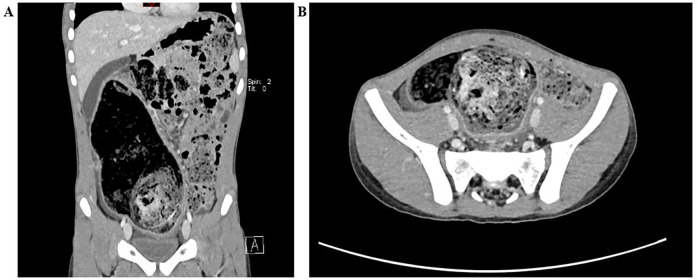
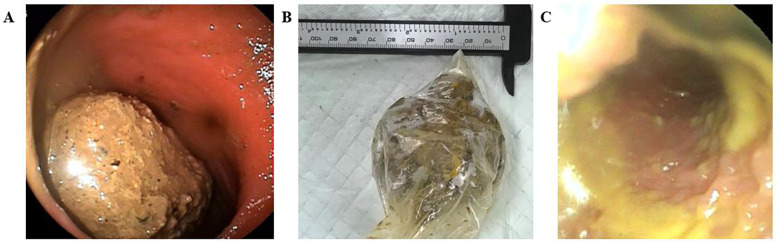
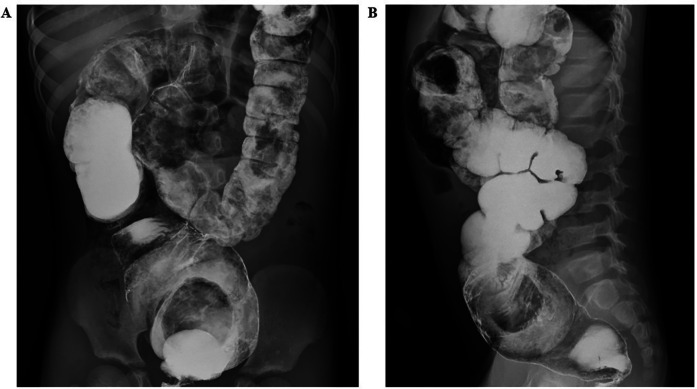
Fecaliths are concretions composed of undigested or partially digested substances formed within the gastrointestinal lumen, potentially causing obstruction or partial obstruction. The most common type of fecalith is phytobezoar, composed of plant fibers. Due to their high cellulose, hemicellulose, and lignin content, phytobezoars remain undigested within the stomach and intestines, causing blockage in the narrowest portions of the gastrointestinal tract. Obstructions caused by fecaliths typically occur in the stomach and small intestine, whereas colonic obstructions are rare, particularly in pediatric cases. In this study, we report for the first time a case of colonic obstruction caused by a giant fecalith measuring 6 cm × 6 cm, which was successfully managed by colonoscopy-assisted manual extraction under general anesthesia.
粪石是由胃肠道腔内未消化或部分消化的物质形成的凝结物,可能导致梗阻或部分梗阻。最常见的粪石类型是植物粪石,由植物纤维组成。由于其高纤维素、半纤维素和木质素含量,植物粪石在胃和肠道内无法消化,导致胃肠道最狭窄部位堵塞。粪石引起的梗阻通常发生在胃和小肠,而结肠梗阻很少见,尤其是在儿科病例中。在本研究中,我们首次报告了一例由一个6厘米×6厘米的巨大粪石引起的结肠梗阻病例,该病例在全身麻醉下通过结肠镜辅助手动取出成功处理。