Elgamal Mohamed, Ibrahim Abdallah Mohammed, Fadl Basem Tarek, Ragheb Nourhan Ahmed
Department of Removable Prosthodontics, Faculty of Dentistry, Mansoura University, Eldakahlia, Egypt.
Department of Removable Prosthodontics, Faculty of Dentistry, Horus University, Damietta, Egypt.
BMC Oral Health. 2025 May 28;25(1):824. doi: 10.1186/s12903-025-06214-9.
Rapid advancements in computer-aided design and computer-aided manufacturing (CAD-CAM) have opened new pathways in the fabrication of removable partial dentures (RPDs). Digital impression serves as the first step of CAD-CAM technique, which includes two methods for data acquisition: direct intraoral scanning or indirect extraoral scanning. RPD frameworks may be considered the definitive test of accuracy for a digital workflow. This cross-over clinical study aimed to evaluate the overall accuracy of various parts for mandibular metallic RPD frameworks made by selective laser melting (SLM) using fully-digital versus combined analog-digital workflows.
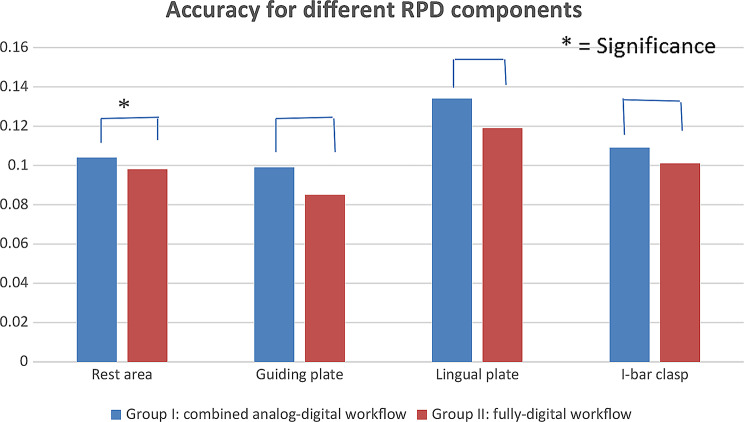
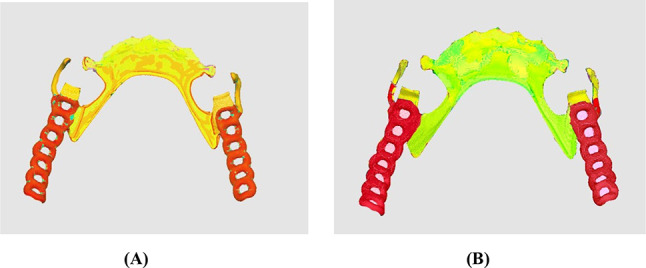
This study was carried out on 24 participants with mandibular Kennedy class I arches. Each participant received two RPDs frameworks, one fabricated using a combined analog-digital workflow (Group I) and the other using a fully- digital workflow (Group II). In Group I, the analog steps involved taking physical impressions and creating stone casts followed by scanning the casts with a laboratory scanner to create virtual casts. In Group II, a definitive scan STL file was created using an intraoral digital scanner. Both groups used 3Shape software for digital design of the RPD framework, ensuring consistency by using the same design, and subsequent fabrication using SLM. To evaluate the accuracy, STL data analysis was performed through intra-oral digital superimposition evaluation, a color map was assessed and overall accuracy and the misfit (distance between each framework component and the reference intra-oral scan STL file) were measured at rest, proximal plate, lingual plate and I-bar retentive clasp terminal areas. The Paired t-test was utilized for statistical analysis of the data.
In Group I: combined analog-digital workflow color map assessment revealed more gaps particularly in the lingual plate and proximal plate areas, whereas Group II: fully-digital workflow showed better accuracy. Regarding the overall accuracy in the rest, proximal plate, lingual plate, and I-bar clasp retentive terminal, Group II was significantly superior to Group I (P = 0.0125, 0.0019, < 0.001, < 0.001, and 0.0119, respectively).
Within the limitations of this study, both workflows resulted in frameworks with clinically acceptable accuracy. However, SLM RPD frameworks fabricated using the fully-digital workflow showed superior accuracy in key areas such as the rest, proximal plate, lingual plate, and I-bar clasp retentive terminal areas, when compared to the combined analog-digital workflow.
Retrospectively registered (NCT06412159) 03/05/2024.
计算机辅助设计与计算机辅助制造(CAD-CAM)的快速发展为可摘局部义齿(RPD)的制作开辟了新途径。数字印模是CAD-CAM技术的第一步,包括两种数据采集方法:直接口内扫描或间接口外扫描。RPD支架可被视为数字工作流程准确性的决定性测试。这项交叉临床研究旨在评估使用全数字与模拟-数字组合工作流程通过选择性激光熔化(SLM)制作的下颌金属RPD支架各部分的整体准确性。
本研究对24名下颌Kennedy I类牙弓患者进行。每位患者接受两个RPD支架,一个采用模拟-数字组合工作流程制作(第一组),另一个采用全数字工作流程制作(第二组)。在第一组中,模拟步骤包括制取物理印模并制作石膏模型,然后用实验室扫描仪扫描模型以创建虚拟模型。在第二组中,使用口内数字扫描仪创建最终扫描STL文件。两组均使用3Shape软件进行RPD支架的数字设计,通过使用相同设计确保一致性,并随后使用SLM进行制作。为评估准确性,通过口内数字叠加评估进行STL数据分析,评估彩色地图,并在静止状态、近中板、舌板和I型杆固位卡环末端区域测量整体准确性和不贴合度(每个支架部件与参考口内扫描STL文件之间的距离)。采用配对t检验对数据进行统计分析。
在第一组中:模拟-数字组合工作流程彩色地图评估显示有更多间隙,特别是在舌板和近中板区域,而第二组:全数字工作流程显示出更高的准确性。在静止状态、近中板、舌板和I型杆卡环固位末端的整体准确性方面,第二组明显优于第一组(P分别为0.0125、0.0019、<0.001、<0.001和0.0119)。
在本研究的局限性内,两种工作流程制作的支架在临床上均具有可接受的准确性。然而,与模拟-数字组合工作流程相比,使用全数字工作流程制作的SLM RPD支架在静止状态、近中板、舌板和I型杆卡环固位末端等关键区域显示出更高的准确性。
回顾性注册(NCT06412159)2024年5月3日。