Bellman Jakob, Westerterp Klaas, Wouters Loek, Johannesson Marit, Lundqvist Niklas, Kullberg Joel, Larsson Christel, Gustafsson Mikael, Pettersson Stefan, Fridolfsson Jonatan, Arvidsson Daniel, Börjesson Mats, Curiac Dan, Jansson John-Olov, Jansson Per-Anders, Ohlsson Claes
Department of Physiology, Institute of Neuroscience and Physiology, Sahlgrenska Academy, University of Gothenburg, Medicinaregatan 11, SE-41390, Gothenburg, Sweden.
Department of Nutrition and Movement Sciences, NUTRIM School of Nutrition and Translational Research in Metabolism, Maastricht University Medical Centre, NL-6200 MD, Maastricht, The Netherlands.
BMC Med. 2025 May 30;23(1):317. doi: 10.1186/s12916-025-04143-6.
To investigate the effects of increased weight-loading on body weight, body composition, fat mass distribution, physical activity and energy balance in individuals with obesity.
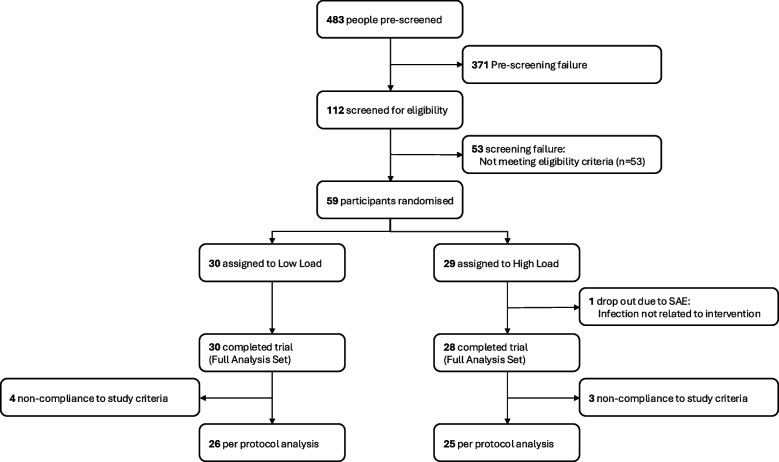
This single-centre non-blinded randomised controlled trial was conducted from August 1, 2021, through February 28, 2022. Adults with obesity class 1 (body mass index, BMI 30-35 kg/m) were assigned to wear either a heavy (high load; 11% of body weight, n = 28) or light (low load; 1% of body weight, n = 30) weight vest for 8 h per day over 5 weeks.
High-load treatment reduced fat mass (mean difference - 2.60%; 95% CI - 3.79, - 1.41) and increased lean mass (mean difference 1.40%; 95% CI 0.37, 2.42), with no significant effect on body weight. Fat mass reductions were primarily observed in weight-loaded regions but not in the non-weight-bearing regions such as the arms. Waist circumference decreased (mean difference - 2.26%; 95% CI - 3.81, - 0.71) in the high-load group compared to the low-load group. Despite these beneficial changes, sedentary time was higher in the high-load group (mean difference 4.69%; 95% CI 0.98, 8.39) compared to the low-load group, while energy expenditure and energy intake remained unchanged.
Increased weight-loading reduced fat mass and increased lean mass, resulting in a healthier body composition. These effects were achieved despite no increase in physical activity. The fat mass-reducing effect was primarily seen in weight-loaded regions, implying local adaptation to the increased loading.
Registered at ClinicalTrials.gov (NCT04697238) in 2021.
研究增加负重对肥胖个体的体重、身体成分、脂肪量分布、身体活动和能量平衡的影响。
本单中心非盲随机对照试验于2021年8月1日至2022年2月28日进行。将1级肥胖成年人(体重指数,BMI 30 - 35kg/m)分为两组,一组每天佩戴重的(高负荷;体重的11%,n = 28),另一组佩戴轻的(低负荷;体重的1%,n = 30)负重背心,持续5周,每天佩戴8小时。
高负荷治疗减少了脂肪量(平均差异 - 2.60%;95%置信区间 - 3.79, - 1.41),增加了瘦体重(平均差异1.40%;95%置信区间0.37,2.42),对体重无显著影响。脂肪量减少主要出现在负重区域,而非手臂等非负重区域。与低负荷组相比,高负荷组的腰围降低(平均差异 - 2.26%;95%置信区间 - 3.81, - 0.71)。尽管有这些有益变化,但与低负荷组相比,高负荷组的久坐时间更长(平均差异4.69%;95%置信区间0.98,8.39),而能量消耗和能量摄入保持不变。
增加负重减少了脂肪量,增加了瘦体重,从而使身体成分更健康。尽管身体活动没有增加,但仍取得了这些效果。脂肪量减少的效果主要出现在负重区域,这意味着身体对增加的负荷产生了局部适应。
2021年在ClinicalTrials.gov(NCT04697238)注册。