Norwich Medical School, University of East Anglia, Norwich NR4 7TJ, UK.
BMJ. 2012 Dec 6;345:e7666. doi: 10.1136/bmj.e7666.
To investigate the relation between total fat intake and body weight in adults and children.
Systematic review and meta-analysis of randomised controlled trials and cohort studies.
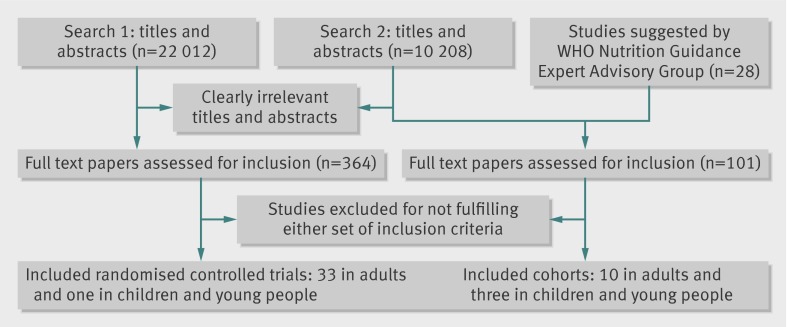
Medline, Embase, CINAHL, and the Cochrane Central Register of Controlled Trials to June 2010.
Randomised controlled trials and cohort studies of adults or children that compared lower versus usual total fat intake and assessed the effects on measures of body fatness (body weight, body mass index, or waist circumference) after at least six months (randomised controlled trials) or one year (in cohorts). Randomised controlled trials with any intention to reduce weight in participants or confounded by additional medical or lifestyle interventions were excluded.
Data were extracted and validity was assessed independently and in duplicate. Random effects meta-analyses, subgroups, sensitivity analyses, and metaregression were done.
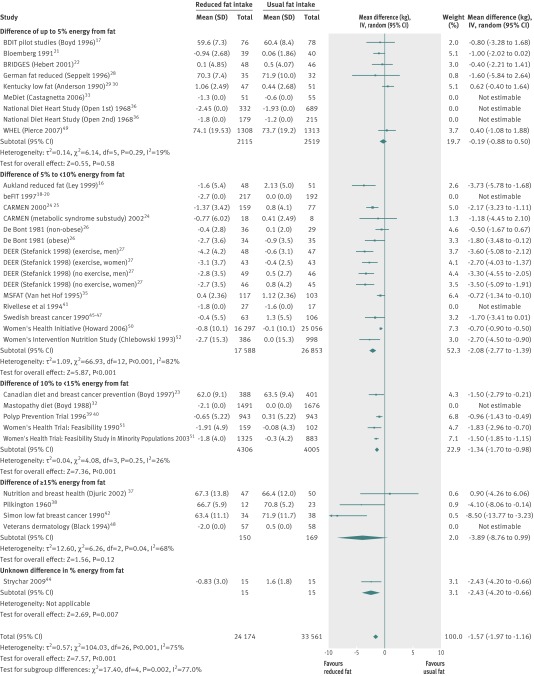
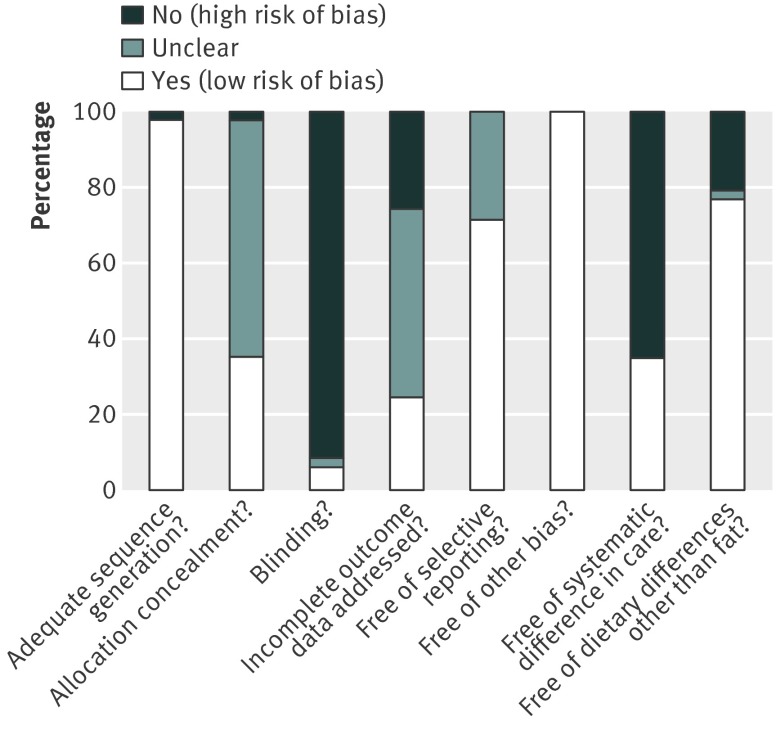
33 randomised controlled trials (73,589 participants) and 10 cohort studies were included, all from developed countries. Meta-analysis of data from the trials suggested that diets lower in total fat were associated with lower relative body weight (by 1.6 kg, 95% confidence interval -2.0 to -1.2 kg, I(2)=75%, 57,735 participants). Lower weight gain in the low fat arm compared with the control arm was consistent across trials, but the size of the effect varied. Metaregression suggested that greater reduction in total fat intake and lower baseline fat intake were associated with greater relative weight loss, explaining most of the heterogeneity. The significant effect of a low fat diet on weight was not lost in sensitivity analyses (including removing trials that expended greater time and attention on low fat groups). Lower total fat intake also led to lower body mass index (-0.51 kg/m(2), 95% confidence interval -0.76 to -0.26, nine trials, I(2)=77%) and waist circumference (by 0.3 cm, 95% confidence interval -0.58 to -0.02, 15,671 women, one trial). There was no suggestion of negative effects on other cardiovascular risk factors (lipid levels or blood pressure). GRADE assessment suggested high quality evidence for the relation between total fat intake and body weight in adults. Only one randomised controlled trial and three cohort studies were found in children and young people, but these confirmed a positive relation between total fat intake and weight gain.
There is high quality, consistent evidence that reduction of total fat intake has been achieved in large numbers of both healthy and at risk trial participants over many years. Lower total fat intake leads to small but statistically significant and clinically meaningful, sustained reductions in body weight in adults in studies with baseline fat intakes of 28-43% of energy intake and durations from six months to over eight years. Evidence supports a similar effect in children and young people.
探讨成年人和儿童总脂肪摄入量与体重之间的关系。
对随机对照试验和队列研究进行系统评价和荟萃分析。
截至 2010 年 6 月,使用 Medline、Embase、CINAHL 和 Cochrane 对照试验中心注册数据库进行检索。
比较低总脂肪摄入量与通常总脂肪摄入量,并在至少 6 个月(随机对照试验)或 1 年(队列研究)后评估对体脂指标(体重、体重指数或腰围)影响的成年人或儿童的随机对照试验和队列研究。排除了有任何减轻参与者体重意向或因额外的医疗或生活方式干预而混杂的随机对照试验。
数据由两人独立提取并评估其有效性。进行了随机效应荟萃分析、亚组分析、敏感性分析和荟萃回归。
纳入了 33 项随机对照试验(73589 名参与者)和 10 项队列研究,均来自发达国家。试验数据的荟萃分析表明,总脂肪摄入量较低的饮食与相对体重较低有关(低 1.6 公斤,95%置信区间 -2.0 至 -1.2 公斤,I(2)=75%,57735 名参与者)。低脂组与对照组相比,体重增加较少的情况在试验中是一致的,但影响的大小有所不同。荟萃回归表明,总脂肪摄入量的较大减少和较低的基线脂肪摄入量与更大的相对体重减轻有关,这解释了大部分的异质性。在敏感性分析中(包括去除对低脂组花费更多时间和关注的试验),低脂饮食对体重的显著影响并没有丢失。较低的总脂肪摄入量还导致体重指数(-0.51kg/m(2),95%置信区间 -0.76 至 -0.26,9 项试验,I(2)=77%)和腰围(-0.3cm,95%置信区间 -0.58 至 -0.02,15671 名女性,1 项试验)降低。没有迹象表明对其他心血管风险因素(血脂水平或血压)有负面影响。GRADE 评估表明,成年人总脂肪摄入量与体重之间的关系具有高质量证据。仅在儿童和青少年中发现了一项随机对照试验和三项队列研究,但这些研究证实了总脂肪摄入量与体重增加之间存在正相关。
有高质量、一致的证据表明,在多年的时间里,大量健康和有风险的试验参与者已经实现了总脂肪摄入量的减少。在基线脂肪摄入量为能量摄入的 28-43%且持续时间从 6 个月到 8 年以上的研究中,较低的总脂肪摄入量导致了小但有统计学意义和临床有意义的、持续的体重减轻。证据支持在儿童和青少年中也有类似的效果。