Wang Jinhua, Zhu Zhenchen, Pan Zhengsong, Tan Weixiong, Han Wei, Zhou Zhen, Hu Ge, Ma Zhuangfei, Xu Yinghao, Ying Zhoumeng, Sui Xin, Jin Zhengyu, Song Lan, Song Wei
Department of Radiology, State Key Laboratory of Complex Severe and Rare Diseases, Peking Union Medical College Hospital, Chinese Academy of Medical Sciences and Peking Union Medical College, No. 1, Shuaifuyuan, Dongcheng District, Beijing, 100730, China.
4+4 Medical Doctor Program, Chinese Academy of Medical Sciences and Peking Union Medical College, Beijing, China.
BMC Med Imaging. 2025 May 30;25(1):200. doi: 10.1186/s12880-025-01746-6.
To compare the image quality and pulmonary nodule detectability and measurement accuracy between deep learning reconstruction (DLR) and hybrid iterative reconstruction (HIR) of chest ultra-low-dose CT (ULDCT).
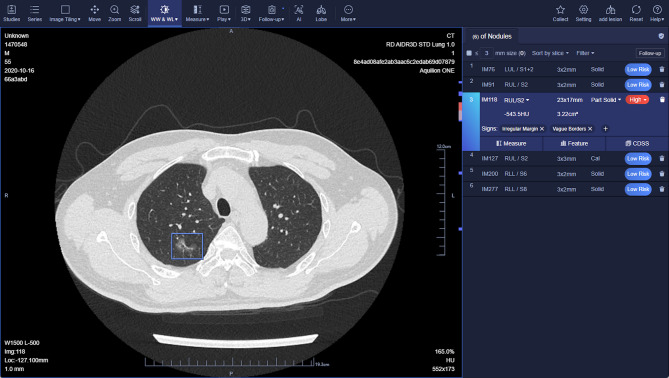
Participants who underwent chest standard-dose CT (SDCT) followed by ULDCT from October 2020 to January 2022 were prospectively included. ULDCT images reconstructed with HIR and DLR were compared with SDCT images to evaluate image quality, nodule detection rate, and measurement accuracy using a commercially available deep learning-based nodule evaluation system. Wilcoxon signed-rank test was used to evaluate the percentage errors of nodule size and nodule volume between HIR and DLR images.
Eighty-four participants (54 ± 13 years; 26 men) were finally enrolled. The effective radiation doses of ULDCT and SDCT were 0.16 ± 0.02 mSv and 1.77 ± 0.67 mSv, respectively (P < 0.001). The mean ± standard deviation of the lung tissue noises was 61.4 ± 3.0 HU for SDCT, 61.5 ± 2.8 HU and 55.1 ± 3.4 HU for ULDCT reconstructed with HIR-Strong setting (HIR-Str) and DLR-Strong setting (DLR-Str), respectively (P < 0.001). A total of 535 nodules were detected. The nodule detection rates of ULDCT HIR-Str and ULDCT DLR-Str were 74.0% and 83.4%, respectively (P < 0.001). The absolute percentage error in nodule volume from that of SDCT was 19.5% in ULDCT HIR-Str versus 17.9% in ULDCT DLR-Str (P < 0.001).
Compared with HIR, DLR reduced image noise, increased nodule detection rate, and improved measurement accuracy of nodule volume at chest ULDCT.
Not applicable.
比较胸部超低剂量CT(ULDCT)深度学习重建(DLR)与混合迭代重建(HIR)的图像质量、肺结节可检测性及测量准确性。
前瞻性纳入2020年10月至2022年1月期间先接受胸部标准剂量CT(SDCT)然后接受ULDCT的参与者。将用HIR和DLR重建的ULDCT图像与SDCT图像进行比较,使用市售的基于深度学习的结节评估系统评估图像质量、结节检测率和测量准确性。采用Wilcoxon符号秩检验评估HIR和DLR图像之间结节大小和结节体积的百分比误差。
最终纳入84名参与者(54±13岁;26名男性)。ULDCT和SDCT的有效辐射剂量分别为0.16±0.02 mSv和1.77±0.67 mSv(P<0.001)。SDCT的肺组织噪声平均值±标准差为61.4±3.0 HU,用HIR-强设置(HIR-Str)和DLR-强设置(DLR-Str)重建的ULDCT分别为61.5±2.8 HU和55.1±3.4 HU(P<0.001)。共检测到535个结节。ULDCT HIR-Str和ULDCT DLR-Str的结节检测率分别为74.0%和83.4%(P<0.001)。ULDCT HIR-Str中结节体积相对于SDCT的绝对百分比误差为19.5%,而ULDCT DLR-Str中为17.9%(P<0.001)。
与HIR相比,DLR降低了胸部ULDCT的图像噪声,提高了结节检测率,并改善了结节体积的测量准确性。
不适用。