Faillace Thiesen Julia, Jacquemet Elise, Campagne Pascal, Chatelain Denis, Brochot Etienne, Herpe Yves-Edouard, Dheilly Nolwenn M, Bouilloux Fabrice, Rognon Bénédicte, Douablin Alexandre, Leboucher Guillaume, Percher Florent, Eloit Marc, Pérot Philippe
Institut Pasteur, Université Paris Cité, Pathogen Discovery Laboratory, 25-28 Rue du Dr. Roux, 75015, Paris, France.
Institut Pasteur, Université Paris Cité, Bioinformatics and Biostatistics Hub, 25-28 Rue du Dr. Roux, 75015, Paris, France.
Mol Med. 2025 May 30;31(1):215. doi: 10.1186/s10020-025-01238-x.
Cervical cancer screening programs are increasingly relying on sensitive molecular approaches as primary tests to detect high-risk human papillomaviruses (hrHPV), the causative agents of cervix cancer. Although hrHPV infection is a pre-requisite for the development of most precancerous lesions, the mere detection of viral nucleic acids, also present in transient infections, is not specific of the underlying cellular state, resulting in poor positive predictive values (PPV) regarding lesional states. There is a need to increase the specificity of molecular tests for better stratifying individuals at risk of cancer and to adapt follow-up strategies.
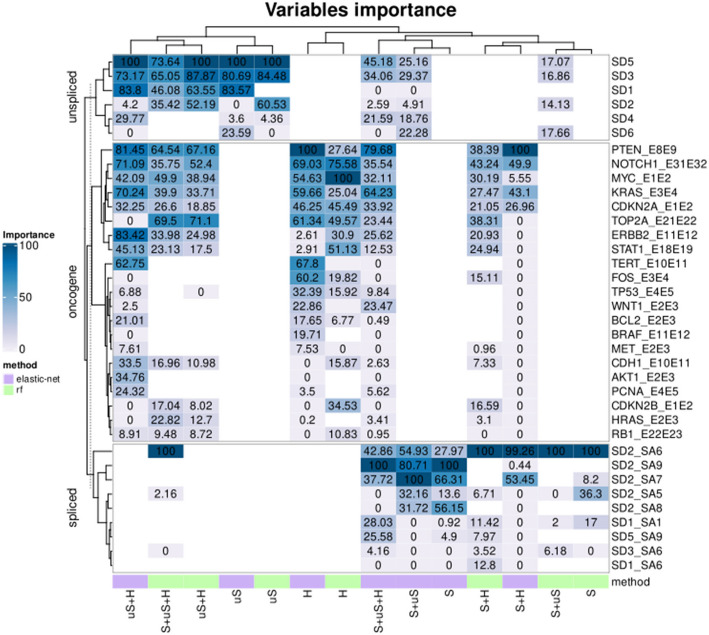
HPV-RNA-SEQ, a targeted RNA next generation sequencing assay allowing the detection of up to 16 hrHPV splice events and key human transcripts, has previously shown encouraging PPV for the detection of precancerous lesions. Herein, on 302 patients with normal cytology (NILM, n = 118), low-grade (LSIL, n = 104) or high-grade squamous intraepithelial lesions (HSIL, n = 80), machine learning-based model improvement was applied to reach 2-classes (NILM vs HSIL) or 3-classes (NILM, LSIL, HSIL) predictive models.
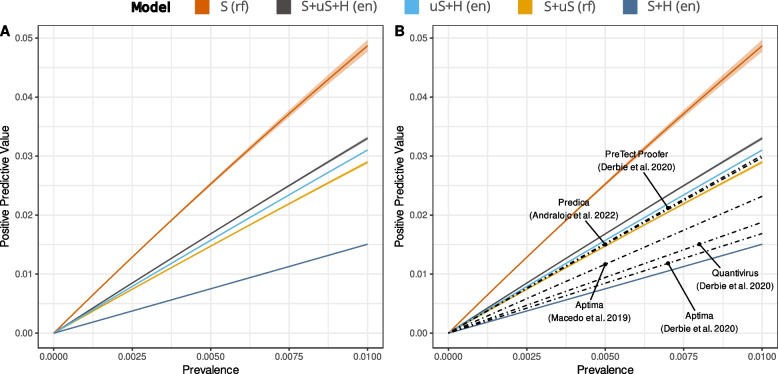
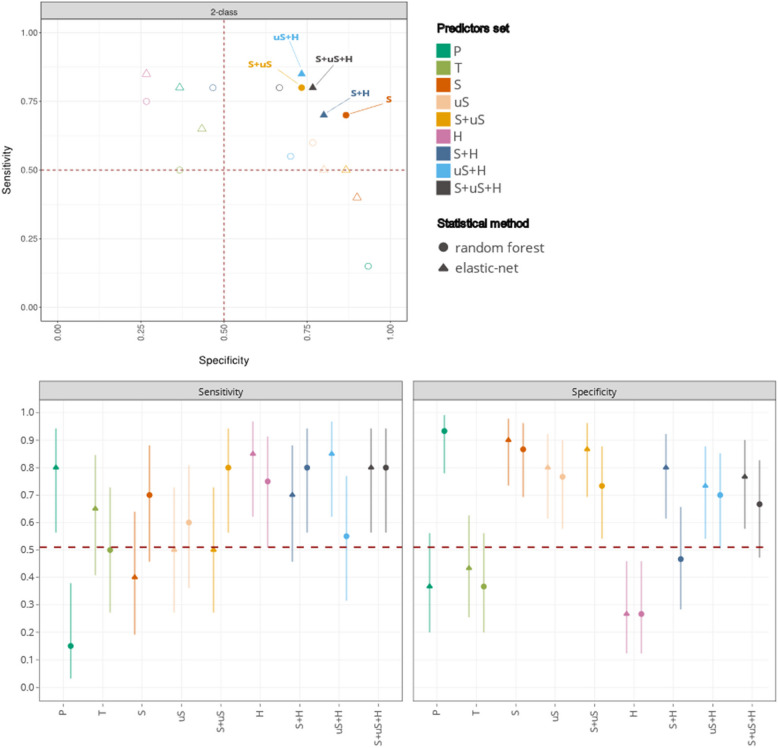
Linear (elastic net) and nonlinear (random forest) approaches resulted in five 2-class models that detect HSIL vs NILM in a validation set with specificity up to 0.87, well within the range of PPV of other competing RNA-based tests in a screening population.
HPV-RNA-SEQ improves the detection of HSIL lesions and has the potential to complete and eventually replace current molecular approaches as a first-line test. Further performance evaluation remains to be done on larger and prospective cohorts.
宫颈癌筛查项目越来越依赖敏感的分子方法作为检测高危型人乳头瘤病毒(hrHPV)的主要检测手段,hrHPV是宫颈癌的致病因子。虽然hrHPV感染是大多数癌前病变发生的先决条件,但仅仅检测病毒核酸(在短暂感染中也存在)并不能特异性反映潜在的细胞状态,导致病变状态的阳性预测值(PPV)较低。需要提高分子检测的特异性,以便更好地对癌症风险个体进行分层,并调整后续策略。
HPV-RNA-SEQ是一种靶向RNA下一代测序检测方法,可检测多达16种hrHPV剪接事件和关键人类转录本,此前已显示出在检测癌前病变方面令人鼓舞的PPV。在此,对302例细胞学正常(NILM,n = 118)、低度(LSIL,n = 104)或高度鳞状上皮内病变(HSIL,n = 80)的患者,应用基于机器学习的模型改进方法,以建立2分类(NILM与HSIL)或3分类(NILM、LSIL、HSIL)预测模型。
线性(弹性网络)和非线性(随机森林)方法产生了五个2分类模型,这些模型在验证集中检测HSIL与NILM的特异性高达0.87,完全在筛查人群中其他竞争性RNA检测的PPV范围内。
HPV-RNA-SEQ改善了HSIL病变的检测,有潜力作为一线检测方法完善并最终取代当前的分子方法。还需要在更大的前瞻性队列中进行进一步的性能评估。