Zhang Xiaoxin, Cheng Chongsheng, Wang Hanghang, Liu Junya, Zhao Jiapeng, Zhang Xinhe, Li Xinyao, Xu Kai-Feng
Department of Pulmonary and Critical Care Medicine, State Key Laboratory of Complex, Severe and Rare Diseases, Peking Union Medical College Hospital, Chinese Academy of Medical Sciences & Peking Union Medical College, #1 Shuaifuyuan Hutong, Beijing, China.
Chinese Academy of Medical Sciences & Peking Union Medical College, Beijing, 100730, China.
Orphanet J Rare Dis. 2025 May 31;20(1):263. doi: 10.1186/s13023-025-03834-w.
Lymphangioleiomyomatosis (LAM) is a rare, low-grade neoplasm. Abnormal activation of the mammalian target of rapamycin (mTOR) pathway plays a critical role in LAM pathogenesis by promoting cell proliferation, which may increase susceptibility to malignancies in these patients. However, owing to the rarity of LAM, comprehensive data on the risk of malignancy in this population are limited.
We retrospectively analyzed 849 LAM patients who participated in the LAM-China Registry Study at Peking Union Medical College Hospital. We collected medical records of patients with malignant tumors and estimated the incidence of malignancy in the LAM-China cohort.
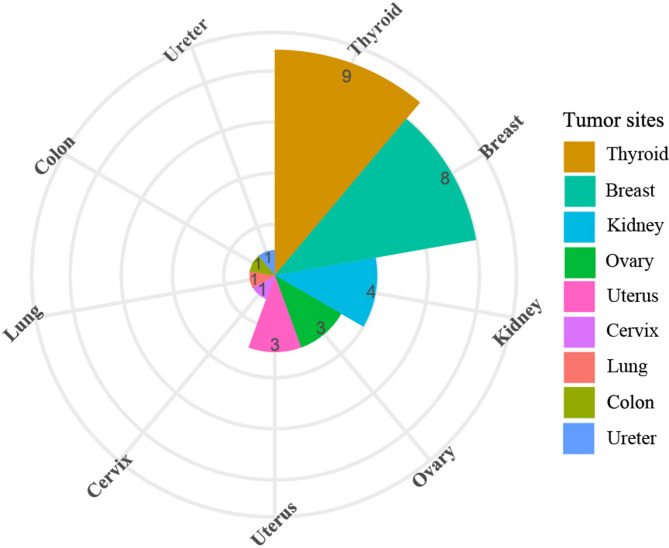
A total of 849 patients were included in our research, of whom 760 were sporadic LAM and 89 had tuberous sclerosis complex-associated LAM. Thirty-one patients (3.65%) had a history of malignancy. More than 80% of LAM and malignant tumors developed successively within 5 years, with a median time interval of 1.5 years. Eighteen patients who were diagnosed with malignancy after diagnosis of LAM were included in the incidence calculation. The three most prevalent cancers were thyroid cancer (n = 5), breast cancer (n = 4) and ovarian cancer (n = 3). Except for lung cancer, the SIRs for all other cancers mentioned in the present study were significantly increased: thyroid cancer (SIR = 10.87, 95% CI 3.53-25.37), breast cancer (SIR = 5.95, 95% CI 1.62-15.24), and ovarian cancer (SIR = 24.54, 95% CI 5.07-71.86). After standardization by age, the SIR for malignancy in our cohort was 3.20 (95% CI 1.89-5.05, p = 0.00003). However, this elevated risk of malignancy appeared to be confined to younger age groups. Among individuals aged over 50 years, there was no statistically significant difference in the incidence of malignancy between LAM patients and the reference population.
The risk of malignant tumors is significantly increased in LAM patients than that in the reference population. Thyroid cancer, breast cancer, and ovarian cancer were the three most prevalent malignancies in our cohort. Each type of cancer that appeared in the cohort presented a relatively high incidence, except for lung cancer.
淋巴管平滑肌瘤病(LAM)是一种罕见的低度恶性肿瘤。雷帕霉素靶蛋白(mTOR)通路的异常激活通过促进细胞增殖在LAM发病机制中起关键作用,这可能增加这些患者患恶性肿瘤的易感性。然而,由于LAM的罕见性,关于该人群恶性肿瘤风险的全面数据有限。
我们回顾性分析了849例在北京协和医院参加LAM-中国注册研究的LAM患者。我们收集了患有恶性肿瘤患者的病历,并估计了LAM-中国队列中恶性肿瘤的发病率。
我们的研究共纳入849例患者,其中760例为散发性LAM,89例为结节性硬化症相关LAM。31例患者(3.65%)有恶性肿瘤病史。超过80%的LAM和恶性肿瘤在5年内相继发生,中位时间间隔为1.5年。在计算发病率时纳入了18例在诊断LAM后被诊断为恶性肿瘤的患者。三种最常见的癌症是甲状腺癌(n = 5)、乳腺癌(n = 4)和卵巢癌(n = 3)。除肺癌外,本研究中提到的所有其他癌症的标准化发病比(SIR)均显著升高:甲状腺癌(SIR = 10.87,95%CI 3.53 - 25.37)、乳腺癌(SIR = 5.95,95%CI 1.62 - 15.24)和卵巢癌(SIR = 24.54,95%CI 5.07 - 71.86)。按年龄标准化后,我们队列中恶性肿瘤的SIR为3.20(95%CI 1.89 - 5.05,p = 0.00003)。然而,这种恶性肿瘤风险的升高似乎仅限于较年轻的年龄组。在50岁以上的个体中,LAM患者和参照人群的恶性肿瘤发病率在统计学上没有显著差异。
LAM患者发生恶性肿瘤的风险显著高于参照人群。甲状腺癌、乳腺癌和卵巢癌是我们队列中三种最常见的恶性肿瘤。队列中出现的每种癌症的发病率都相对较高,肺癌除外。