Lamikanra Abigail A, Tsang Hoi Pat, Morovat Alireza, Hin Harold, Emberson Jonathan, Hill Michael, Clarke Robert, Armitage Jane, Roberts David J
NHS Blood and Transplant, Oxford, UK.
BRC- Haematology Theme and Nuffield Division of Clinical Laboratory Sciences, Radcliffe Department of Medicine, University of Oxford, Oxford, UK.
Br J Nutr. 2025 Jul 14;134(1):28-34. doi: 10.1017/S0007114525103516. Epub 2025 Jun 2.
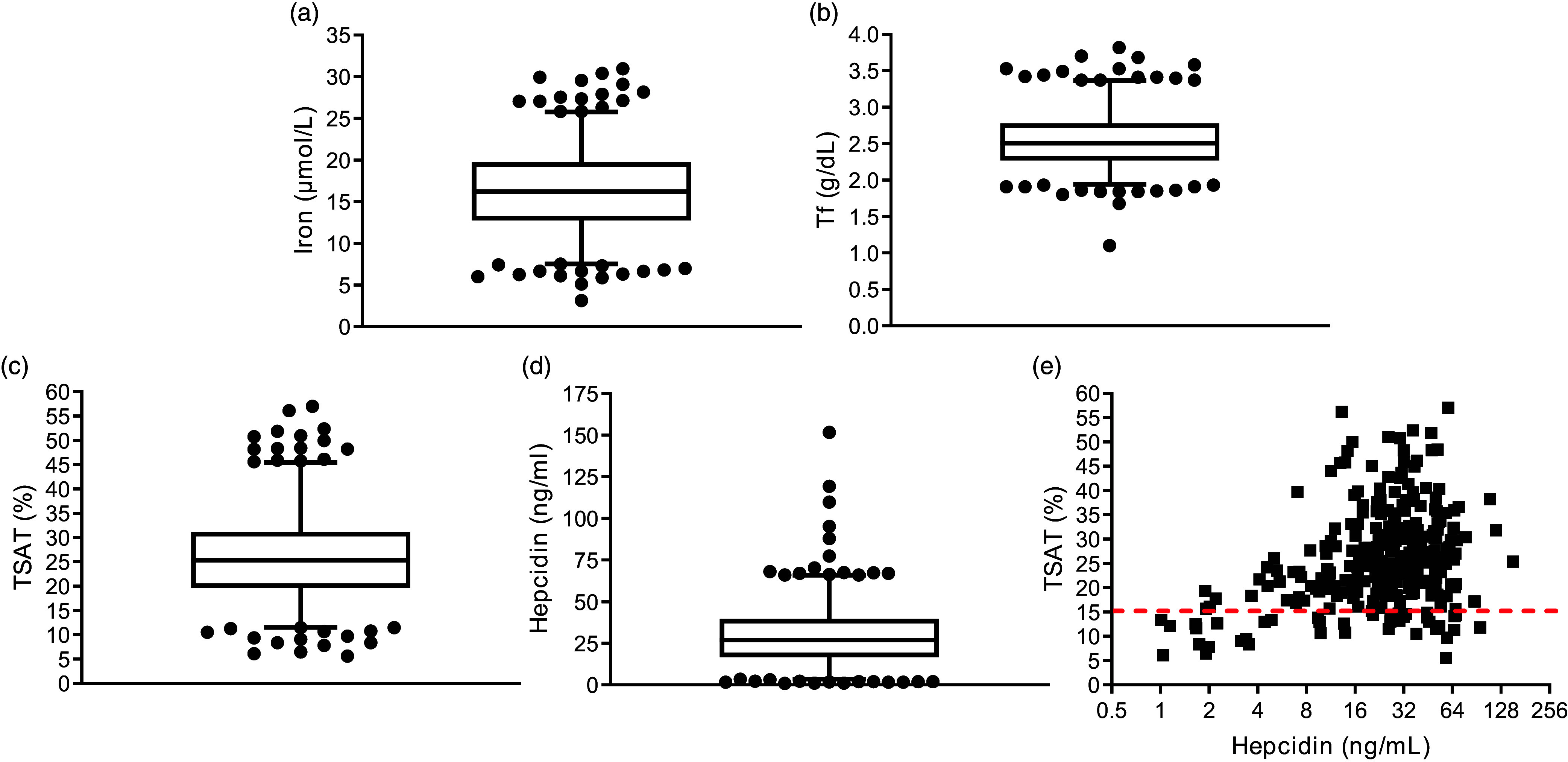
Previous observational studies suggested that vitamin D may control the absorption of iron (Fe) by inhibition of hepcidin, but the causal relevance of these associations is uncertain. Using placebo-controlled randomisation, we assessed the effects of supplementation with vitamin D on biochemical markers of Fe status and erythropoiesis in community-dwelling older people living in the UK. The BEST-D trial, designed to establish the optimum dose of vitamin D3 for future trials, had 305 participants, aged 65 years or older, randomly allocated to 4000 IU vitamin D3 ( 102), 2000 IU vitamin D3 ( 102) or matching placebo ( 101). We estimated the effect of vitamin D allocation on plasma levels of hepcidin, soluble transferrin receptor (sTfR), ferritin, Fe, transferrin, saturated transferrin (TSAT%) and the sTfR-ferritin index. Despite increases in 25-hydroxy-vitamin D, neither dose had significant effects on biochemical markers of Fe status or erythropoiesis. Geometric mean concentrations were similar in vitamin D3 arms . placebo for hepcidin (20·7 [se 0·90] . 20·5 [1·21] ng/ml), sTfR (0·69 [0·010] . 0·70 [0·015] µg/ml), ferritin (97·1 [2·81] . 97·8 [4·10] µg/l) and sTfR-ferritin ratio (0·36 [0·006] . 0·36 [0·009]), respectively, while arithmetic mean levels were similar for Fe (16·7 [0·38] . 17·3 [0·54] µmol/l), transferrin (2·56 [0·014] . 2·60 [0·021] g/dl) and TSAT% (26·5 [0·60] . 27·5 [0·85]). The proportions of participants with ferritin < 15 µg/l and TSAT < 16 % were unaltered by vitamin D3 suggesting that 12 months of daily supplementation with moderately high doses of vitamin D3 are unlikely to alter the Fe status of older adults.
以往的观察性研究表明,维生素D可能通过抑制铁调素(hepcidin)来控制铁(Fe)的吸收,但这些关联的因果关系尚不确定。我们采用安慰剂对照随机分组的方法,评估了补充维生素D对居住在英国的社区老年人铁状态和红细胞生成生化指标的影响。旨在确定未来试验中维生素D3最佳剂量的BEST-D试验共有305名65岁及以上的参与者,他们被随机分配到4000 IU维生素D3组(102人)、2000 IU维生素D3组(102人)或匹配的安慰剂组(101人)。我们估计了维生素D分配对血浆中铁调素、可溶性转铁蛋白受体(sTfR)、铁蛋白、铁、转铁蛋白、饱和转铁蛋白(TSAT%)和sTfR-铁蛋白指数水平的影响。尽管25-羟基维生素D有所增加,但两种剂量对铁状态或红细胞生成的生化指标均无显著影响。维生素D3组的几何平均浓度与安慰剂组相似,铁调素分别为(20.7 [标准误0.90]……20.5 [1.21] ng/ml)、sTfR为(0.69 [0.010]……0.70 [0.015] µg/ml)、铁蛋白为(97.1 [2.81]……97.8 [4.10] µg/l)和sTfR-铁蛋白比值为(0.36 [新行0.006]……0.36 [0.009]),而铁的算术平均水平相似(16.7 [0.38]……17.3 [0.54] µmol/l)、转铁蛋白为(2.56 [0.014]……2.60 [0.021] g/dl)和TSAT%为(26.5 [0.60]……27.5 [0.85])。铁蛋白<15 µg/l和TSAT<16%的参与者比例未因维生素D3而改变,这表明每日补充中等高剂量的维生素D3持续12个月不太可能改变老年人的铁状态。 (注:原文中部分“……”处似乎有信息缺失未完整呈现,但按照要求完整翻译了现有内容)