Institute for Health Metrics and Evaluation, University of Washington, Seattle, WA, USA.
Centre for Fertility and Health, Norwegian Institute of Public Health, Oslo, Norway; Columbia Aging Center, Columbia University, New York, NY, USA.
Lancet Public Health. 2019 Mar;4(3):e159-e167. doi: 10.1016/S2468-2667(19)30019-2.
Traditional metrics for population health ageing tend not to differentiate between extending life expectancy and adding healthy years. A population ageing metric that reflects both longevity and health status, incorporates a comprehensive range of diseases, and allows for comparisons across countries and time is required to understand the progression of ageing and to inform policies.
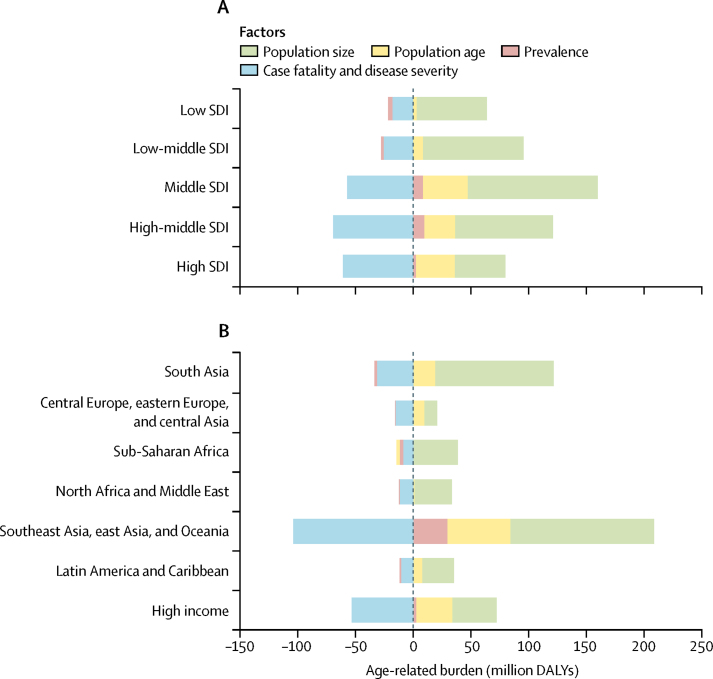
Using the Global Burden of Diseases, Injuries, and Risk Factors Study 2017, we developed a metric that reflects age-related morbidity and mortality at the population level. First, we identified a set of age-related diseases, defined as diseases with incidence rates among the adult population increasing quadratically with age, and measured their age-related burden, defined as the sum of disability-adjusted life-years (DALYs) of these diseases among adults. Second, we estimated age-standardised age-related health burden across 195 countries between 1990 and 2017. Using global average 65-year-olds as the reference population, we calculated the equivalent age in terms of age-related disease burden for all countries. Third, we analysed how the changes in age-related burden during the study period relate to different factors with a decomposition analysis. Finally, we describe how countries with similar levels of overall age-related burden experience different onsets of ageing. We represent the uncertainty of our estimates by calculating uncertainty intervals (UI) from 1000 draw-level estimates for each disease, country, year, and age.
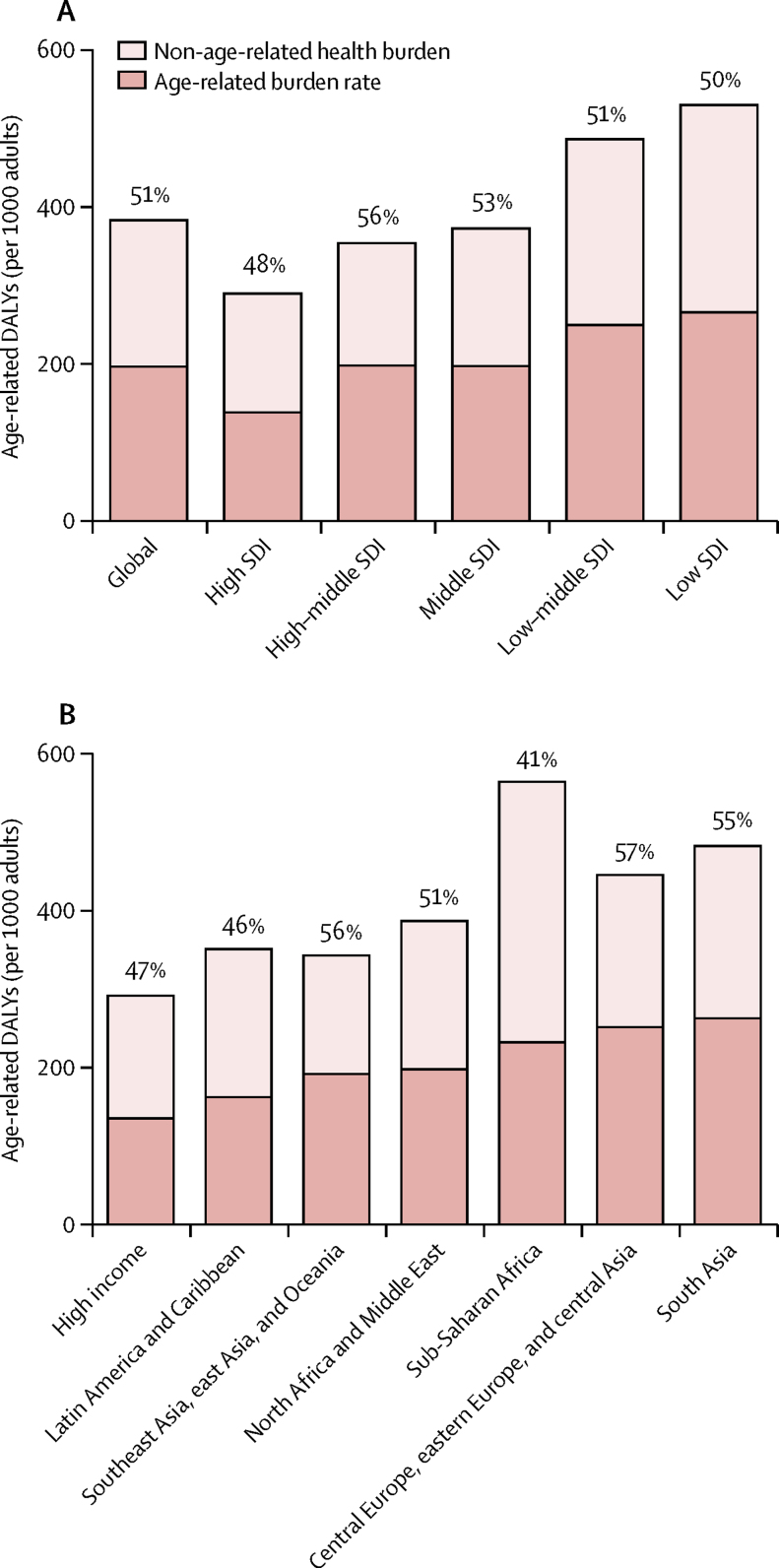
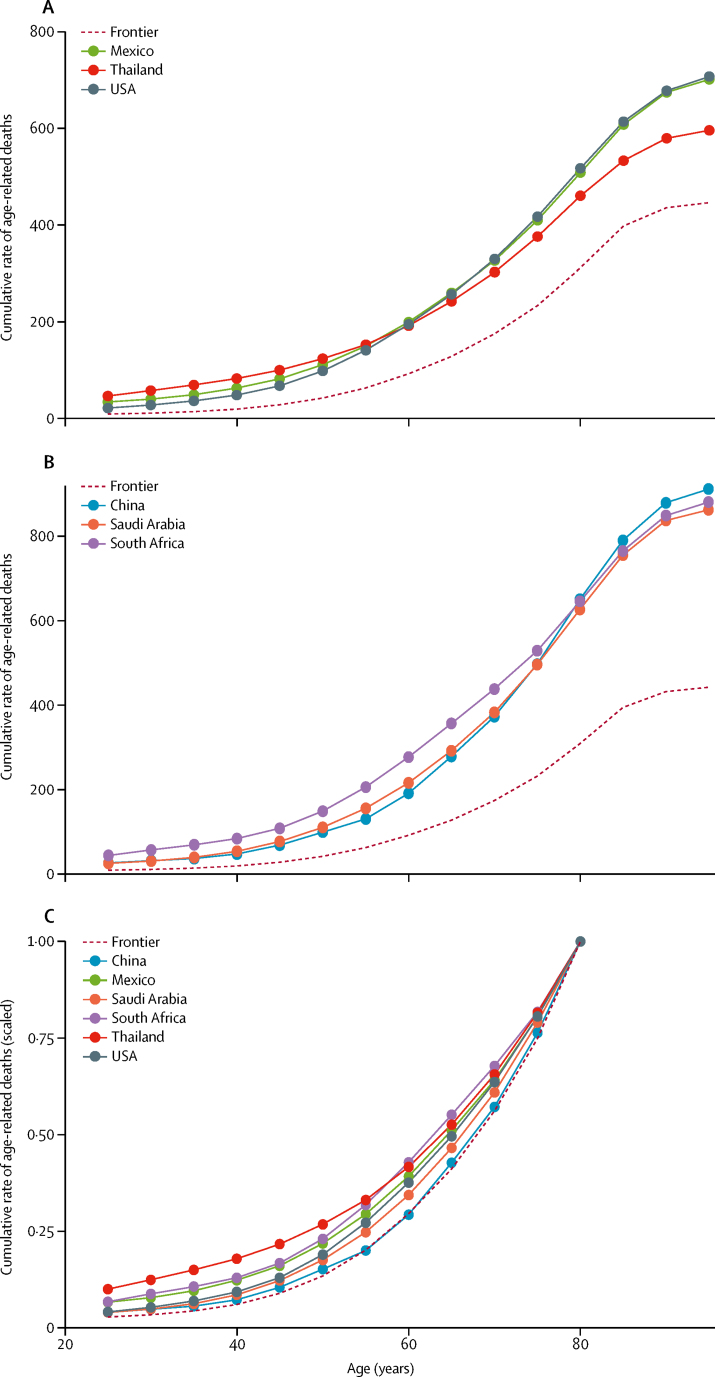
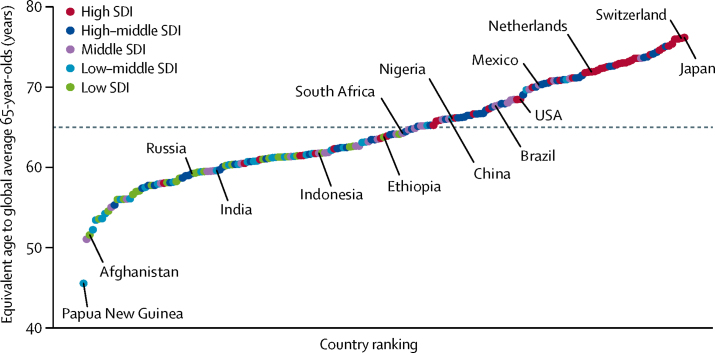
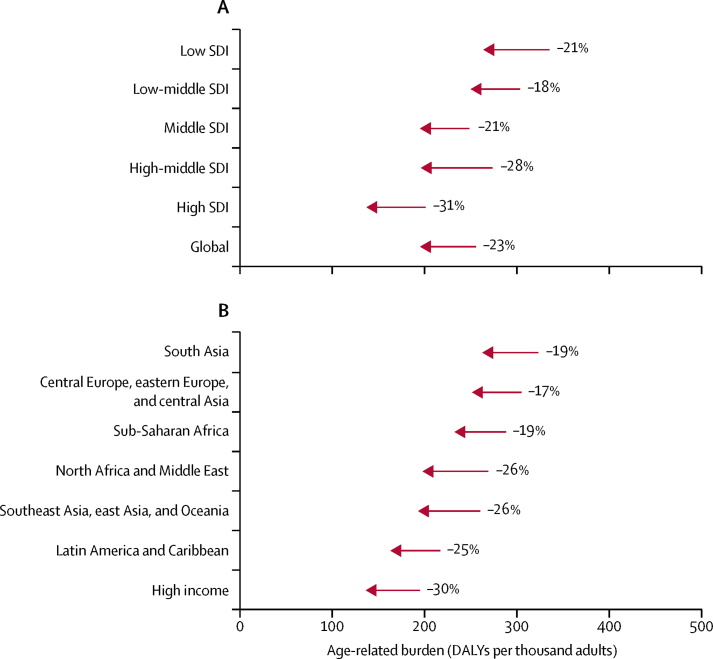
92 diseases were identified as age related, accounting for 51·3% (95% UI 48·5-53·9) of all global burden among adults in 2017. Across the Socio-demographic Index (SDI), the rate of age-related burden ranged from 137·8 DALYs (128·9-148·3) per 1000 adults in high SDI countries to 265·9 DALYs (251·0-280·1) in low SDI countries. The equivalent age to average 65-year-olds globally spanned from 76·1 years (75·6-76·7) in Japan to 45·6 years (42·6-48·2) in Papua New Guinea. Age-standardised age-related disease rates have decreased over time across all SDI levels and regions between 1990 and 2017, mainly due to decreases in age-related case fatality and disease severity. Even among countries with similar age-standardised death rates, large differences in the onset and patterns of accumulating age-related burden exist.
The new metric facilitates the shift from thinking not just about chronological age but the health status and disease severity of ageing populations. Our findings could provide inputs into policymaking by identifying key drivers of variation in the ageing burden and resources required for addressing the burden.
National Institute on Aging of the National Institutes of Health.
传统的人口健康老龄化指标往往无法区分延长预期寿命和增加健康年限。需要一种反映长寿和健康状况、包含广泛疾病的人口老龄化指标,并能够进行国家间和时间上的比较,以便了解老龄化的进展并为政策提供信息。
我们使用 2017 年全球疾病、伤害和危险因素研究,开发了一种反映人口水平与年龄相关的发病率和死亡率的指标。首先,我们确定了一组与年龄相关的疾病,这些疾病的发病率在成年人群体中随年龄呈二次增长,并衡量了这些疾病在成年人群体中的年龄相关负担,定义为这些疾病的残疾调整生命年(DALY)之和。其次,我们估计了 195 个国家在 1990 年至 2017 年期间的年龄标准化与年龄相关的健康负担。使用全球平均 65 岁人群作为参考人群,我们计算了所有国家在与年龄相关的疾病负担方面的等效年龄。第三,我们通过分解分析研究期间与年龄相关的负担变化与不同因素之间的关系。最后,我们描述了具有相似整体与年龄相关负担的国家如何经历不同的老龄化开始。我们通过为每种疾病、国家、年份和年龄计算 1000 次抽取水平估计的不确定性区间(UI)来表示我们估计的不确定性。
确定了 92 种与年龄相关的疾病,占 2017 年成年人群体所有全球负担的 51.3%(95%UI 48.5-53.9)。在社会人口指数(SDI)范围内,与年龄相关的负担率从高 SDI 国家每 1000 名成年人 137.8 DALY(128.9-148.3)到低 SDI 国家的 265.9 DALY(251.0-280.1)不等。全球与 65 岁平均年龄相匹配的等效年龄跨度从日本的 76.1 岁(75.6-76.7)到巴布亚新几内亚的 45.6 岁(42.6-48.2)。1990 年至 2017 年期间,所有 SDI 水平和地区的年龄标准化与年龄相关的疾病发生率都有所下降,这主要是由于与年龄相关的病死率和疾病严重程度下降所致。即使在具有相似年龄标准化死亡率的国家之间,与年龄相关的负担的起始和积累模式也存在很大差异。
新指标有助于从不仅仅考虑年龄,而是考虑人口老龄化的健康状况和疾病严重程度的角度进行思考。我们的发现可以通过确定老龄化负担变化的关键驱动因素和解决负担所需的资源,为决策提供信息。
美国国立卫生研究院国家老龄化研究所。