Grundtvig Josefine, Sværke Katrine, Preskou Mathilde, Christensen Louisa Marguerite, Steiner Thorsten, Christensen Hanne
Department of Neurology, Bispebjerg and Frederiksberg Hospital, and University of Copenhagen, Copenhagen, Denmark.
Department of Neurology, Klinikum Frankfurt Höchst, Frankfurt, and Department of Neurology, Heidelberg University Hospital, Heidelberg, Germany.
Glob Epidemiol. 2025 Apr 29;9:100201. doi: 10.1016/j.gloepi.2025.100201. eCollection 2025 Jun.
We aimed to compare access to diagnostics, treatment, rehabilitation, and outcome in women and men with stroke.
In this observational study we used routinely-collected, aggregate health data from all patients admitted with a stroke in the Capital Region and Region Zealand, Denmark from May 2016 until October 2022.
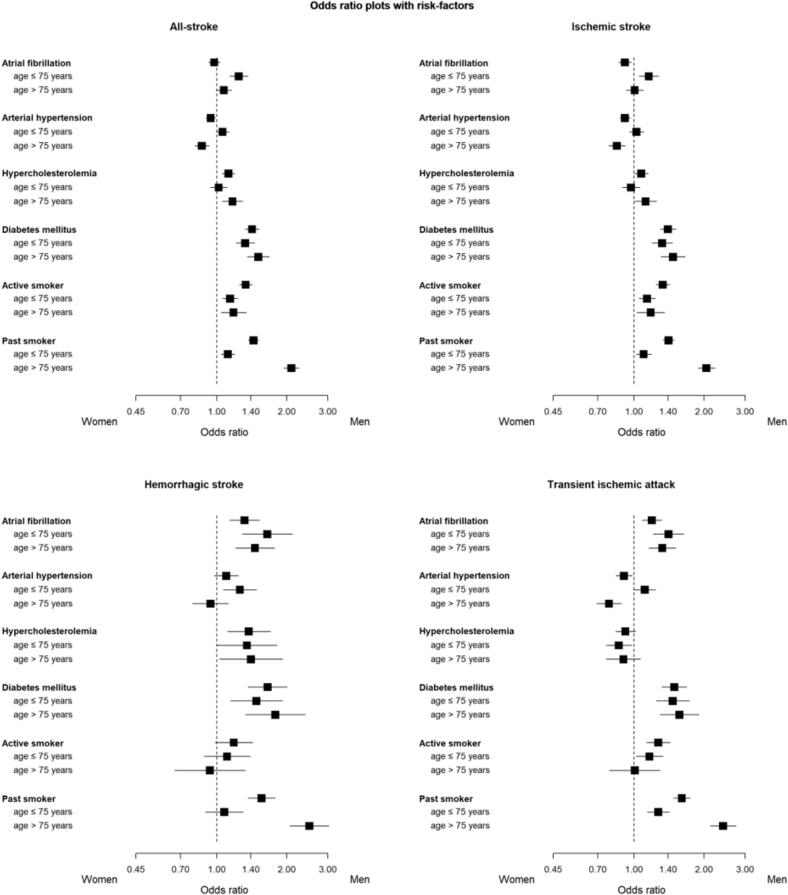
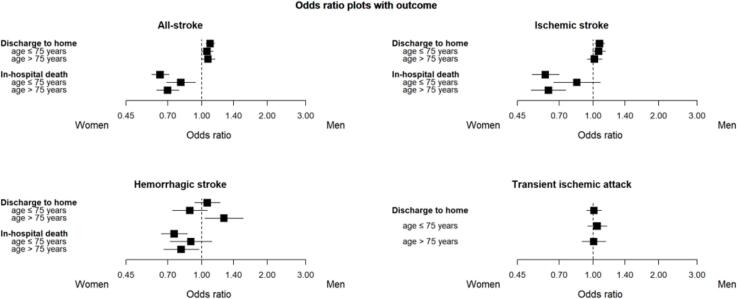
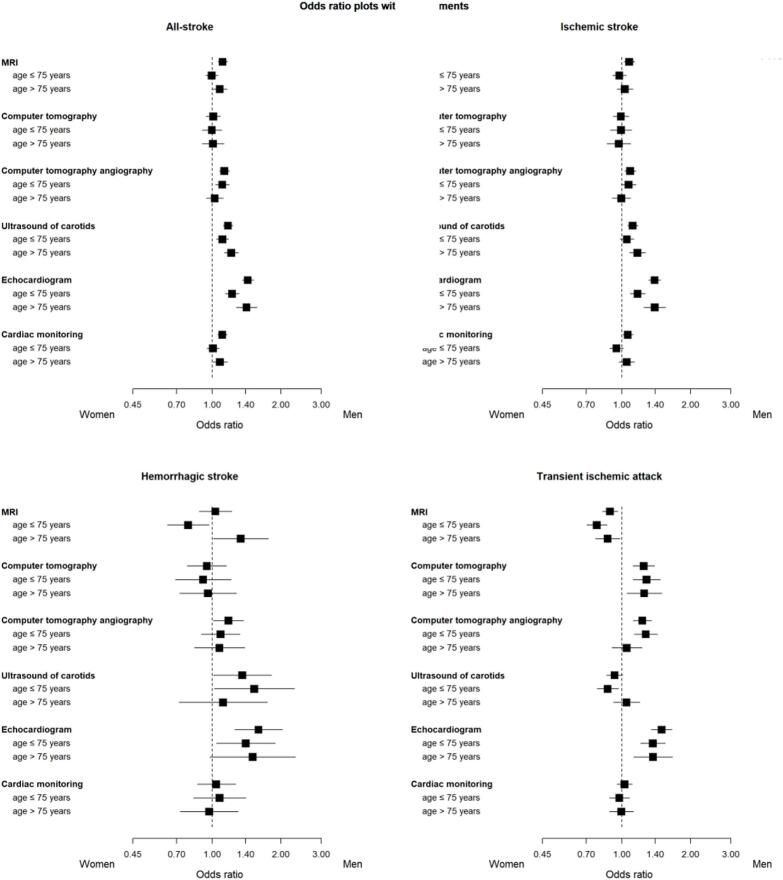
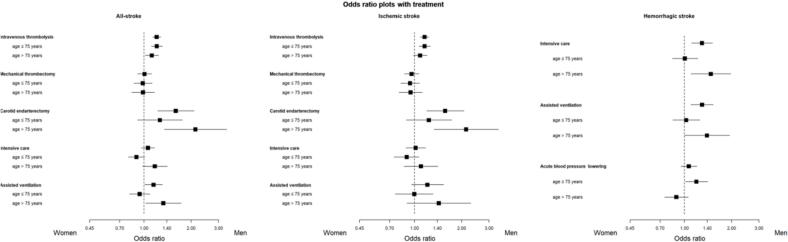
Among 28,855 stroke patients (55 % men, 45 % women), women were older (53 % women vs. 47 % men with age > 75 years). Overall, women had reduced access to: magnetic resonance imaging (MRI; 40 % vs. 43 %, CI 95 %: 1.06-1.16), computer tomography (CT)-angiography (25 % vs. 28 %, CI95%: 1.07-1.19), carotid ultrasound (48 % vs. 52 %, CI95%: 1.12-1.23), thrombolysis (16 % vs. 18 %, CI95%: 1.13-1.28), and neuropsychological assessment (9 % vs. 16 %, CI95%: 1.70-1.97). Home discharge rates were lower for women (45 % vs. 47 %, CI95%: 1.04-1.15), while in-hospital mortality was higher (8 % vs. 6 %, CI95%: 0.59-0.71). For patients >75 years, women had less access to MRI (34 % vs. 35 %, CI95%: 1-1.16), carotid ultrasound (46 % vs. 51 %, CI95%: 1.13-1.30), thrombolysis (15 % vs. 16 %, CI95%: 1.02-1.24), and neuropsychological assessment (2 % vs. 4 %, CI95%: 1.60-2.42). Women's in-hospital mortality remained higher also in patients >75 years (12 % vs. 8 %, CI95%: 0.62-0.79).
Women had reduced access to testing, treatment, and rehabilitation across all age groups and stroke types. This disparity was most notable in interventions not included in the national quality assessment program.
我们旨在比较中风女性和男性在诊断、治疗、康复及预后方面的情况。
在这项观察性研究中,我们使用了丹麦首都地区和西兰岛从2016年5月至2022年10月期间所有中风住院患者的常规收集的汇总健康数据。
在28,855名中风患者中(55%为男性,45%为女性),女性年龄更大(75岁以上的女性占53%,男性占47%)。总体而言,女性在以下方面的机会减少:磁共振成像(MRI;40%对43%,95%置信区间:1.06 - 1.16)、计算机断层扫描(CT)血管造影(25%对28%,95%置信区间:1.07 - 1.19)、颈动脉超声检查(48%对52%,95%置信区间:1.12 - 1.23)、溶栓治疗(16%对18%,95%置信区间:1.13 - 1.28)以及神经心理学评估(9%对16%,95%置信区间:1.70 - 1.97)。女性的出院回家率较低(45%对47%,95%置信区间:1.04 - 1.15),而住院死亡率较高(8%对6%,95%置信区间:0.59 - 0.71)。对于75岁以上的患者,女性接受MRI检查的机会更少(34%对35%,95%置信区间:1 - 1.16)、颈动脉超声检查(46%对51%,95%置信区间:1.13 - 1.30)、溶栓治疗(15%对16%,95%置信区间:1.02 - 1.24)以及神经心理学评估(2%对4%,95%置信区间:1.60 - 2.42)。在75岁以上的患者中,女性的住院死亡率也仍然较高(12%对8%,95%置信区间:0.62 - 0.79)。
在所有年龄组和中风类型中,女性接受检查、治疗和康复的机会减少。这种差异在国家质量评估计划未涵盖的干预措施中最为明显。