
在巴基斯坦卡拉奇贫民窟学校共同创建并实施由青年主导的非传染性疾病风险降低干预措施的可行性:一项混合方法的干预前和干预后研究方案
Feasibility of co-creating and delivering a youth-led noncommunicable diseases risk reduction intervention in schools of slums in Karachi, Pakistan: protocol for a mixed-methods, pre- and post-intervention study.
作者信息
Naz Sabahat, Ilyas Munazzah, Iqbal Romaina
机构信息
Community Health Sciences Department, The Aga Khan University, Karachi, 74800, Pakistan.
出版信息
Pilot Feasibility Stud. 2025 Jun 2;11(1):76. doi: 10.1186/s40814-025-01662-0.
BACKGROUND
Adolescents are more susceptible to the shared risk factors of noncommunicable diseases (NCDs), including physical inactivity, tobacco use (smoking and smokeless), and unhealthy diets. However, there is limited literature from Pakistan that involves school-going adolescents in developing and delivering NCD risk-reduction interventions among their younger peers.
OBJECTIVE
This study aims to assess the feasibility of co-creating and delivering a youth-led NCD risk reduction intervention in schools of slums in Karachi, Pakistan.
METHODS
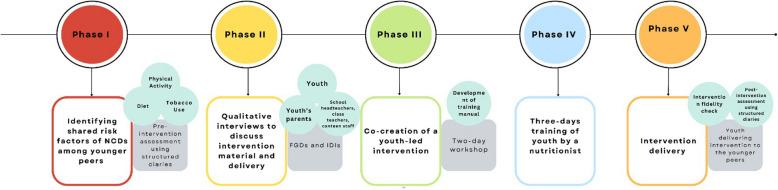
Using a mixed-methods, pre- and post-intervention design approach, we will conduct the study in 10 randomly selected schools (5 government and 5 private) in Azam Basti and Mehmoodabad, the urban slums in Karachi. The study comprises five sequential phases: Phase I involves identifying shared risk factors of NCDs among younger peers aged 9 to 12 (grades 5 and 6 students) (n = 100) using structured diaries, which will also serve as a pre-intervention assessment. Phase II entails conducting qualitative interviews with youth aged 14 to 16 (grades 9 and 10 students) (n = 40), their parents, school head teachers, class teachers, and canteen staff to discuss intervention components, materials, and delivery methods. In Phase III, workshops will be held to co-create the intervention with the help of youth. Phase IV will involve 3 days of comprehensive youth training by a qualified nutritionist on delivering the intervention to their younger peers. Finally, in Phase V, youth will deliver the intervention among all grades 5 and 6 students in their schools, followed by a post-intervention assessment, in which the younger peers will complete the structured diaries for the shared risk factors. Two independent data collectors will also perform fidelity checks of the intervention delivery using a checklist. The expected outcomes will include the feasibility of developing and implementing a culturally relevant youth-led NCD risk reduction intervention and youth training manual. The feasibility of the intervention will be assessed using the recruitment and retention rates for schools, youth, and younger peers, youth attendance at workshops and training sessions, structured diaries completion rates at pre- and post-intervention, the fidelity of delivering the intervention, and the preliminary change in the risk factors at post-intervention compared to the baseline.
ETHICS AND DISSEMINATION
The study was approved by the Ethical Review Committee of the Aga Khan University (ref.: 2024-9763-29,256). If the intervention proves feasible, we will disseminate our findings to both academic and nonacademic audiences. Additionally, we will implement a definitive trial across various slum settings in Karachi, Pakistan.
TRIAL REGISTRATION
ClinicalTrials.gov, NCT06465771. Registered 20 June 2024-prospectively registered, https://clinicaltrials.gov/study/NCT06465771 .
背景
青少年更容易受到非传染性疾病(NCDs)共同风险因素的影响,包括身体活动不足、烟草使用(吸烟和无烟烟草)以及不健康饮食。然而,来自巴基斯坦的涉及在校青少年在其年幼同龄人中制定和实施非传染性疾病风险降低干预措施的文献有限。
目的
本研究旨在评估在巴基斯坦卡拉奇贫民窟的学校共同创建并实施由青年主导的非传染性疾病风险降低干预措施的可行性。
方法
采用混合方法、干预前和干预后设计方法,我们将在卡拉奇城市贫民窟阿扎姆巴斯蒂和梅赫穆达巴德随机选择的10所学校(5所政府学校和5所私立学校)开展研究。该研究包括五个连续阶段:第一阶段涉及使用结构化日记确定9至12岁年幼同龄人(5年级和6年级学生)(n = 100)中常见的非传染性疾病风险因素,这也将作为干预前评估。第二阶段需要对14至16岁的青年(9年级和10年级学生)(n = 40)、他们的父母、学校校长、班主任和食堂工作人员进行定性访谈,以讨论干预内容、材料和实施方法。在第三阶段,将举办研讨会,在青年的帮助下共同创建干预措施。第四阶段将由一名合格的营养师对青年进行为期3天的全面培训,内容是向他们年幼的同龄人实施干预措施。最后,在第五阶段,青年将在他们学校的所有5年级和6年级学生中实施干预措施,随后进行干预后评估,其中年幼的同龄人将完成关于共同风险因素的结构化日记。两名独立的数据收集人员还将使用清单对干预措施的实施进行保真度检查。预期结果将包括制定和实施与文化相关的由青年主导的非传染性疾病风险降低干预措施以及青年培训手册的可行性。将使用学校、青年和年幼同龄人的招募和保留率、青年参加研讨会和培训课程的情况、干预前和干预后结构化日记的完成率、干预措施实施的保真度以及与基线相比干预后风险因素的初步变化来评估干预措施的可行性。
伦理与传播
该研究获得了阿迦汗大学伦理审查委员会的批准(参考号:20⒉4-9763-29,256)。如果干预措施被证明可行,我们将把研究结果传播给学术和非学术受众。此外,我们将在巴基斯坦卡拉奇的各种贫民窟环境中开展一项确定性试验。
试验注册
ClinicalTrials.gov,NCT06465771。2024年6月20日注册——前瞻性注册,https://clinicaltrials.gov/study/NCT06465771 。


 Zotero 插件