Cohen Rinat, Maydan Gal, Brill Shai, Cohen-Mansfield Jiska
Minerva Center for Interdisciplinary Study of End of Life, Tel Aviv University, Chaim Levanon St 55, Tel Aviv-Yafo, 6997801, Israel.
Beit Rivka Geriatric Medical Center, Clalit Health Services, Ha-Khamisha St 4, Petah Tikva, 4924577, Israel.
Int J Nurs Stud Adv. 2025 Apr 19;8:100333. doi: 10.1016/j.ijnsa.2025.100333. eCollection 2025 Jun.
Despite an acknowledged need to improve communication between staff and family caregivers of non-communicative care recipients (i.e., care recipients who are unable to engage in discussions with the medical staff about their treatment and care at geriatric facilities), no tools exist to measure the quality of this communication nor the extent to which family caregivers' communication needs are met.
To develop and test two assessment tools to evaluate the extent to which family caregivers' communication needs are met according to family caregivers and for evaluating the quality of communication with the staff member most often consulted.
Instrument development, including reliability, validity, and construct testing.
Five geriatric facilities (two geriatric medical centers and three nursing homes) in Israel.
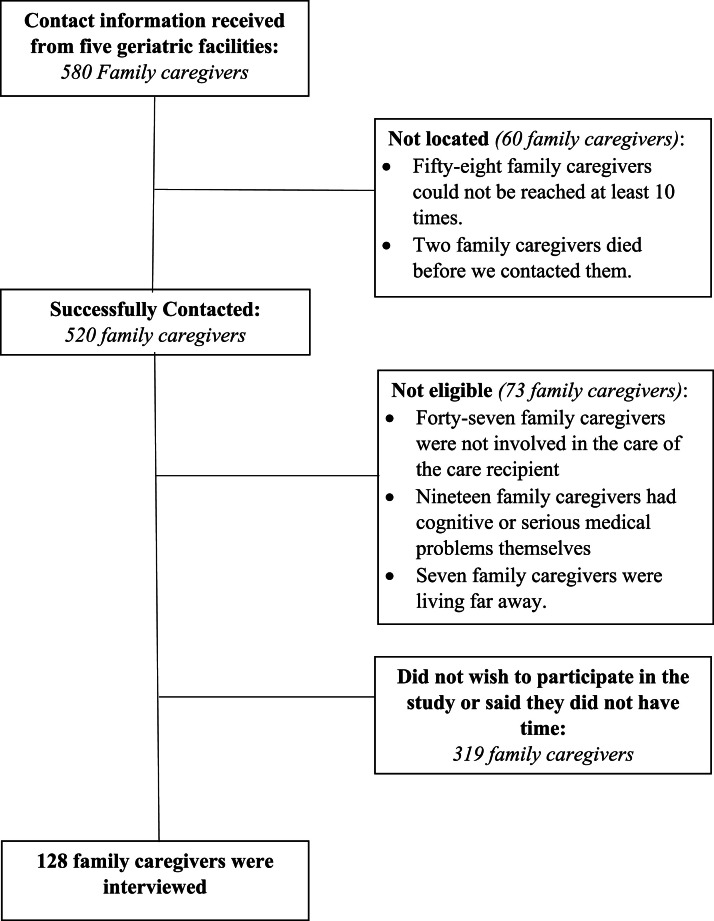
128 family caregivers of non-communicative care recipients at geriatric facilities.
Based on our previous findings, we developed the Family Caregiver's Communication Needs Questionnaire, which assesses the extent to which family caregivers' communication needs are met according to them, and the Staff-Family Quality of Communication Questionnaire, which evaluates the quality of communication with the staff member most often consulted. We conducted personal interviews with the participants to explore both tools' items and reliability and examined the reliability and convergent validity of the Family Caregiver's Communication Needs Questionnaire in a different sub-sample. The Family Caregiver's Communication Needs Questionnaire's construct was tested using a factor analysis.
Both tools' internal consistency reliabilities were high (Family Caregiver's Communication Needs Questionnaire, Cronbach's α = 0.92, 23 items; Staff-Family Quality of Communication Questionnaire, α = 0.86, 8 items). Exploratory factor analysis for the Family Caregiver's Communication Needs Questionnaire reinforced the four factors that emerged in a prior study (staff's availability and attitude, relating to family caregivers' caregiving experience, clarity and reliability of information, and language barriers), accounting together for 63.3 % of the variance. Both tools demonstrated good convergent validity.
The Family Caregiver's Communication Needs Questionnaire and Staff-Family Quality of Communication Questionnaire are valid and reliable tools for assessing the quality of staff-family communication, assisting in identifying communication strengths and weaknesses, suggesting potential interventions for improved communication, and providing outcome measures for such interventions.
尽管人们公认需要改善非沟通性护理接受者(即无法与医护人员就其在老年护理机构的治疗和护理进行讨论的护理接受者)的工作人员与家庭护理人员之间的沟通,但目前尚无工具来衡量这种沟通的质量,也无法衡量家庭护理人员的沟通需求得到满足的程度。
开发并测试两种评估工具,以根据家庭护理人员评估其沟通需求得到满足的程度,并评估与最常咨询的工作人员的沟通质量。
工具开发,包括信度、效度和结构测试。
以色列的五家老年护理机构(两家老年医疗中心和三家疗养院)。
老年护理机构中128名非沟通性护理接受者的家庭护理人员。
基于我们之前的研究结果,我们开发了《家庭护理人员沟通需求问卷》,该问卷根据家庭护理人员自身评估其沟通需求得到满足的程度,以及《工作人员-家庭沟通质量问卷》,该问卷评估与最常咨询的工作人员的沟通质量。我们对参与者进行了个人访谈,以探讨这两种工具的项目和信度,并在另一个子样本中检验了《家庭护理人员沟通需求问卷》的信度和收敛效度。使用因子分析对《家庭护理人员沟通需求问卷》的结构进行了测试。
两种工具的内部一致性信度都很高(《家庭护理人员沟通需求问卷》,克朗巴哈α系数=0.92,23个项目;《工作人员-家庭沟通质量问卷》,α系数=0.86,8个项目)。对《家庭护理人员沟通需求问卷》的探索性因子分析强化了先前研究中出现的四个因素(工作人员的可及性和态度、与家庭护理人员护理经历的相关性、信息的清晰度和可靠性以及语言障碍),这四个因素共同解释了63.3%的方差。两种工具都显示出良好的收敛效度。
《家庭护理人员沟通需求问卷》和《工作人员-家庭沟通质量问卷》是评估工作人员与家庭沟通质量的有效且可靠的工具,有助于识别沟通的优势和劣势,提出改善沟通的潜在干预措施,并为此类干预措施提供结果指标。
