Liu Leon, Chachad Nisha, Tadjalli Arash, Rajput Vijay
Medical Education, Nova Southeastern University Dr. Kiran C. Patel College of Allopathic Medicine, Davie, USA.
Medical Education, Nova Southeastern University Dr. Kiran C. Patel College of Allopathic Medicine, Fort Lauderdale, USA.
Cureus. 2025 May 2;17(5):e83335. doi: 10.7759/cureus.83335. eCollection 2025 May.
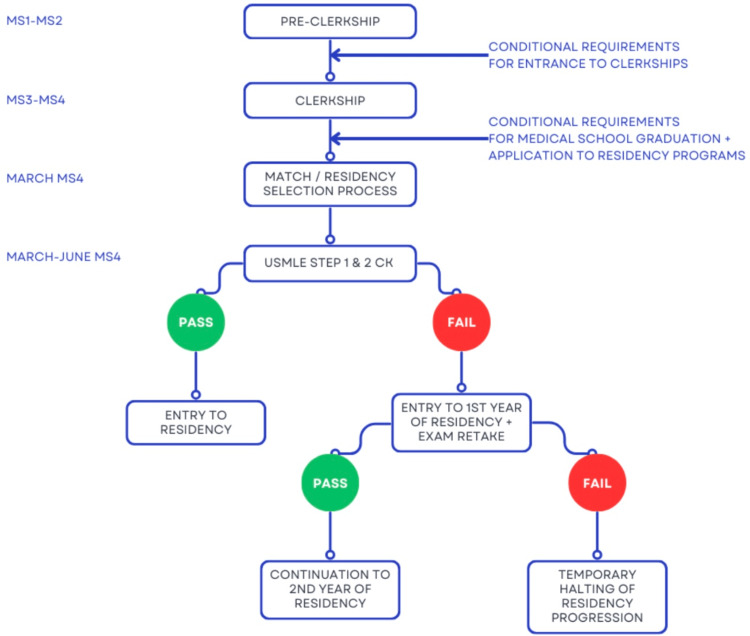
The United States Medical Licensing Examination (USMLE) program administers a series of longitudinal assessments across medical education to ensure that future physicians meet baseline competency for independent clinical practice. Through the current system of USMLE integration within medical school education, passing the Step 1 and 2 Clinical Knowledge (CK) exams is required for both application to residency programs and graduation from undergraduate medical education (UME). While the original intentions of such standardized exams were to establish benchmarks for medical knowledge and clinical competence, the current high-stakes system has diverged to the point that USMLE performance is now the single most defining factor utilized in residency consideration. Over-prioritization of USMLE exams by curriculum developers and program directors (PDs) alike has heightened stress levels and intensified reliance on parallel curricula, where the use of third-party resources far outweighs genuine engagement in formal medical school curriculum and education due to perceived inadequacy of classroom didactics in preparing students for board exams. For this reason, we have proposed the separation of USMLE from the medical school curriculum and the transition toward a new system where both Step 1 and 2 CK are postponed until after the residency match. In doing so, we aim to promote enhanced well-being of medical students and increased emphasis on holistic learning based on curiosity and intrinsic motivation for the practice of medicine. There may be unintended consequences to this proposition, particularly with regard to internal assessment of minimum standards for medical school graduation and changes in the residency application process. However, we hold that our proposal, combined with a reevaluation of criteria used in the residency selection process, would support well-roundedness among students and the full realization of their potential as the next generation of physicians.
美国医学执照考试(USMLE)项目在医学教育过程中进行一系列纵向评估,以确保未来的医生具备独立临床实践的基线能力。通过目前将USMLE融入医学院校教育的体系,申请住院医师培训项目和本科医学教育(UME)毕业都需要通过第一步和第二步临床知识(CK)考试。虽然此类标准化考试的初衷是为医学知识和临床能力设定基准,但当前这种高风险体系已经偏离了初衷,以至于USMLE成绩现在成为住院医师选拔中唯一最重要的决定性因素。课程开发者和项目主任(PDs)对USMLE考试的过度重视都加剧了压力水平,并强化了对平行课程的依赖,由于认为课堂教学在帮助学生准备委员会考试方面不足,第三方资源的使用远远超过了对正规医学院校课程和教育的真正参与。出于这个原因,我们提议将USMLE与医学院校课程分离,并向一个新系统过渡,即第一步和第二步CK都推迟到住院医师匹配之后。这样做的目的是促进医学生的幸福感提升,并更加注重基于对医学实践的好奇心和内在动力的全面学习。这一主张可能会产生意想不到的后果,特别是在医学院校毕业最低标准的内部评估以及住院医师申请流程的变化方面。然而,我们认为,我们的提议,再加上对住院医师选拔过程中使用的标准进行重新评估,将有助于学生的全面发展,并充分发挥他们作为下一代医生的潜力。