Mash Robert, Nyasulu Juliet, Malan Zelra, Hirschhorn Lisa
Division of Family Medicine and Primary Care, Faculty of Medicine and Health Sciences, Stellenbosch University, Cape Town.
Afr J Prim Health Care Fam Med. 2025 Jun 3;17(2):e1-e7. doi: 10.4102/phcfm.v17i2.4934.
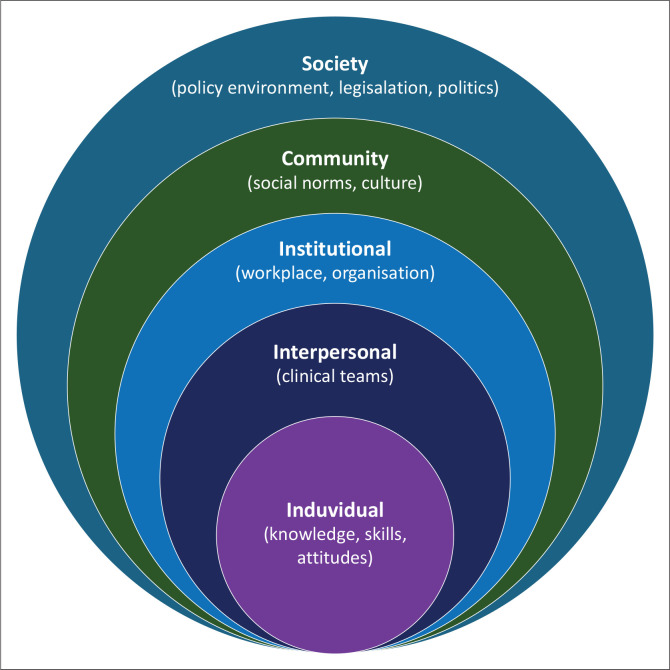
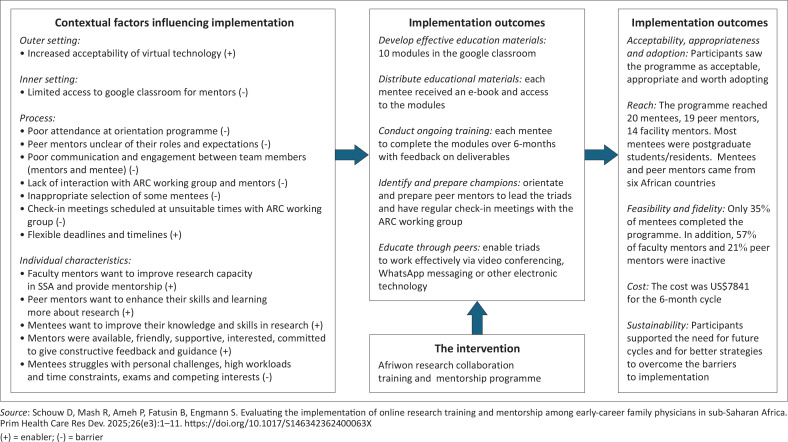
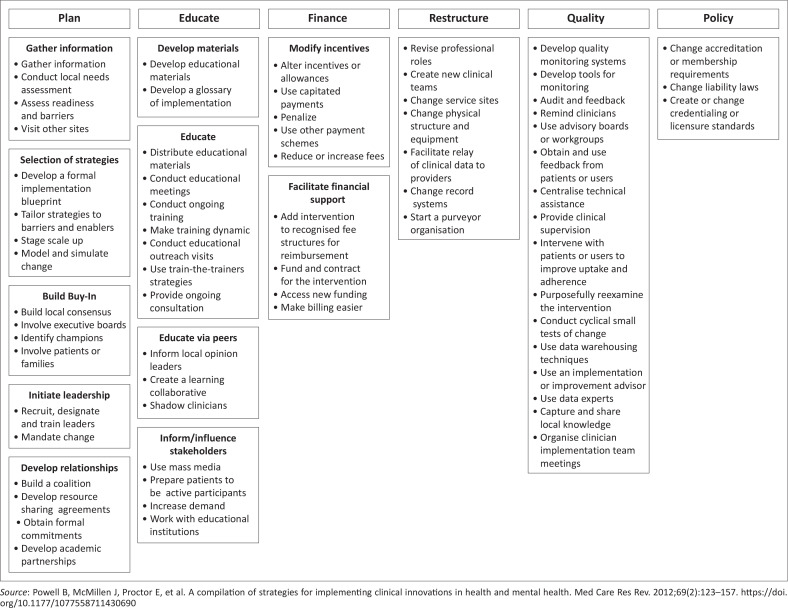
Implementation research (IR) focuses on understanding and closing the gap between evidence-based interventions and practice. Key elements to evaluate include the design of the intervention itself, contextual barriers and enablers to implementation, the use of implementation strategies as well as the achievement of implementation outcomes. This article gives an overview of IR for doctoral-level researchers in the fields of family medicine and primary care. The consolidated framework for IR and socioecological model are considered for making sense of the contextual factors. A typology of implementation strategies is also described to make conceptualisation, reporting and sharing of findings easier. Standard implementation outcomes are described, such as coverage or reach, acceptability, adoption, appropriateness, feasibility, fidelity, costs and sustainability. The RE-AIM framework for implementation outcomes is described. Finally, different study designs are discussed, including hybrid effectiveness-implementation designs and approaches to reporting using the IR logic model.
实施研究(IR)侧重于理解并弥合循证干预措施与实践之间的差距。需要评估的关键要素包括干预措施本身的设计、实施的背景障碍和促进因素、实施策略的运用以及实施结果的达成情况。本文为家庭医学和初级保健领域的博士级研究人员概述了实施研究。为了理解背景因素,考虑了实施研究的综合框架和社会生态模型。还描述了一种实施策略类型,以便更轻松地进行研究结果的概念化、报告和分享。阐述了标准的实施结果,如覆盖范围、可接受性、采用情况、适宜性、可行性、保真度、成本和可持续性。介绍了实施结果的RE-AIM框架。最后,讨论了不同的研究设计,包括混合效果-实施设计以及使用实施研究逻辑模型进行报告的方法。