Evans Alexander, Collins Rice Clement G, Turner Zoë R, O'Hare Dermot
Chemistry Research Laboratory, Department of Chemistry, University of Oxford, 12 Mansfield Road, Oxford OX1 3TA, U.K.
ACS Appl Mater Interfaces. 2025 Jun 11;17(23):34592-34601. doi: 10.1021/acsami.5c07594. Epub 2025 Jun 3.
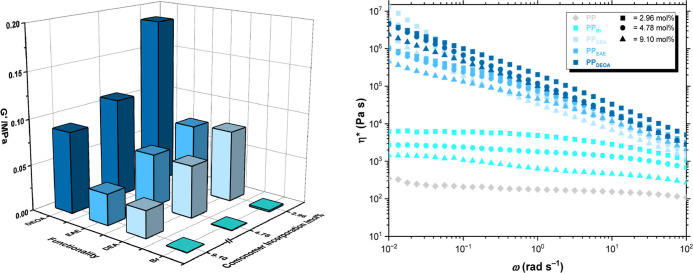
Amine-modified polypropylenes (, R = NH(Et) (DEA); NH(Et)(CHCHOH) (EAE); NH(CHCHOH) (DEOA)) have been prepared via a two-step synthesis and display enhanced adhesive performance with respect to both steel and polypropylene (PP) substrates. PP typically displays poor adhesion to polar substrates, which consequently restricts its utility as a hot-melt adhesive (HMA). Solvent-free, quantitative postmodification of poly(propylene)--(11-bromo-1-undecene) (range of comonomer incorporations (3-9 mol %)) with secondary amines yielded amine-modified PPs: , , and . Rheological and FT-IR characterization identified the presence of a PP-based supramolecular hydrogen bonding network. (Co)polymers were evaluated as HMAs by lap shear strength between steel-steel and steel-plastic substrates. and both excelled as HMAs between steel, recording the largest mean adhesive forces of 16.8 and 17.4 MPa, respectively; displayed a 252-fold increase vs and comparable adhesive strengths to conventional structural adhesives. The adhesive failure mode in multisubstrate adhesion was found to be a function of interfacial effects, depending on the relative ability of the HMAs to bind to the polar steel surface and diffuse into the plastic substrate. and were found to be optimal in this case with failure by stock break indicative of adhesion greater than the tensile strength of the substrate and consequently appropriate for the application. The unique properties of these bifunctional materials highlight the versatility of the relatively limited application of functionalized PPs to date. This study now allows further sets of functionalized PPs to be readily prepared to meet a diverse array of multisubstrate adhesive requirements.
胺改性聚丙烯(,R = NH(Et)₂(二乙胺);NH(Et)(CH₂CH₂OH)(乙醇乙胺);NH(CH₂CH₂OH)₂(二乙醇胺))已通过两步合成法制备而成,并且在与钢和聚丙烯(PP)基材的粘合性能方面表现出增强效果。PP通常对极性基材的粘附性较差,因此限制了其作为热熔胶(HMA)的用途。用仲胺对聚(丙烯)-(11-溴-1-十一碳烯)(共聚单体掺入量范围为(3 - 9摩尔%))进行无溶剂定量后改性,得到了胺改性PP:,,和。流变学和傅里叶变换红外光谱(FT-IR)表征确定了基于PP的超分子氢键网络的存在。通过钢-钢和钢-塑料基材之间的搭接剪切强度对(共)聚合物作为HMA进行了评估。和作为钢之间的HMA均表现出色,分别记录到最大平均粘合力为16.8和17.4 MPa;与相比,显示出252倍的增长,并且与传统结构胶粘剂具有相当的粘合强度。发现多基材粘附中的粘合失效模式是界面效应的函数,这取决于HMA与极性钢表面结合并扩散到塑料基材中的相对能力。在这种情况下,发现和是最佳的,其破坏形式为基材断裂,表明粘合力大于基材的拉伸强度,因此适用于该应用。这些双功能材料的独特性能突出了迄今为止功能化PP相对有限的应用的多功能性。这项研究现在使得能够容易地制备更多组功能化PP,以满足各种各样的多基材粘合要求。