Cadena Santiago, Teutli-Hernández Claudia, Herrera-Silveira Jorge A, Aguirre-Macedo M Leopoldina, Falcón Luisa I, Bebout Brad M, García-Maldonado José Q
Centro de Investigaciones Químicas, Universidad Autónoma del Estado de Morelos, Cuernavaca, Morelos, Mexico.
Escuela Nacional de Estudios Superiores Mérida, Universidad Nacional Autónoma de México, Ucú, Yucatan, Mexico.
PLoS One. 2025 Jun 3;20(6):e0325200. doi: 10.1371/journal.pone.0325200. eCollection 2025.
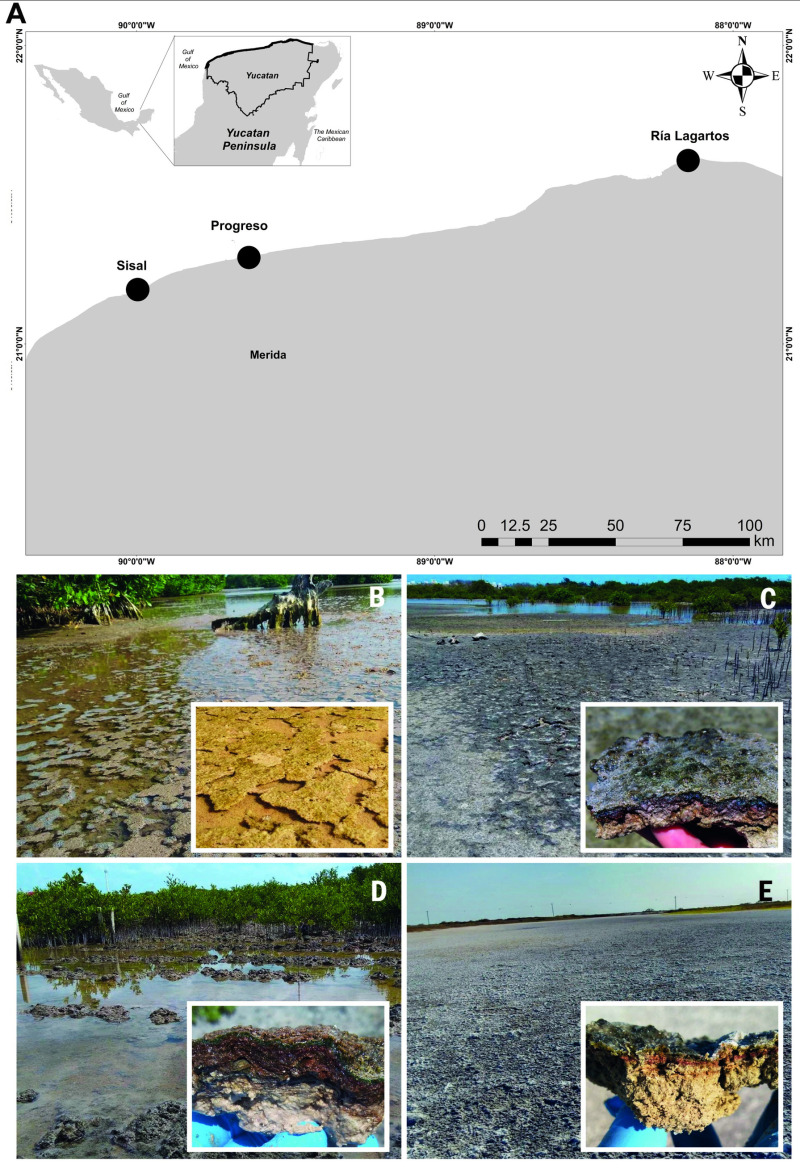
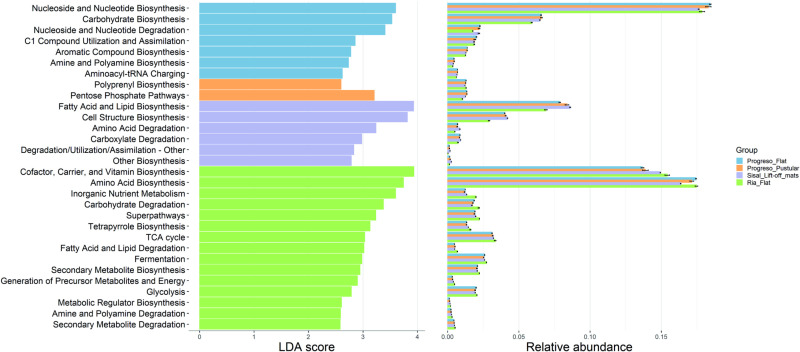
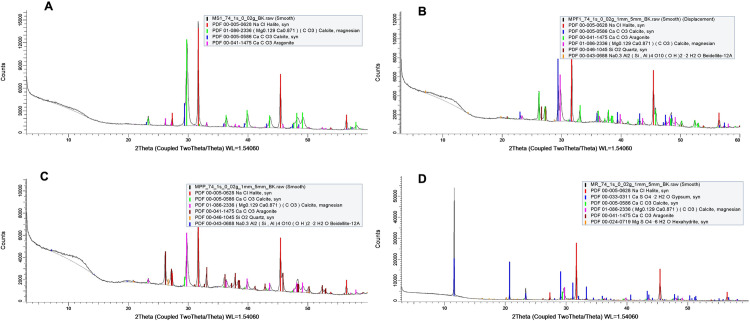
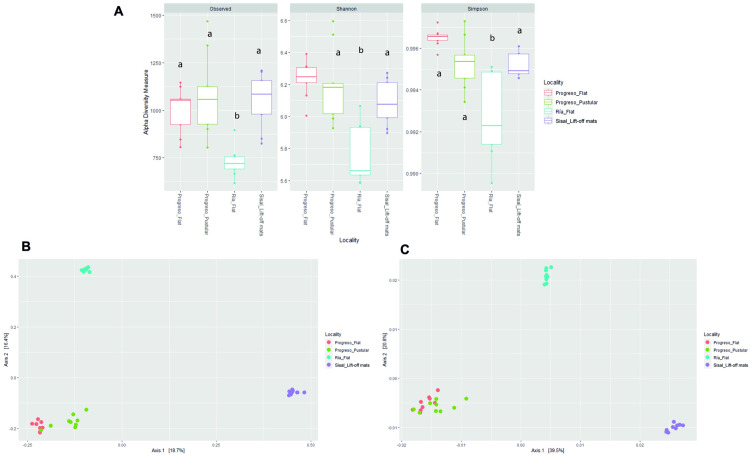
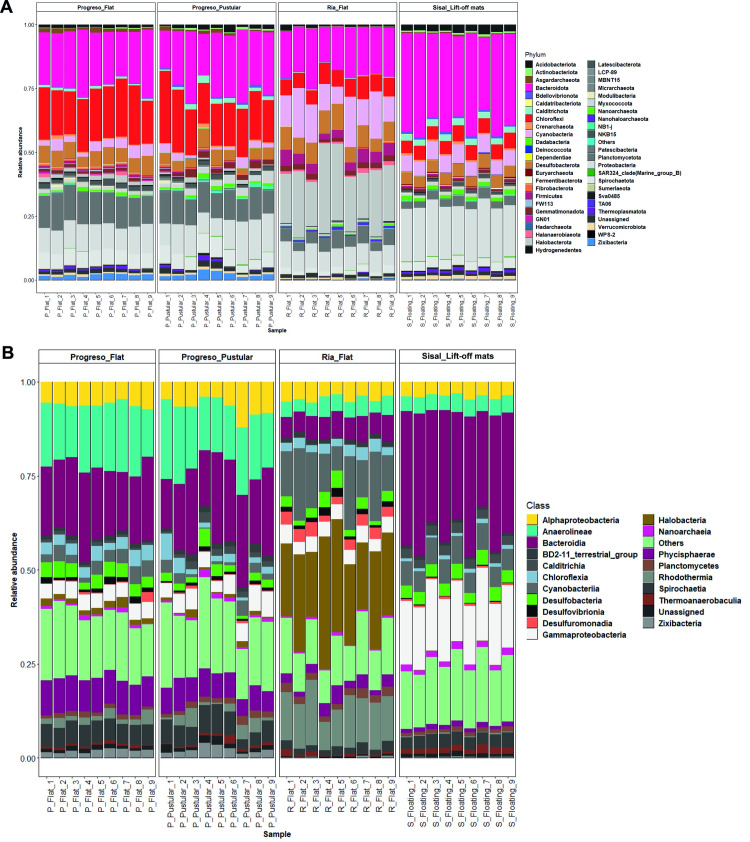
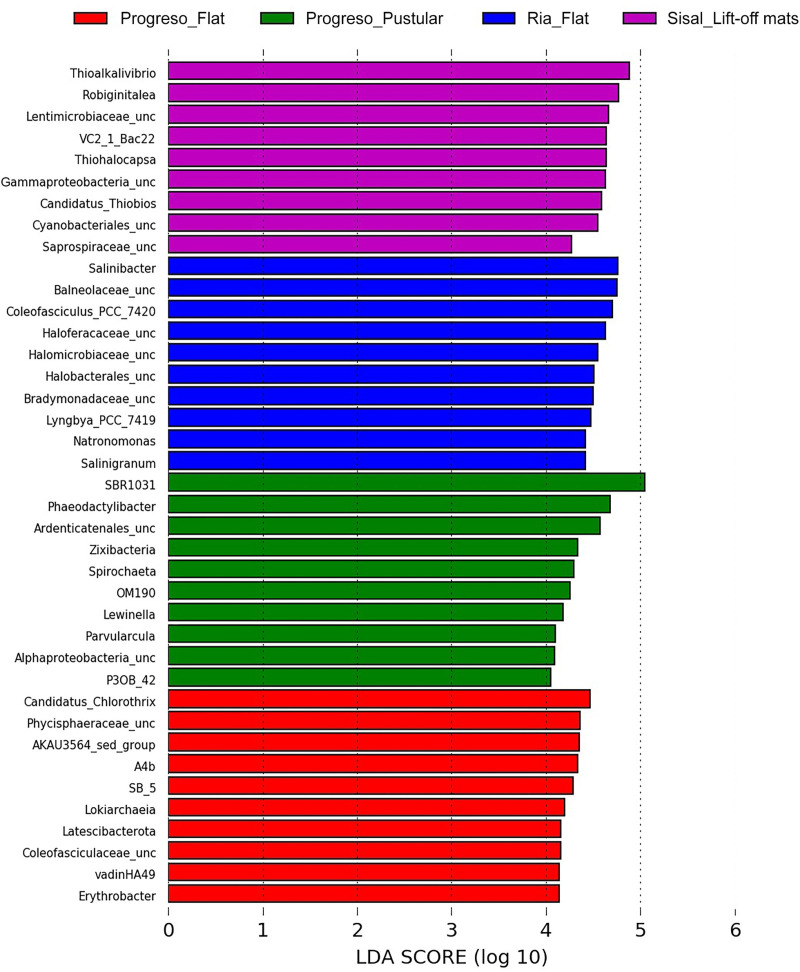
In this study, we report for the first time an exploration of the physicochemical characteristics and the prokaryotic diversity of three different types of microbial mats from karstic habitats located in Sisal, Progreso and Ría Lagartos, in the Yucatan Peninsula, Mexico. Our results showed that lift-off mats were found in the lower salinity (2.2%) area (Sisal), while flat and pustular mats were detected in hypersaline (6-9%) sites (Progreso and Ría Lagartos). Notably, some of these microbial mat structures were in close proximity to mangrove forest ecosystems with both degraded and restored regimes. XRD analysis revealed different mineral compositions of the mats; however, aragonite, calcite, and halite were commonly found in all samples studied. High-throughput sequencing of the 16S rRNA gene identified differences in microbial communities across the different mat types, and statistical analyses revealed that salinity, redox potential, and temperature were significant factors in explaining the variance of the prokaryotic assemblages. Microbial groups identified in this study include those known to be important in the biogeochemical cycling of key elements, such as carbon, nitrogen, and sulfur. Interestingly, the community composition of flat and pustular mats from Progreso was similar, with Bacteroidia, Anaerolineae, and Phycisphaerae being the most abundant microbial groups in flat mats; and Bacteroidia, Anaerolineae, and Alphaproteobacteria dominating pustular mats. By contrast, flat mats from Ría Lagartos were dominated by Halobacteria, Cyanobacteria and Bacteroidota, while Bacteroidia, Gammaproteobacteria and Cyanobacteria dominated lift-off mats from Sisal. This work contributes to understanding the distribution, physicochemical characteristics and microbial diversity of coastal microbial mats, providing valuable new insights into microbial mats that develop in karstic ecosystems. This information is relevant to ongoing and future efforts to manage and preserve coastal ecosystems in the Yucatan Peninsula.
在本研究中,我们首次报告了对来自墨西哥尤卡坦半岛锡萨尔、普罗格雷索和里阿拉加托斯岩溶栖息地的三种不同类型微生物席的物理化学特征和原核生物多样性的探索。我们的结果表明,在低盐度(2.2%)区域(锡萨尔)发现了剥离型微生物席,而在高盐度(6 - 9%)地点(普罗格雷索和里阿拉加托斯)检测到了扁平型和脓疱型微生物席。值得注意的是,其中一些微生物席结构紧邻红树林生态系统,这些生态系统既有退化的也有恢复的状态。X射线衍射分析揭示了微生物席不同的矿物成分;然而,在所研究的所有样本中普遍发现了文石、方解石和石盐。对16S rRNA基因的高通量测序确定了不同类型微生物席之间微生物群落的差异,统计分析表明盐度、氧化还原电位和温度是解释原核生物组合差异的重要因素。本研究中鉴定出的微生物类群包括那些已知在碳、氮和硫等关键元素的生物地球化学循环中起重要作用的类群。有趣的是,普罗格雷索的扁平型和脓疱型微生物席的群落组成相似,拟杆菌纲、厌氧绳菌纲和球形杆菌纲是扁平型微生物席中最丰富的微生物类群;而拟杆菌纲、厌氧绳菌纲和α - 变形菌纲在脓疱型微生物席中占主导地位。相比之下,里阿拉加托斯的扁平型微生物席以嗜盐菌、蓝细菌和拟杆菌门为主,而锡萨尔的剥离型微生物席则以拟杆菌纲、γ - 变形菌纲和蓝细菌为主。这项工作有助于了解沿海微生物席的分布、物理化学特征和微生物多样性,为岩溶生态系统中发育的微生物席提供了有价值的新见解。这些信息与尤卡坦半岛沿海生态系统当前和未来的管理与保护工作相关。