Anderson Kristin A, deSouza Beverly, Castellano-Escuder Pol, Lin Zhihong, Ilkayeva Olga R, Muehlbauer Michael J, Grimsrud Paul A, Hirschey Matthew D
Department of Pharmacology & Cancer Biology, Duke University School of Medicine, Durham, NC.
Duke Molecular Physiology Institute and Sarah W. Stedman Nutrition and Metabolism Center, Duke University School of Medicine, Durham, NC.
bioRxiv. 2025 May 13:2025.05.12.653532. doi: 10.1101/2025.05.12.653532.
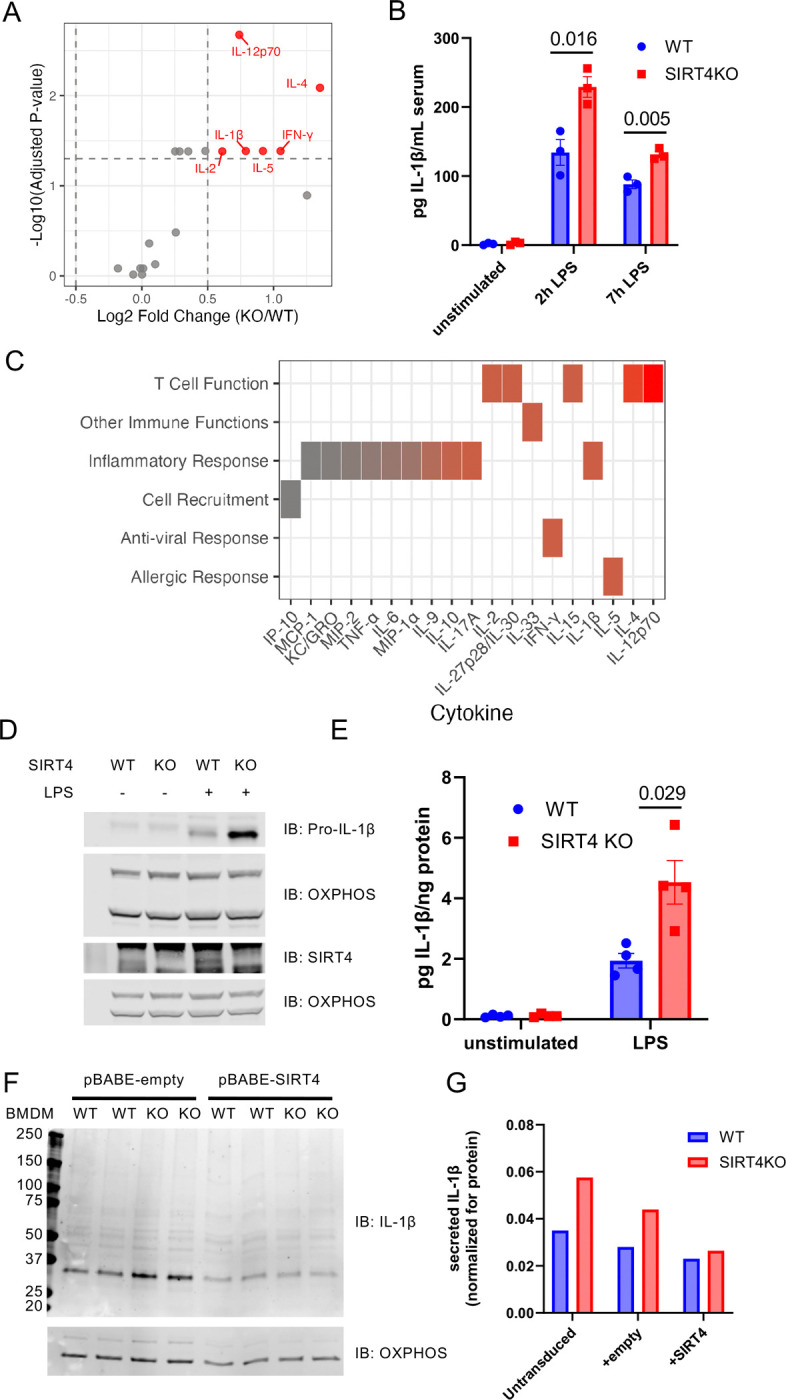
Proper regulation of inflammatory responses is essential for organismal health. Dysregulation can lead to accelerated development of the diseases of aging and the aging process itself. Here, we identify a novel enzymatic activity of the mitochondrial sirtuin SIRT4 as a lysine deitaconylase that regulates macrophage inflammatory responses. Itaconate is a metabolite abundantly produced in activated macrophages. We find it forms a protein modification called lysine itaconylation. Using biochemical and proteomics approaches, we demonstrate that SIRT4 efficiently removes this modification from target proteins both and . In macrophages, elevated protein itaconylation increases upon LPS stimulation, coinciding with elevated SIRT4 expression. SIRT4-deficient macrophages exhibit significantly increased IL-1β production in response to LPS stimulation. This phenotype is intrinsic to macrophages, as demonstrated by both lentiviral over-expression and acute SIRT4 knockdown models. Mechanistically, we identify key enzymes in branched-chain amino acid (BCAA) metabolism as targets of hyperitaconylation in SIRT4-deficient macrophages. The BCKDH complex component dihydrolipoamide branched chain transacylase E2 (DBT) is hyperitaconylated and has reduced BCKDH activity in SIRT4KO macrophages. Physiologically, SIRT4-deficient mice exhibit significantly delayed wound healing, demonstrating a consequence of dysregulated macrophage function. Our data reveal a novel protein modification pathway in immune cells and establish SIRT4 as a critical regulator at the intersection of metabolism and inflammation. These findings have implications for understanding immune dysregulation in aging and metabolic disease.
炎症反应的适当调节对于机体健康至关重要。调节异常会导致衰老相关疾病的加速发展以及衰老过程本身。在此,我们鉴定出线粒体去乙酰化酶SIRT4的一种新的酶活性,即作为赖氨酸衣康酰基转移酶来调节巨噬细胞的炎症反应。衣康酸是活化巨噬细胞中大量产生的一种代谢产物。我们发现它会形成一种名为赖氨酸衣康酰化的蛋白质修饰。利用生化和蛋白质组学方法,我们证明SIRT4能有效地从靶蛋白上移除这种修饰。在巨噬细胞中,LPS刺激后蛋白质衣康酰化水平升高,同时SIRT4表达也升高。SIRT4缺陷型巨噬细胞在LPS刺激下IL-1β的产生显著增加。这种表型是巨噬细胞所特有的,慢病毒过表达和急性SIRT4敲低模型均证明了这一点。从机制上讲,我们确定支链氨基酸(BCAA)代谢中的关键酶是SIRT4缺陷型巨噬细胞中高衣康酰化的靶点。BCKDH复合物成分二氢硫辛酰胺支链转酰基酶E2(DBT)在SIRT4基因敲除巨噬细胞中发生高衣康酰化,且BCKDH活性降低。在生理上,SIRT4缺陷型小鼠的伤口愈合显著延迟,这证明了巨噬细胞功能失调的后果。我们的数据揭示了免疫细胞中一种新的蛋白质修饰途径,并确立了SIRT4作为代谢与炎症交叉点上的关键调节因子。这些发现对于理解衰老和代谢疾病中的免疫失调具有重要意义。