Peng Xiaoying, Xia Kaijiang, Xiao Lingzhen, Qi Haoran, Huang Qingting, Xiang Manli, Han Lu, Qiu Haipeng, Gu Qiong, Chen Bingyi, Zhou Huihao
State Key Laboratory of Anti-Infective Drug Discovery and Development, School of Pharmaceutical Sciences, Sun Yat-sen University, Guangzhou 510006, China.
Guangdong Provincial Key Laboratory of Chiral Molecule and Drug Discovery, School of Pharmaceutical Sciences, Sun Yat-sen University, Guangzhou 510006, China.
Nucleic Acids Res. 2025 May 22;53(10). doi: 10.1093/nar/gkaf466.
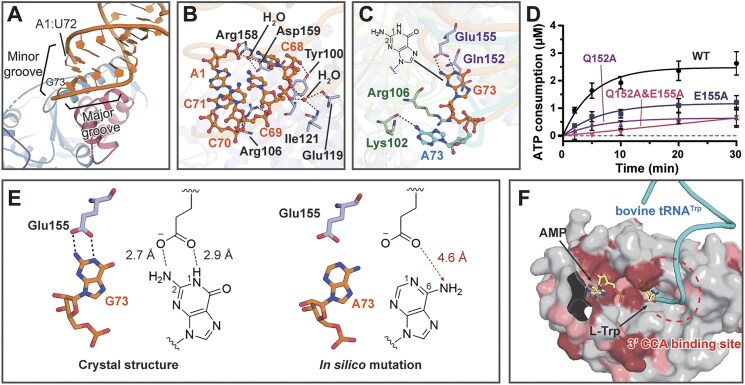
Tryptophanyl-tRNA synthetase (TrpRS) catalyzes the attachment of tryptophan (l-Trp) to tRNATrp, thereby providing the ribosome with a crucial substrate for the decoding of the UGG codon during protein translation. Both bacterial and eukaryotic TrpRSs are unable to efficiently cross-aminoacylate their respective tRNATrp substrates, indicating the evolution of lineage-specific mechanisms for tRNATrp recognition. Herein, we present the first co-crystal structure of bacterial TrpRS from Escherichia coli (EcTrpRS) in complex with its tRNATrp. EcTrpRS demonstrates bacterial-specific interactions with both the anticodon triplet and the acceptor arm of tRNATrp. Particularly, the bacterial-specific residue Glu155 forms hydrogen bonds with the discriminator base G73, thereby stabilizing it in a conformation distinct from that of A73 in the eukaryotic tRNATrp bound to human TrpRS. Through compound screening, we identified tirabrutinib and its analogues as selective inhibitors of bacterial TrpRS. These compounds occupy the l-Trp and tRNATrp CCA end binding sites of bacterial TrpRS, both of which exhibit less conservation compared to the ATP binding site between bacterial and eukaryotic TrpRSs. These findings enhance our understanding of the lineage-specific recognition of tRNATrp by bacterial TrpRS and highlight the CCA end binding site as a promising target for the future development of selective bacterial TrpRS inhibitors as potential antimicrobials.
色氨酰 - tRNA合成酶(TrpRS)催化色氨酸(l - Trp)与tRNATrp连接,从而为核糖体提供关键底物,以便在蛋白质翻译过程中对UGG密码子进行解码。细菌和真核生物的TrpRS均无法有效地对各自的tRNATrp底物进行交叉氨酰化,这表明存在tRNATrp识别的谱系特异性机制。在此,我们展示了来自大肠杆菌(EcTrpRS)的细菌TrpRS与其tRNATrp复合物的首个共晶体结构。EcTrpRS与tRNATrp的反密码子三联体和受体臂均表现出细菌特异性相互作用。特别地,细菌特异性残基Glu155与判别碱基G73形成氢键,从而将其稳定在与结合于人TrpRS的真核生物tRNATrp中的A不同的构象中。通过化合物筛选,我们鉴定出替拉鲁替尼及其类似物为细菌TrpRS的选择性抑制剂。这些化合物占据细菌TrpRS的l - Trp和tRNATrp CCA末端结合位点,与细菌和真核生物TrpRS之间的ATP结合位点相比,这两个位点的保守性较低。这些发现加深了我们对细菌TrpRS对tRNATrp的谱系特异性识别的理解,并突出了CCA末端结合位点作为未来开发选择性细菌TrpRS抑制剂作为潜在抗菌剂的有前景的靶点。