Czerniewska Alexandra, Brimicombe Chloe, Saez Reale Alejandro, Shumake-Guillemot Joy, Sharkey Alyssa, Portela Anayda
Health Equity and Human Rights LLC, Princeton, USA.
Wegener Center for Climate and Global Change, University of Graz, Graz, Austria.
J Glob Health. 2025 Jun 6;15:04157. doi: 10.7189/jogh.15.04157.
Newborns, children, and pregnant and postpartum populations are among the most at risk from exposure to extreme heat. Heat Health Action Plans (HHAPs) are promoted by the World Health Organization to manage public health risks of heat. Still, limited research exists on how well current HHAPs address the needs of women and children in the context of increasingly frequent heat events.
We identified national and subnational HHAPs published between January 2004 and July 2024 using various search channels. We extracted content to assess whether and how HHAPs included actions and indicators related to pregnant, postpartum, or breastfeeding individuals; newborns; and children.
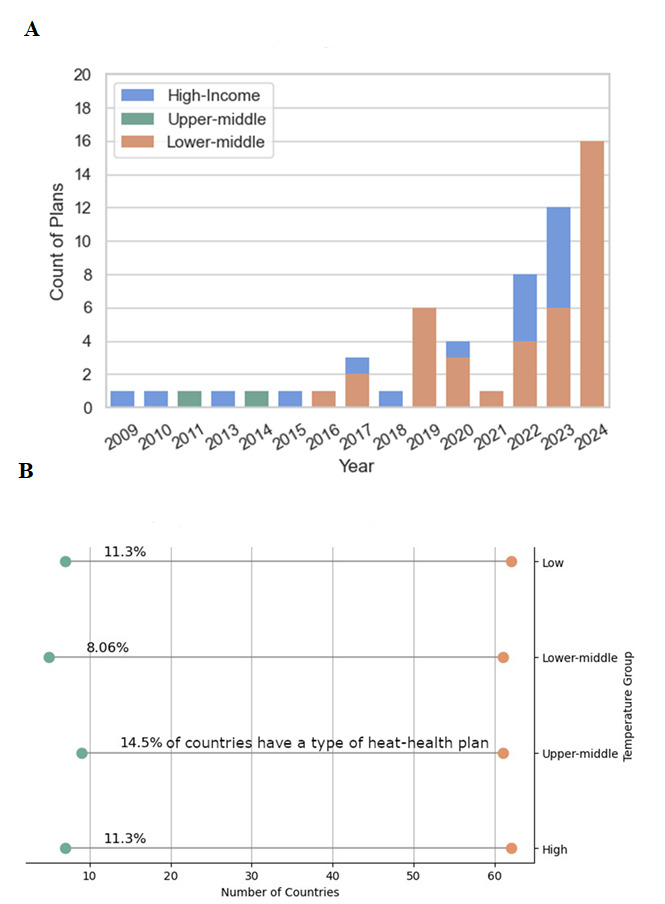
We identified 83 eligible HHAPs from 24 countries, predominantly from high-income (49%) or lower-middle-income (47%) economies, with none from low-income economies. Most HHAPs identified children as a key population to protect (83%), with fewer naming pregnant individuals (52%). Even fewer mentioned newborns (39%) or postpartum and breastfeeding individuals (14%) as at-risk groups. We identified five broad activity categories targeting maternal, newborn, and child health (MNCH), with 'informing, education, and awareness raising' (77%) and 'improving care in health services or school settings' (59%) being the most common. However, no HHAP comprehensively addressed MNCH risks during extreme heat, and monitoring mechanisms were inadequate for assessing the impact of heat on MNCH.
This is the first review mapping MNCH content in HHAPs. Comprehensive action plans must incorporate targeted strategies for at-risk MNCH populations to ensure equitable health outcomes during heat events. While many HHAPs focus on behaviour change messages, structural and policy changes are needed to build broader resilience. Strengthened in-country monitoring mechanisms and global support for better documentation are essential to build an evidence base.
新生儿、儿童以及孕妇和产后人群是遭受极端高温影响风险最高的群体。世界卫生组织推广了热健康行动计划(HHAPs)来管理高温带来的公共卫生风险。然而,在高温事件日益频繁的背景下,关于当前的热健康行动计划如何满足妇女和儿童需求的研究仍然有限。
我们通过各种搜索渠道,确定了2004年1月至2024年7月期间发布的国家和次国家级热健康行动计划。我们提取了相关内容,以评估热健康行动计划是否以及如何纳入与孕妇、产后或哺乳期个体、新生儿和儿童相关的行动和指标。
我们从24个国家确定了83项符合条件的热健康行动计划,这些国家主要来自高收入(49%)或中低收入(47%)经济体,没有来自低收入经济体的。大多数热健康行动计划将儿童确定为需要保护的关键人群(83%),提及孕妇个体的较少(52%)。更少的热健康行动计划将新生儿(39%)或产后和哺乳期个体(14%)列为高危人群。我们确定了针对孕产妇、新生儿和儿童健康(MNCH)的五大类活动,其中“宣传、教育和提高认识”(77%)和“改善卫生服务或学校环境中的护理”(59%)最为常见。然而,没有一个热健康行动计划全面解决极端高温期间的孕产妇、新生儿和儿童健康风险,监测机制也不足以评估高温对孕产妇、新生儿和儿童健康的影响。
这是首次对热健康行动计划中孕产妇、新生儿和儿童健康内容进行梳理的综述。全面的行动计划必须纳入针对高危孕产妇、新生儿和儿童人群的有针对性战略,以确保高温事件期间的公平健康结果。虽然许多热健康行动计划侧重于行为改变信息,但需要进行结构和政策变革以建立更广泛的复原力。加强国内监测机制以及全球对更好记录的支持对于建立证据基础至关重要。