Carayannis Elias G, Morawska-Jancelewicz Joanna
School of Business, Department of Information Systems and Technology Management, George Washington University, Washington, DC USA.
Faculty of Human Geography and Planning, Adam Mickiewicz University, Poznan, Poland.
J Knowl Econ. 2022;13(4):3445-3471. doi: 10.1007/s13132-021-00854-2. Epub 2022 Jan 5.
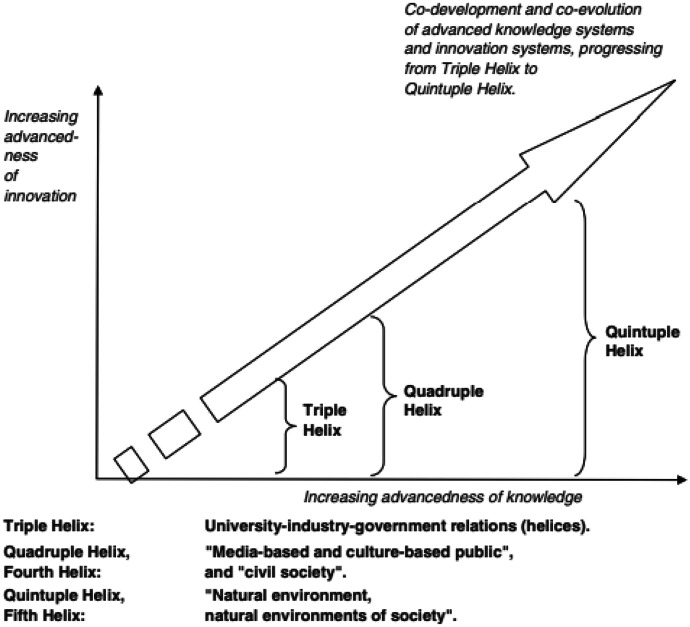
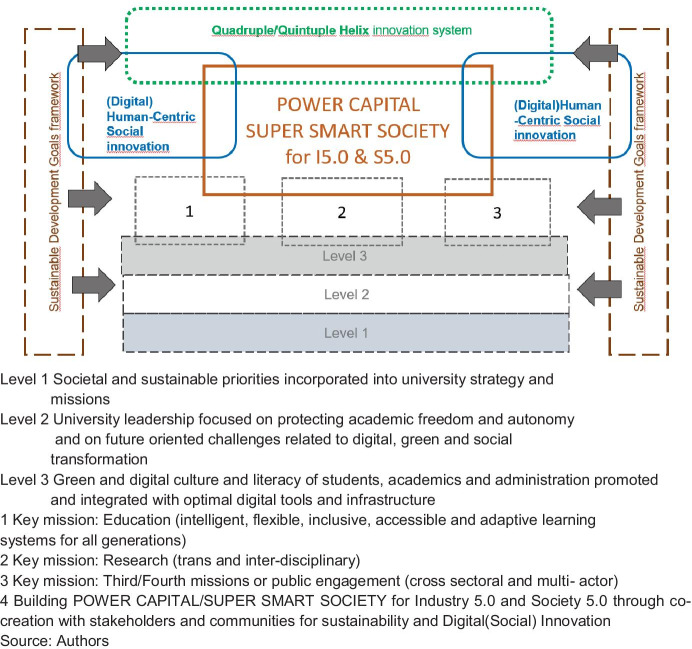
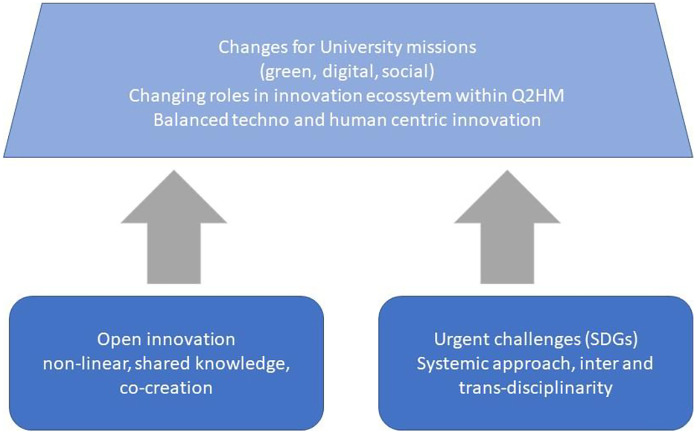
The concept of Society 5.0 and Industry 5.0 is not a simple chronological continuation or alternative to Industry 4.0 paradigm. Society 5.0 aims to place human beings at the midpoint of innovation, exploiting the impact of technology and Industry 4.0 results with the technological integration to improve quality of life, social responsibility and sustainability. This ground-breaking perspective has common points with the objectives of the United Nations Sustainable Development Goals. It also has major implication for universities transformations. Universities are called upon producing knowledge for new technologies and social innovation. In our paper, we argue that digitalisation opens new perspectives for universities and can become one of the main drivers of their change. Incorporating the assumptions of Society 5.0 and Industry 5.0 into the universities practices and policies will allow both universities and societies to fully benefit from digital transformation. Making the human-oriented innovation as the universities trademark and developing new cooperative models will also help to achieve sustainable priorities. The use of the Quintuple Helix Model (QHM) might foster the process of necessary transformations capacities as it integrates different perspectives and sets the stage for sustainability priorities and considerations. As far as the practical goal is concerned, the paper proposes a set of recommendations for universities aiming at developing new forms and channels of distribution of education, research and innovation within in the context of QHM and Society 5.0. We call them socially and digitally engaged model.
社会5.0和工业5.0的概念并非是工业4.0范式简单的时间延续或替代方案。社会5.0旨在将人类置于创新的中心位置,利用技术的影响以及工业4.0的成果,通过技术整合来提高生活质量、社会责任和可持续性。这一开创性的观点与联合国可持续发展目标的宗旨有共同之处。它对大学转型也具有重大意义。大学被要求为新技术和社会创新创造知识。在我们的论文中,我们认为数字化为大学开启了新的视野,并可能成为其变革的主要驱动力之一。将社会5.0和工业5.0的设想纳入大学的实践和政策中,将使大学和社会都能充分受益于数字化转型。将以人为本的创新作为大学的标志并开发新的合作模式,也将有助于实现可持续发展的优先事项。采用五元螺旋模型(QHM)可能会促进必要的转型能力的提升,因为它整合了不同的观点,并为可持续发展的优先事项和考量奠定了基础。就实际目标而言,本文针对大学提出了一系列建议,旨在在QHM和社会5.0的背景下开发教育、研究和创新的新形式和传播渠道。我们将其称为社会与数字参与模式。