Tang Hao, Yu Juan, Lin Borong, Geng Yang, Wang Zhe, Chen Xi, Yang Li, Lin Tianshu, Xiao Feng
School of Architecture, Tsinghua University, Beijing, China.
Key Laboratory of Eco Planning & Green Building, Ministry of Education, Tsinghua University, Beijing, China.
J Build Eng. 2023 Apr 15;65:105740. doi: 10.1016/j.jobe.2022.105740. Epub 2022 Dec 13.
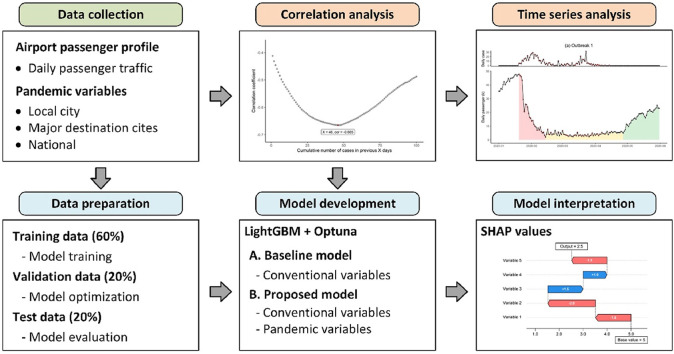
Passengers significantly affect airport terminal energy consumption and indoor environmental quality. Accurate passenger forecasting provides important insights for airport terminals to optimize their operation and management. However, the COVID-19 pandemic has greatly increased the uncertainty in airport passenger since 2020. There are insufficient studies to investigate which pandemic-related variables should be considered in forecasting airport passenger trends under the impact of COVID-19 outbreaks. In this study, the interrelationship between COVID-19 pandemic trends and passenger traffic at a major airport terminal in China was analyzed on a day-by-day basis. During COVID-19 outbreaks, three stages of passenger change were identified and characterized, i.e., the decline stage, the stabilization stage, and the recovery stage. A typical "sudden drop and slow recovery" pattern of passenger traffic was identified. A LightGBM model including pandemic variables was developed to forecast short-term daily passenger traffic at the airport terminal. The SHapley Additive exPlanations (SHAP) values was used to quantify the contribution of input pandemic variables. Results indicated the inclusion of pandemic variables reduced the model error by 27.7% compared to a baseline model. The cumulative numbers of COVID-19 cases in previous weeks were found to be stronger predictors of future passenger traffic than daily COVID-19 cases in the most recent week. In addition, the impact of pandemic control policies and passengers' travel behavior was discussed. Our empirical findings provide important implications for airport terminal operations in response to the on-going COVID-19 pandemic.
乘客对机场航站楼的能源消耗和室内环境质量有重大影响。准确的乘客流量预测为机场航站楼优化运营和管理提供了重要见解。然而,自2020年以来,新冠疫情极大地增加了机场客流量的不确定性。目前尚缺乏足够的研究来调查在新冠疫情爆发的影响下,预测机场客流量趋势时应考虑哪些与疫情相关的变量。在本研究中,我们逐日分析了中国一个主要机场航站楼的新冠疫情趋势与客流量之间的相互关系。在新冠疫情爆发期间,确定并描述了乘客变化的三个阶段,即下降阶段、稳定阶段和恢复阶段。确定了一种典型的客流量“突然下降和缓慢恢复”模式。开发了一个包含疫情变量的LightGBM模型来预测机场航站楼的短期每日客流量。使用SHapley加性解释(SHAP)值来量化输入疫情变量的贡献。结果表明,与基线模型相比,纳入疫情变量使模型误差降低了27.7%。研究发现,前几周的新冠病例累计数比最近一周的每日新冠病例数更能预测未来的客流量。此外,还讨论了疫情防控政策和乘客出行行为的影响。我们的实证研究结果为机场航站楼应对当前的新冠疫情提供了重要启示。