Hall Naomi M, Dickens Danielle D, Minor Kelly A, Thomas Zharia, Mitchell Cheyane, Johnson Nailah
Department of Psychological Sciences, Winston-Salem State University, NC, USA.
Department of Psychology, Spelman College, Atlanta, GA, USA.
Womens Health (Lond). 2025 Jan-Dec;21:17455057251335358. doi: 10.1177/17455057251335358. Epub 2025 Jun 7.
Black women, relative to their Black male and White counterparts, may be more prone to experiencing racism and sexism in academic and other professional settings due to the "double jeopardy" or stigma of being both Black and a woman. Few studies have quantitatively studied how Black women in academic and professional spaces may mitigate the oppressive circumstances experienced by engaging in a coping strategy called identity shifting.
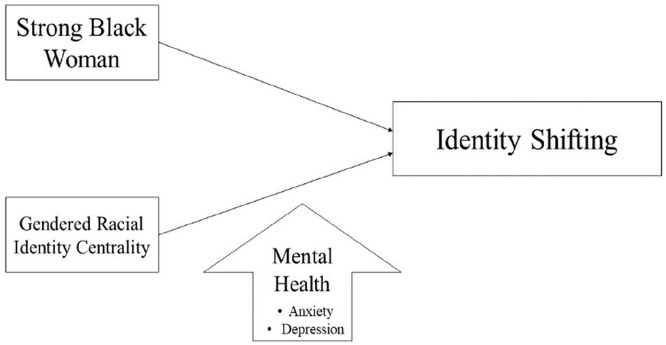
This study used an intersectional framework to investigate the relationships between the strong Black woman (SBW) stereotype, gendered racial identity centrality (GRIC), identity shifting, and mental health outcomes among 289 Black women ( = 29.46 years, SD = 10.74). It was hypothesized that there was a significant positive relationship between endorsement of the SBW schema, GRIC, and identity shifting. Additionally, we hypothesized the relationship between SBW and identity shifting is moderated by mental health such that more (a) depressive (b) and anxiety symptoms will result in a stronger relationship between stereotype endorsement and identity shifting strategies.
This study employed a quantitative, cross-sectional design using data collected in 2019 and 2020 from a larger validation study.
Participants were recruited through emails, campus flyers, text messages, and social media postings. After providing informed consent, participants completed a 30- to 40-min online survey via Qualtrics.
There was partial support for the first hypothesis. While greater endorsement of the SBW stereotype by Black women did result in engagement with more identity shifting strategies, the relationship between these strategies and GRIC was not significant. The second hypothesis was not supported as mental health variables did not moderate the relationship between SBW and identity shifting.
The importance of examining the gendered racial experiences of Black women is discussed, along with the importance of addressing SBW and identity shifting in academia and in professional workspaces.
相对于黑人男性和白人女性,黑人女性可能因身为黑人且为女性的“双重困境”或污名,在学术及其他专业环境中更容易遭受种族主义和性别歧视。很少有研究定量探讨学术和专业领域的黑人女性如何通过一种名为身份转变的应对策略来缓解所经历的压迫性环境。
本研究采用交叉性框架,调查289名黑人女性(年龄 = 29.46岁,标准差 = 10.74)中,强大黑人女性(SBW)刻板印象、性别化种族身份中心性(GRIC)、身份转变和心理健康结果之间的关系。研究假设SBW模式认同、GRIC和身份转变之间存在显著正相关。此外,我们假设SBW与身份转变之间的关系受到心理健康的调节,即更多的(a)抑郁(b)和焦虑症状会导致刻板印象认同与身份转变策略之间的关系更强。
本研究采用定量横断面设计,使用2019年和2020年从一项更大的验证性研究中收集的数据。
通过电子邮件、校园传单、短信和社交媒体帖子招募参与者。在获得知情同意后,参与者通过Qualtrics完成了一项30至40分钟的在线调查。
第一个假设得到部分支持。虽然黑人女性对SBW刻板印象的更多认同确实导致她们采用更多身份转变策略,但这些策略与GRIC之间的关系并不显著。第二个假设未得到支持,因为心理健康变量并未调节SBW与身份转变之间的关系。
讨论了审视黑人女性性别化种族经历的重要性,以及在学术界和专业工作场所应对SBW和身份转变的重要性。