Wu Liang, Cheng Can, Zhao Ning, Zhu Liang, Li Heng, Liu Jingwen, Wu Yang, Chen Xi, Yao Hanhui, Liu Lianxin
Department of Gastrointestinal Surgery, the First Affiliated Hospital of USTC, Division of Life Sciences and Medicine, University of Science and Technology of China, Anhui Province Key Laboratory of Hepatopancreatobiliary Surgery, Hefei 230001, China.
Department of Vascular Surgery, the First Affiliated Hospital of USTC, Division of Life Sciences and Medicine, University of Science and Technology of China, Anhui Province Key Laboratory of Hepatopancreatobiliary Surgery, Hefei 230001, China.
Acta Pharm Sin B. 2025 Apr;15(4):1938-1955. doi: 10.1016/j.apsb.2025.02.014. Epub 2025 Feb 18.
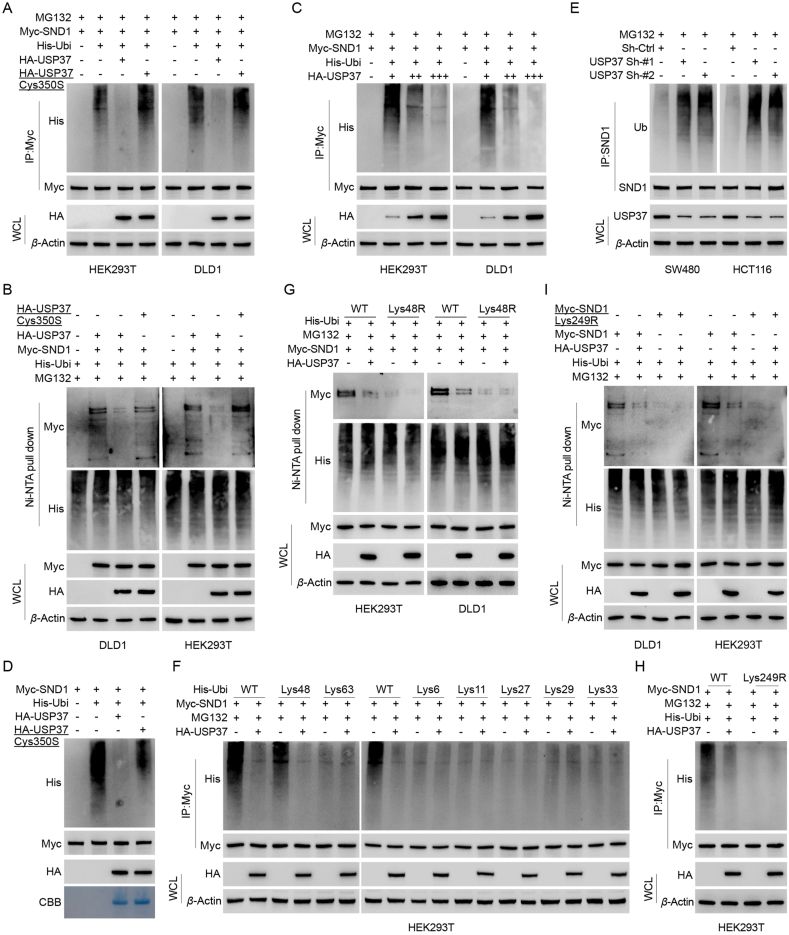
Colorectal cancer (CRC) poses a severe global health challenge with high incidence and mortality rates. USP37 has been identified as the bona fide deubiquitinase of SND1, playing a critical role in stabilizing SND1, thereby augmenting its oncogenic potential. The interaction between USP37 and SND1 was confirmed through extensive proteomics, ubiquitinomics, and interactomics, underscoring their synergistic effects on CRC proliferation and metastasis. Additionally, CDK1 has emerged as a pivotal regulator of USP37, phosphorylating it at threonine 631 rather than serine 628, enhancing its deubiquitinase activity, and consequently stabilizing SND1 to drive CRC malignancy further. Histological analyses of human CRC samples linked the upregulation of CDK1 and USP37 with increased SND1 levels and poor patient prognosis. High-throughput virtual screening and subsequent experimental validation identified Dacarbazine as a pharmacological inhibitor of USP37, and its inhibition disrupted SND1 stability, hindering CRC cell proliferation and metastasis. This study reveals a novel and promising molecular mechanism driving CRC progression through the CDK1-USP37-SND1 axis, highlighting the clinical importance of targeting this pathway to improve patient outcomes.
结直肠癌(CRC)因其高发病率和死亡率对全球健康构成了严峻挑战。USP37已被确定为SND1真正的去泛素化酶,在稳定SND1方面发挥关键作用,从而增强其致癌潜力。通过广泛的蛋白质组学、泛素组学和相互作用组学证实了USP37与SND1之间的相互作用,突出了它们对CRC增殖和转移的协同作用。此外,CDK1已成为USP37的关键调节因子,在苏氨酸631而非丝氨酸628处使其磷酸化,增强其去泛素化酶活性,进而稳定SND1以进一步推动CRC的恶性发展。对人类CRC样本的组织学分析表明,CDK1和USP37的上调与SND1水平升高及患者预后不良相关。高通量虚拟筛选及随后的实验验证确定达卡巴嗪为USP37的一种药理抑制剂,其抑制作用破坏了SND1的稳定性,阻碍了CRC细胞的增殖和转移。本研究揭示了一种通过CDK1-USP37-SND1轴驱动CRC进展的新的且有前景的分子机制,突出了靶向该途径以改善患者预后的临床重要性。