Reiter Noushka, Dimon Richard, Bohman Björn, Batley Michael, McLachlan Alex, Woodward John, Phillips Ryan D
Royal Botanic Gardens Victoria, Science Division, Cranbourne, VIC, Australia.
Department of Ecological, Plant and Animal Sciences, and Research Centre for Future Landscapes, La Trobe University, Melbourne, VIC, Australia.
Front Plant Sci. 2025 May 23;16:1566543. doi: 10.3389/fpls.2025.1566543. eCollection 2025.
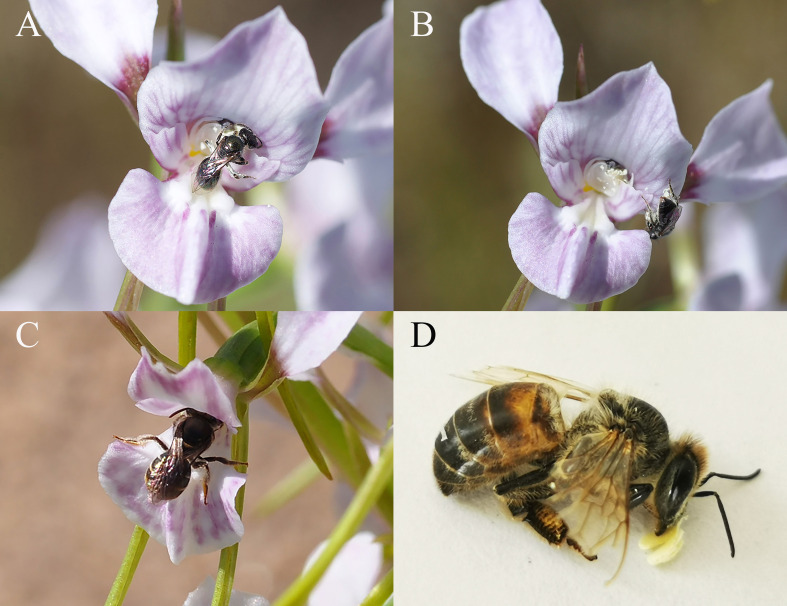
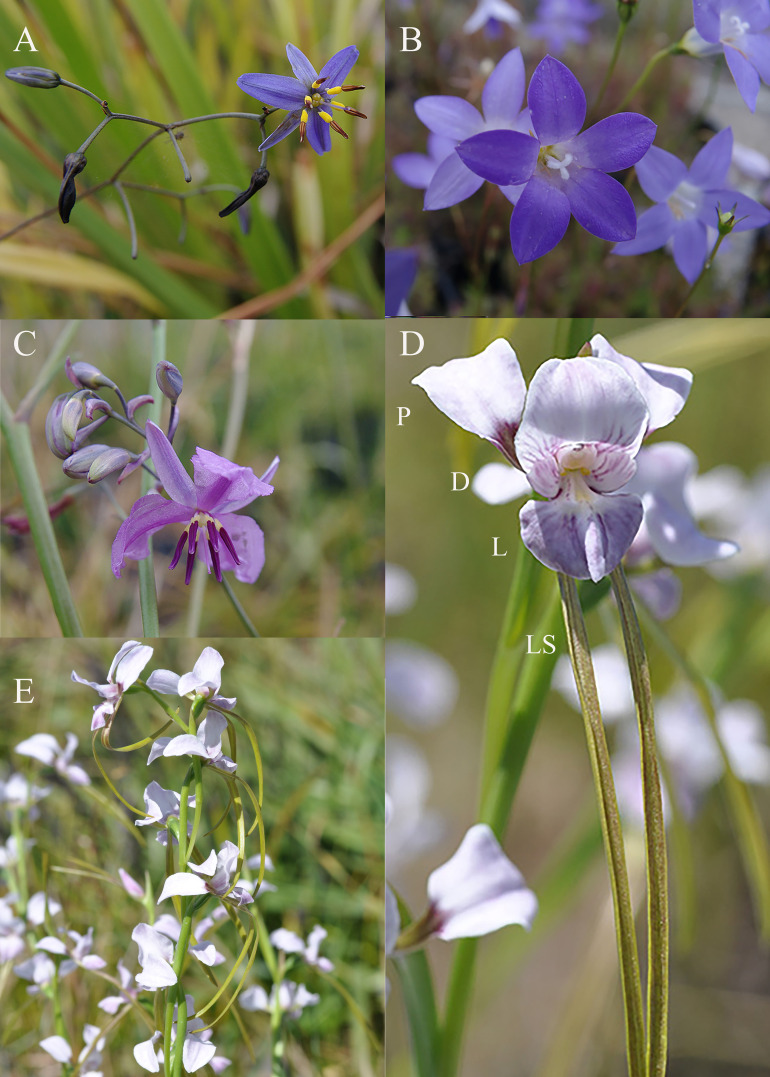
In many geographic regions grasslands have been heavily cleared and degraded, which represents a challenge for translocating threatened flora back into these landscapes. As most plant species require animals for pollination, pollinators are potentially a key limitation for re-establishing populations. For the Critically Endangered orchid , we identify the pollinator(s), survey for pollinators at candidate translocation sites, test if remnant size affects bee species richness, and test if pollination rates can be enhanced through co-planting with rewarding plant species. We found that is visited by ten species of bee but is only effectively pollinated by two native species, sp. (Halictidae) and (Halictidae), and the introduced honeybee (Apidae). Interestingly, was responsible for the greatest number of pollinia removals and depositions. Pollinators of were not detected at some candidate translocation sites, with bee species richness and overall abundance significantly increasing with grassland remnant size. The pollination of was significantly enhanced through the presence of (Campanulaceae) within 30 cm of plants, but not (Asparagaceae) or (Asphodelaceae). We recommend that prior to conservation translocations of that pollinator surveys are undertaken, with preference given to larger grassland remnants. may serve to buffer against loss of native pollinators from remnant grassland but could have adverse effects on other native species. We show that co-planting with rewarding species may be an effective approach for improving pollination success of threatened orchids.
在许多地理区域,草原已被大量开垦和退化,这对将受威胁植物重新引入这些景观构成了挑战。由于大多数植物物种需要动物进行授粉,传粉者可能是种群重建的关键限制因素。对于极度濒危的兰花,我们确定其传粉者,在候选重新引入地点调查传粉者,测试残余面积是否影响蜜蜂物种丰富度,并测试通过与有回报的植物物种混种是否可以提高授粉率。我们发现有10种蜜蜂会拜访该兰花,但只有两种本地物种能有效为其授粉,即Halictidae科的某种蜜蜂和Halictidae科的另一种蜜蜂,以及引入的蜜蜂(蜜蜂科)。有趣的是,引入的蜜蜂导致的花粉块移除和沉积数量最多。在一些候选重新引入地点未检测到该兰花的传粉者,蜜蜂物种丰富度和总体丰度随草原残余面积显著增加。在植株30厘米范围内存在风铃草科植物时,该兰花的授粉显著增强,但天门冬科或日光兰科植物则无此效果。我们建议在对该兰花进行保护重新引入之前,先进行传粉者调查,优先选择较大的草原残余地。引入的蜜蜂可能有助于缓冲该兰花免受残余草原本地传粉者损失的影响,但可能对其他本地物种产生不利影响。我们表明,与有回报的物种混种可能是提高受威胁兰花授粉成功率的有效方法。