Jimenez Carlos, Verhagen Evert
Amsterdam Collaboration on Health and Safety in Sports, Department of Public and Occupational Health, Amsterdam Movement Sciences, Amsterdam UMC, Amsterdam, The Netherlands.
Medical & Anti-Doping Unit, Football Division, UEFA, Nyon, Switzerland.
BMJ Open Sport Exerc Med. 2025 Jun 3;11(2):e002479. doi: 10.1136/bmjsem-2025-002479. eCollection 2025.
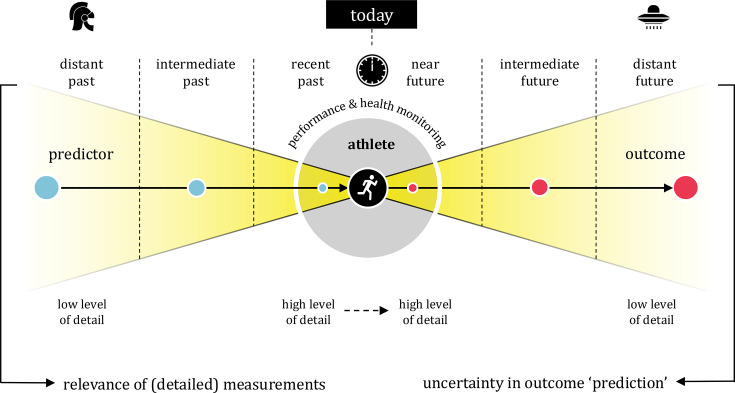
Injury prevention and performance optimisation in sports are evolving from generic strategies to more personalised, timely and data-informed approaches. Traditional systems often rely on infrequent assessments and binary classifications of injury, which fail to reflect the complexity of athlete health. This perspective advocates for a refined approach to athlete screening and monitoring that captures historical and real-time data to support precise, context-driven decisions. We differentiate between screening as a point-in-time evaluation of underlying risk and monitoring as the continuous assessment of an athlete's changing condition. The key principles of this approach include using valid, outcome-specific measures, timely data collection close to decision points and seamless integration into daily practice. By moving beyond simplistic metrics and incorporating advanced analytical techniques, this approach offers a more nuanced and proactive way to manage athlete health. It bridges the gap between research and real-world application, supporting better decision-making and long-term performance outcomes.
运动中的损伤预防和表现优化正在从通用策略向更个性化、及时且基于数据的方法演变。传统系统通常依赖于不频繁的评估和损伤的二元分类,这无法反映运动员健康的复杂性。这种观点倡导采用一种改进的运动员筛查和监测方法,该方法可获取历史和实时数据,以支持精确的、基于具体情况的决策。我们区分筛查(作为对潜在风险的即时评估)和监测(作为对运动员不断变化状况的持续评估)。这种方法的关键原则包括使用有效的、针对特定结果的测量方法,在接近决策点时及时收集数据,并无缝融入日常实践。通过超越简单的指标并纳入先进的分析技术,这种方法提供了一种更细致入微且积极主动的方式来管理运动员健康。它弥合了研究与实际应用之间的差距,支持更好的决策制定和长期表现结果。