Revêchon Gwladys, Witasp Anna, Viceconte Nikenza, Helgadottir Hafdis T, Machtel Piotr, Stefani Fabiana, Whisenant Daniel, Sola-Carvajal Agustin, McGuinness Dagmara, Abutaleb Nadia O, Artiach Gonzalo, Arzt Emelie Wallén, Soveri Inga, Babler Anne, Ziegler Susanne, Kramann Rafael, Bäck Magnus, Thorell Anders, Truskey George A, Wennberg Lars, Shiels Paul G, Wernerson Annika, Stenvinkel Peter, Eriksson Maria
Department of Medicine, Huddinge, Karolinska Institutet, Huddinge, Sweden.
Department of Clinical Science, Intervention and Technology, Division of Renal Medicine, Karolinska Institutet, Stockholm, Sweden.
Nat Aging. 2025 Jun;5(6):1046-1062. doi: 10.1038/s43587-025-00882-6. Epub 2025 Jun 10.
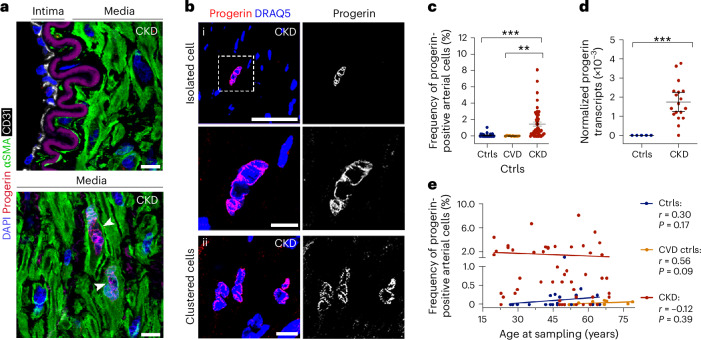
Early vascular aging plays a central role in chronic kidney disease (CKD), but its molecular causes remain unclear. Somatic mutations accumulate in various cells with age, yet their functional contribution to aging tissues is not well understood. Here we found progerin, the protein responsible for the premature aging disease Hutchinson-Gilford progeria syndrome, steadily recurring in vascular smooth muscle cells of patients with CKD. Notably, the most common progeria-causing mutation, LMNA c.1824C>T, was identified as a somatic mutation in CKD arteries. Clusters of proliferative progerin-expressing cells in CKD arteries and in vivo lineage-tracing in mice revealed clonal expansion capacity of mutant cells. Mosaic progerin expression contributed to genomic damage, endoplasmic reticulum stress and senescence in CKD arteries and resulted in vascular aging phenotypes in vivo. These findings suggest that certain somatic mutations may be clonally expanded in the arterial wall, contributing to the disease-related functional decline of the tissue.
早期血管衰老在慢性肾脏病(CKD)中起核心作用,但其分子病因仍不清楚。随着年龄增长,体细胞突变在各种细胞中积累,然而它们对衰老组织的功能贡献尚未得到充分了解。在这里,我们发现早老素(一种导致早衰疾病哈钦森 - 吉尔福德早衰综合征的蛋白质)在CKD患者的血管平滑肌细胞中持续稳定出现。值得注意的是,最常见的导致早衰的突变LMNA c.1824C>T被鉴定为CKD动脉中的体细胞突变。CKD动脉中表达早老素的增殖细胞簇以及小鼠体内谱系追踪揭示了突变细胞的克隆扩增能力。镶嵌式早老素表达导致CKD动脉中的基因组损伤、内质网应激和衰老,并在体内导致血管衰老表型。这些发现表明,某些体细胞突变可能在动脉壁中发生克隆扩增,导致与疾病相关的组织功能衰退。