Ichikawa Takahiro, Okada Hiroshi, Hamaguchi Masahide, Hara Megumi, Takashima Naoyuki, Suzuki Sadao, Tanoue Shiroh, Kato Yasufumi, Nagayoshi Mako, Tamura Takashi, Fukui Michiaki, Matsuo Keitaro
Department of Endocrinology and Metabolism, Graduate School of Medical Science, Kyoto Prefectural University of Medicine, 465 Kajii-cho, Kawaramachi-Hirokoji, Kamigyo-ku, Kyoto, 602-8566, Japan.
Department of Preventive Medicine, Faculty of Medicine, Saga University, 5-1-1 Nabeshima, Saga, 849-8501, Japan.
Lipids Health Dis. 2025 Jun 10;24(1):212. doi: 10.1186/s12944-025-02634-2.
In postmenopausal women, lower levels of sex hormone-binding globulin (SHBG) have been linked to various metabolic conditions. The association between SHBG levels and the presence of dyslipidemia was investigated in comparison with other sex hormones.
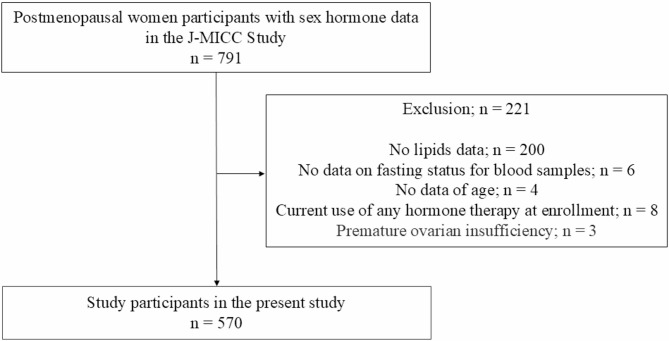
Data from 570 postmenopausal women were analyzed. To assess the relationship between circulating sex hormone concentrations and dyslipidemia, logistic regression and receiver operating characteristic (ROC) curve analyses were performed to assess the relationships.
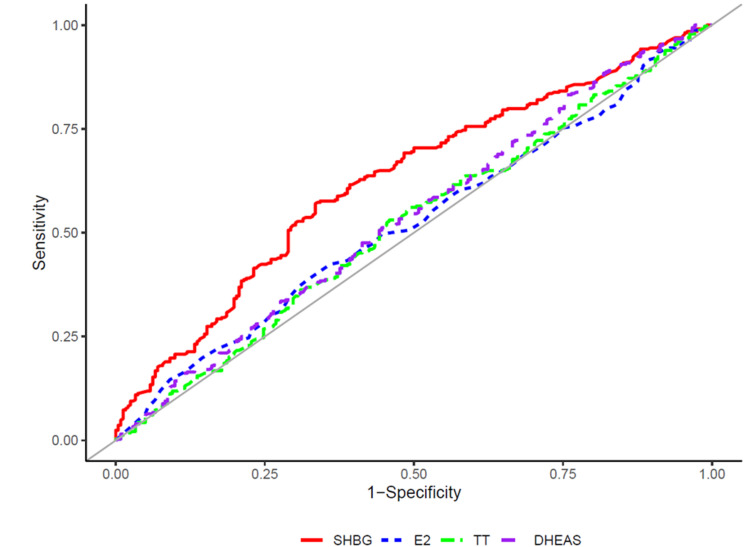
Participants had a median age of 51.0 years (49.0-53.0). The multivariate analysis revealed that SHBG levels were significantly associated with dyslipidemia. Specifically, low SHBG levels correlated with hypertriglyceridemia and low high-density lipoprotein levels. The area under the curve (AUC) and the optimal SHBG level cutoff value for identifying the presence of dyslipidemia were 0.626 and 69.0 nmol/L, respectively. The AUCs for SHBG levels were highest for estradiol (E2), total testosterone (TT) and dehydroepiandrosterone sulfate (DHEAS) levels.
SHBG levels were significantly associated with dyslipidemia in postmenopausal women and outperformed E2, TT, and DHEAS levels. These findings highlight SHBG as a potential biomarker for dyslipidemia risk in postmenopausal women, warranting further research into its prognostic utility.
在绝经后女性中,性激素结合球蛋白(SHBG)水平降低与多种代谢状况有关。与其他性激素相比,研究了SHBG水平与血脂异常之间的关联。
分析了570名绝经后女性的数据。为评估循环性激素浓度与血脂异常之间的关系,进行了逻辑回归和受试者工作特征(ROC)曲线分析。
参与者的中位年龄为51.0岁(49.0 - 53.0)。多变量分析显示,SHBG水平与血脂异常显著相关。具体而言,低SHBG水平与高甘油三酯血症和低高密度脂蛋白水平相关。识别血脂异常的曲线下面积(AUC)和最佳SHBG水平临界值分别为0.626和69.0 nmol/L。SHBG水平的AUC在雌二醇(E2)、总睾酮(TT)和硫酸脱氢表雄酮(DHEAS)水平中最高。
绝经后女性的SHBG水平与血脂异常显著相关,且优于E2、TT和DHEAS水平。这些发现突出了SHBG作为绝经后女性血脂异常风险潜在生物标志物的作用,值得进一步研究其预后效用。