Zuliani Carolina Coli, da Cunha Jéssica Bruna, de Souza Victor Marchiori, de Andrade Kleber Cursino, Moraes Ângela Maria, Coimbra Ibsen Bellini
Department of Orthopedics, Rheumatology and Traumatology, School of Medical Sciences, Universidade Estadual de Campinas (UNICAMP), Campinas, SP, Brazil.
Department of Gynecology and Obstetrics, School of Medical Sciences, Universidade Estadual de Campinas (UNICAMP), Campinas, SP, Brazil.
Future Sci OA. 2025 Dec;11(1):2476922. doi: 10.1080/20565623.2025.2476922. Epub 2025 Jun 11.
Articular cartilage injuries are challenging due to limited regenerative capacity, causing chronic pain and impaired mobility. Current treatments are often inadequate, necessitating novel cartilage repair approaches. This study investigates amniotic fluid-derived mesenchymal stromal cells (AF-MSC) as a promising cell source for tissue engineering.
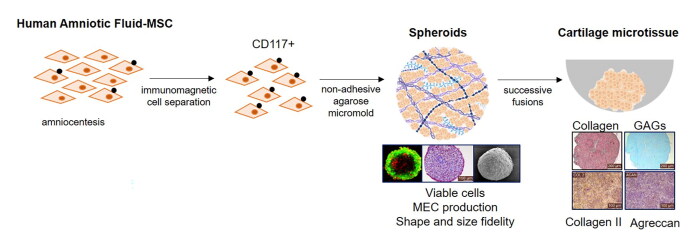
Cartilage-like microtissues were produced by differentiating AF-MSC into chondrocytes within a 3D culture system. Using a 3D-printed non-adhesive micromold, AF-MSC spheroids were formed and fused into larger microtissues. Spheroids were characterized for morphology, viability, and extracellular matrix (ECM) production. The mechanical properties of resulting microtissues were compared to native cartilage and agarose hydrogel.
AF-MSC proved a viable, scalable cell source for cartilage microtissues. Spheroid fusion created structures with mechanical properties and ECM components resembling native cartilage.
AF-MSCs differentiated into chondrocytes when stimulated with TGF-β3 in a 3D micromolded culture, forming uniform, viable spheroids with robust ECM production and mechanical properties. These spheroids fused into neocartilage microtissue, showing potential for regenerative medicine, especially osteoarthritis treatment and drug testing. Further research should optimize conditions and evaluate long-term biomechanical performance.
由于再生能力有限,关节软骨损伤具有挑战性,会导致慢性疼痛和活动能力受损。目前的治疗方法往往不足,因此需要新的软骨修复方法。本研究调查了羊水来源的间充质基质细胞(AF-MSC)作为一种有前景的组织工程细胞来源。
通过在三维培养系统中将AF-MSC分化为软骨细胞来制备类软骨微组织。使用3D打印的非粘性微模具,形成AF-MSC球体并融合成更大的微组织。对球体的形态、活力和细胞外基质(ECM)产生进行表征。将所得微组织的力学性能与天然软骨和琼脂糖水凝胶进行比较。
AF-MSC被证明是一种可行的、可扩展的软骨微组织细胞来源。球体融合产生的结构具有类似于天然软骨的力学性能和ECM成分。
在三维微模培养中用TGF-β3刺激时,AF-MSCs分化为软骨细胞,形成具有强大ECM产生和力学性能的均匀、有活力的球体。这些球体融合成新软骨微组织,显示出再生医学的潜力,特别是在骨关节炎治疗和药物测试方面。进一步的研究应优化条件并评估长期生物力学性能。