Lederer Alyssa M, Oswalt Sara B, Eddens Katherine S
Department of Applied Health Science, Indiana University School of Public Health-Bloomington, Bloomington, Indiana, United States of America.
Department of Public Health, University of Texas at San Antonio, San Antonio, Texas, United States of America.
PLoS One. 2025 Jun 11;20(6):e0323610. doi: 10.1371/journal.pone.0323610. eCollection 2025.
Behaviors associated with chronic disease can become habituated during young adulthood and may influence students' academic achievement, affecting their future health and economic prospects. However, more research is needed to understand this relationship. This study therefore examined the connection, both individually and collectively, between undergraduate students' chronic disease prevention behaviors and academic performance.
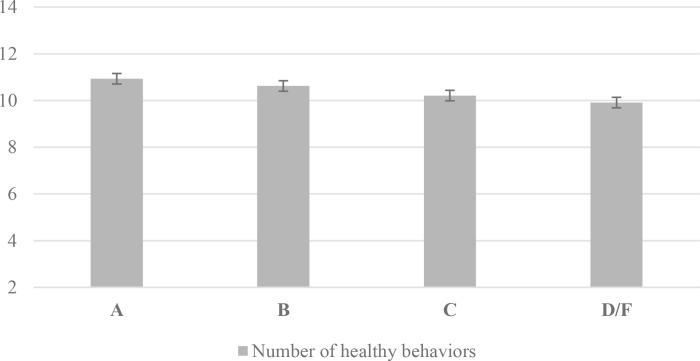
We examined the relationship between 14 positive health behaviors related to diet, physical activity, sedentary screen time, and tobacco product use and cumulative grade point average (GPA; A, B, C, D/F) using the Spring 2023 American College Health Association-National College Health Assessment III (N = 50,792 students; N = 125 institutions). Log binomial regressions produced adjusted prevalence ratios for performing each health behavior based on GPA, controlling for year in school, sex/gender, race/ethnicity, and BMI. A composite health index was also calculated, and multivariate negative binomial regression examined the health index score by GPA category.
Analyses found that A and B GPA categories were significantly different than D/F for all dietary behaviors, all physical activity behaviors, watching TV and gaming, and using vaping products. Students with a higher GPA had significantly more positive health behaviors based on the composite index than each proceeding GPA group.
This study found a relationship between students' academic achievement and engagement in positive behaviors that prevent or mitigate chronic disease and is the first to examine college students' health behaviors cumulatively. Initiatives that support college student well-being may benefit students' academic success as well as reduce chronic disease risk.
与慢性病相关的行为在青年期可能会形成习惯,并可能影响学生的学业成绩,进而影响他们未来的健康和经济前景。然而,需要更多的研究来了解这种关系。因此,本研究考察了本科生慢性病预防行为与学业成绩之间的个体和总体联系。
我们使用2023年春季美国大学健康协会-全国大学健康评估III(N = 50,792名学生;N = 125所院校),研究了与饮食、体育活动、久坐屏幕时间和烟草制品使用相关的14种积极健康行为与累积平均绩点(GPA;A、B、C、D/F)之间的关系。对数二项回归根据GPA得出了每种健康行为的调整患病率比值,并对在校年份、性别、种族/民族和BMI进行了控制。还计算了一个综合健康指数,并通过多元负二项回归按GPA类别检查了健康指数得分。
分析发现,在所有饮食行为、所有体育活动行为、看电视和玩游戏以及使用电子烟产品方面,A和B类GPA与D/F类有显著差异。根据综合指数,GPA较高学生的积极健康行为明显多于每个较低GPA组的学生。
本研究发现学生的学业成绩与参与预防或减轻慢性病的积极行为之间存在关联,并且是首个对大学生健康行为进行累积研究的。支持大学生福祉的举措可能有益于学生的学业成功,同时降低慢性病风险。