Trotta Caterina, Fraschini Giuseppe, Tacchi Elena, Tensi Leonardo, Zuccaccia Cristiano, Menendez Rodriguez Gabriel, Macchioni Alceo
Department of Chemistry, Biology and Biotechnology and CIRCC, University of Perugia, Via Elce di sotto 8, Perugia 06123, Italy.
Department of Chemical Sciences, University of Padova, Via Marzolo 1, Padova 35131, Italy.
ACS Catal. 2025 May 19;15(11):9417-9429. doi: 10.1021/acscatal.5c02162. eCollection 2025 Jun 6.
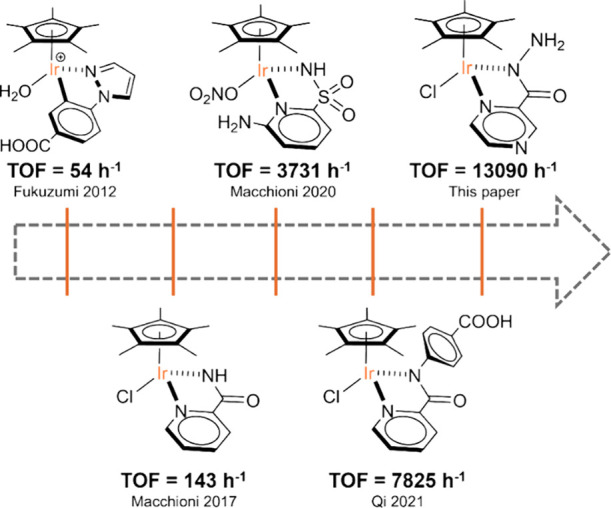
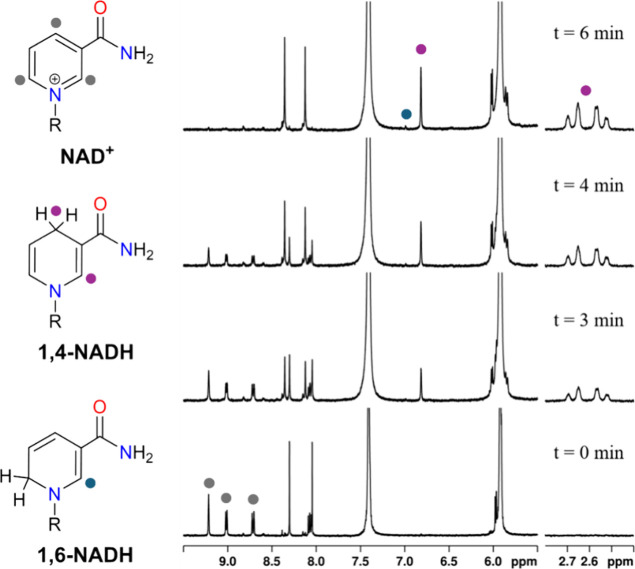
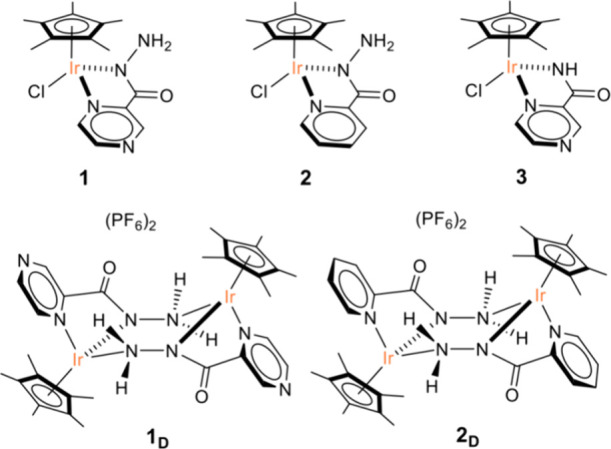
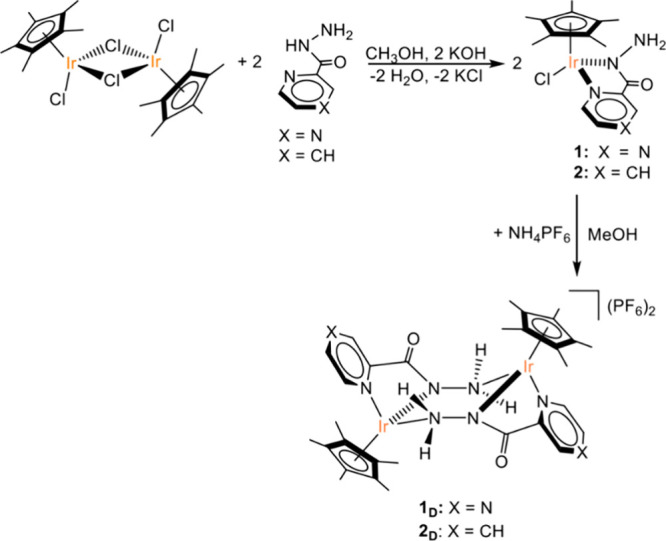
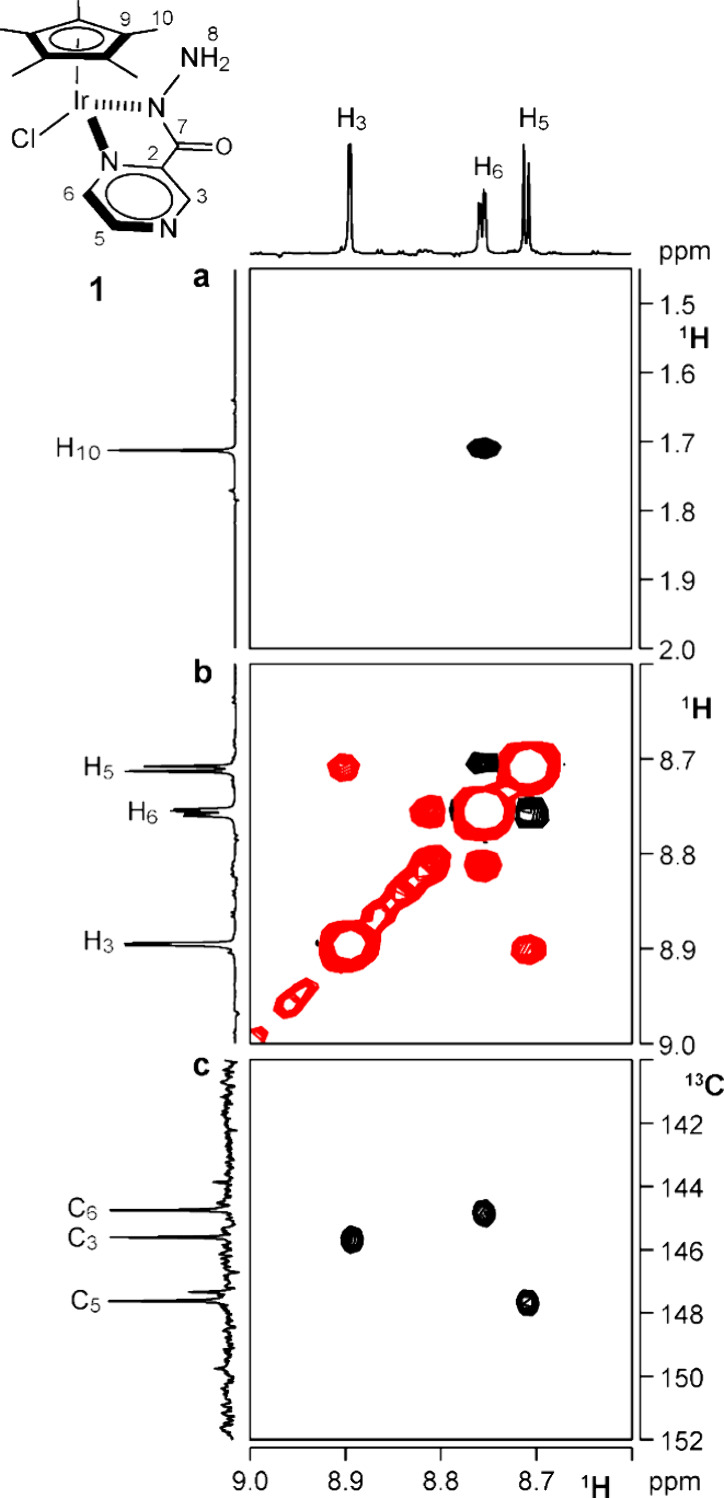
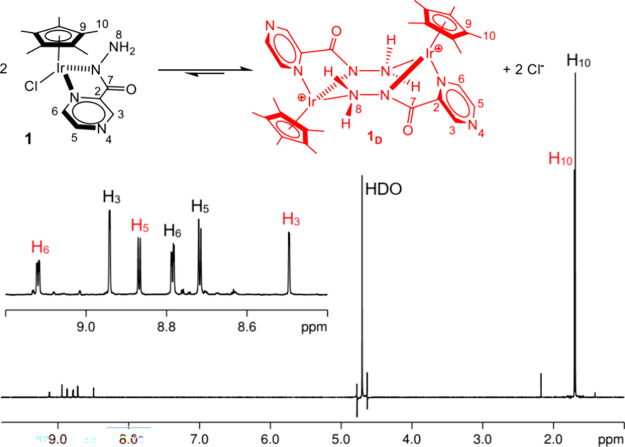
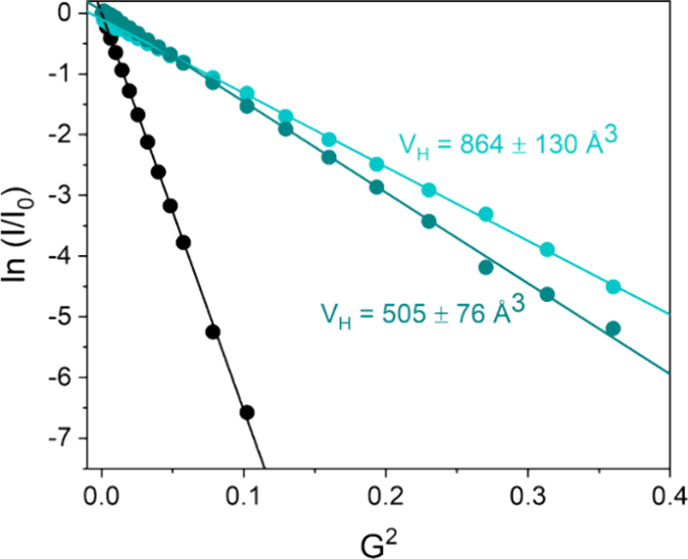
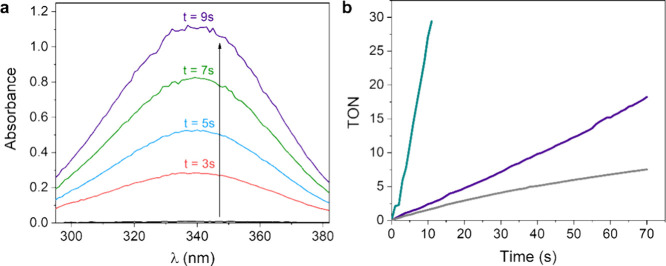
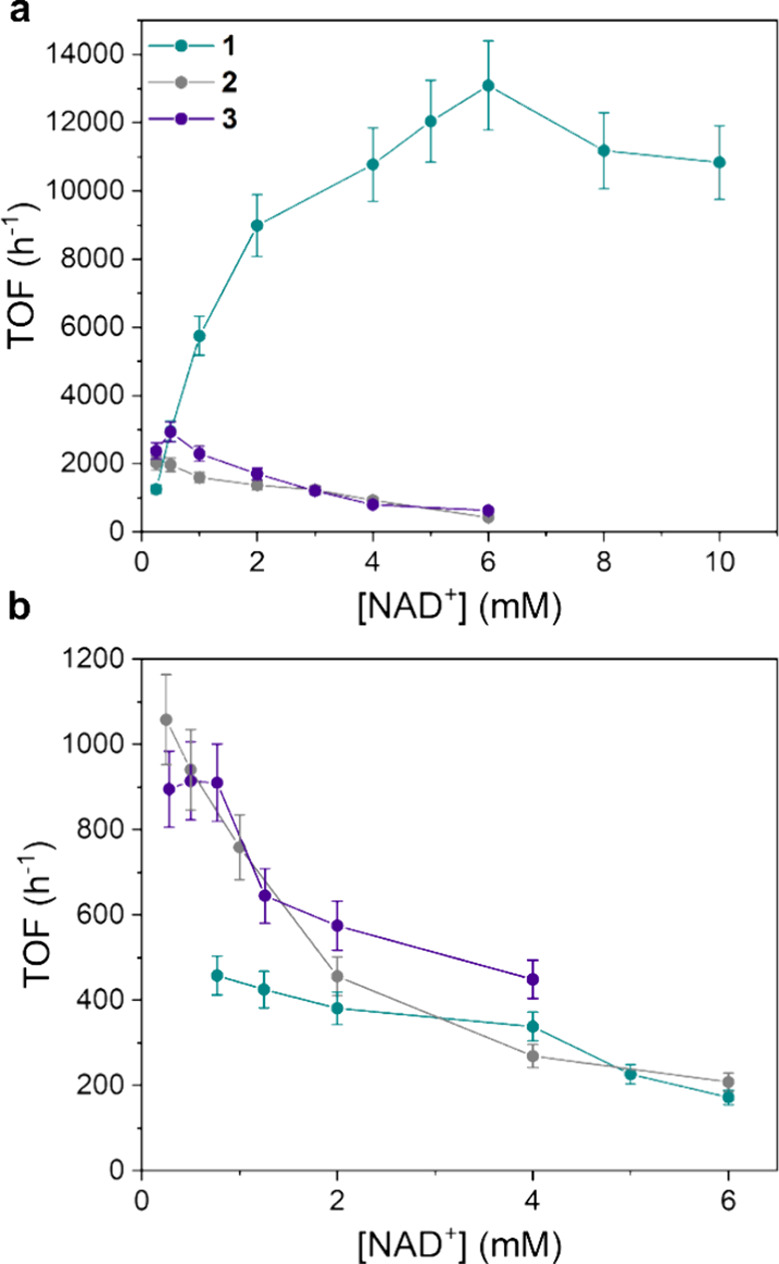
A rational design, based on a deep understanding of the reaction mechanism, led to the development of an iridium organometallic catalyst with activity comparable to that of enzymes in the chemical regeneration of NADH, using phosphite as a reducing agent. The innovative structural elements were individuated in replacing pyridine with pyrazine and adding a carbohydrazide moiety in the bidentate amidate supporting ligand. Resulting [CpIr-(pyza-NH)-Cl] (pyza-NH = κ-pyrazinecarbohydrazide; ) outperforms both the analogous complex with pyridine, [CpIr-(pica-NH)-Cl] (pica-NH= κ-pyridincarbohydrazide; ), and that missing the -NH moiety, [CpIr-(pyza)-Cl] (pyza = κ-pyrazineamidate; ). A maximum TOF of 13,090 h was observed for ([NAD] = 6 mM, [cat] = 7.5 μM, pH 6.58 by phosphite buffer 0.4 M, 313 K), a value never reached for any organometallic catalyst and comparable with that of enzymes. H diffusion NMR experiments indicate that and undergo dimerization in water through the ionization of the Ir-Cl bond and coordination of the carbohydrazide moiety to a second iridium center. This leads to [CpIr-(pyza-NH)]X ( ) and [Cp*Ir-(pica-NH)]X ( ) that were isolated as PF salts by anion metathesis with NHPF and fully characterized both in solution (multinuclear multidimensional NMR) and in the solid state (single-crystal X-ray diffractometry). Catalytic NADH regeneration experiments were carried out starting from stock solutions of - complexes in acetonitrile, where diffusion NMR experiments ensure the main presence of mononuclear catalytic precursors, in order to avoid complications due to dimerization. In-depth kinetic studies evidenced that catalyst in combination with the HPO donor is superior to and in all aspects, facilitating the formation of the Ir-H intermediate and the tendency to donate the hydride to NAD, at the same time inhibiting the detrimental accumulation of the off-cycle cat/NAD adduct. The introduction of the pyrazine moiety, much less σ-donating and more π-accepting than the pyridine one, is likely responsible for most of the increased activity and stability of with respect to . Meanwhile, the dandling -NH carbohydrazide moiety might further accelerate the process by providing a basic functionality close to the reactive coordination position and introducing some steric hindrance to hamper the formation of the off-cycle cat/NAD adduct.
基于对反应机理的深入理解进行的合理设计,开发出了一种铱有机金属催化剂,该催化剂在使用亚磷酸酯作为还原剂的NADH化学再生过程中,其活性与酶相当。通过用吡嗪取代吡啶并在双齿酰胺基支撑配体中添加酰肼部分,确定了创新的结构元素。所得的[CpIr-(pyza-NH)-Cl](pyza-NH = κ-吡嗪酰肼)的性能优于含吡啶的类似配合物[CpIr-(pica-NH)-Cl](pica-NH = κ-吡啶酰肼)以及缺少-NH部分的[CpIr-(pyza)-Cl](pyza = κ-吡嗪酰胺)。在([NAD] = 6 mM,[催化剂] = 7.5 μM,由0.4 M亚磷酸酯缓冲液在pH 6.58、313 K条件下)观察到最大TOF为13,090 h -1,这一数值是任何有机金属催化剂都未曾达到过的,且与酶的相当。1H扩散NMR实验表明,[CpIr-(pyza-NH)-Cl]和[CpIr-(pica-NH)-Cl]在水中通过Ir-Cl键的离子化以及酰肼部分与第二个铱中心的配位而发生二聚化。这导致形成了[CpIr-(pyza-NH)]X(X = Cl - )和[CpIr-(pica-NH)]X(X = Cl - ),通过与NH4PF6进行阴离子交换,将其分离为PF6 - 盐,并在溶液(多核多维NMR)和固态(单晶X射线衍射)中进行了全面表征。催化NADH再生实验从乙腈中的 - 配合物储备溶液开始进行,其中扩散NMR实验确保主要存在单核催化前体,以避免由于二聚化引起的复杂性。深入的动力学研究表明,催化剂[CpIr-(pyza-NH)-Cl]与HPO3供体结合在各个方面都优于[CpIr-(pica-NH)-Cl]和[CpIr-(pyza)-Cl],有利于Ir-H中间体的形成以及向NAD供氢化物的趋势,同时抑制了非循环催化剂/NAD加合物的有害积累。吡嗪部分的引入,其σ-供电子能力比吡啶部分弱且π-接受能力更强,可能是[CpIr-(pyza-NH)-Cl]相对于[CpIr-(pica-NH)-Cl]活性和稳定性提高的主要原因。同时,悬垂的-NH酰肼部分可能通过在反应性配位位置附近提供一个碱性官能团并引入一些空间位阻来阻碍非循环催化剂/NAD加合物的形成,从而进一步加速该过程。