Geenjaar Eloy, Kim Donghyun, Calhoun Vince
School of Electrical and Computer Engineering, Georgia Institute of Technology, Atlanta, Georgia, United States of America.
Tri-Institutional Center for Translational Research in Neuroimaging and Data Science (TReNDS), Georgia State, Georgia Tech, Emory, Atlanta, Georgia, United States of America.
PLoS One. 2025 Jun 12;20(6):e0324066. doi: 10.1371/journal.pone.0324066. eCollection 2025.
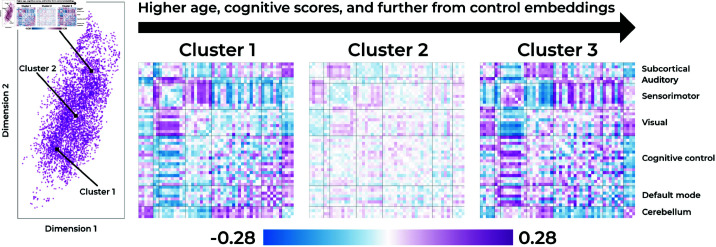
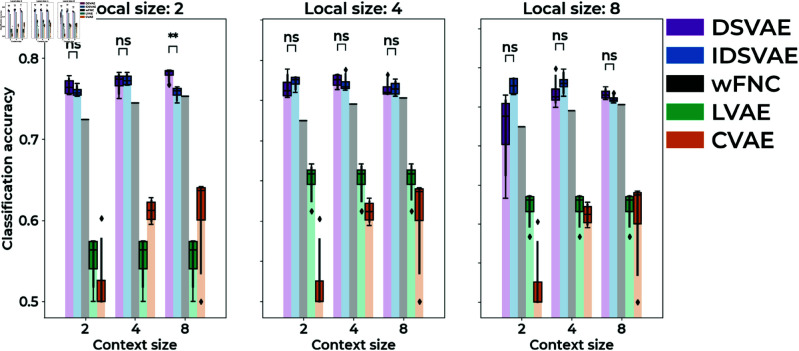
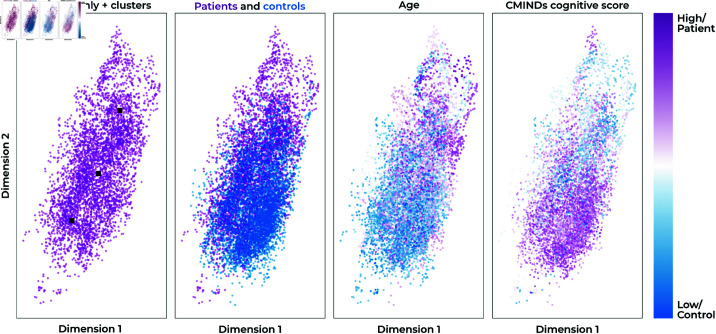
Approaches studying the dynamics of resting-state functional magnetic resonance imaging (rs-fMRI) activity often focus on time-resolved functional connectivity (tr-FC). While many tr-FC approaches have been proposed, most are linear approaches, e.g. computing the linear correlation at a timestep or within a window. In this work, we propose to use a generative non-linear deep learning model, a disentangled variational autoencoder (DSVAE), that factorizes out window-specific (context) information from timestep-specific (local) information. This has the advantage of allowing our model to capture differences at multiple temporal scales. We find that by separating out temporal scales our model's window-specific embeddings, or as we refer to them, context embeddings, more accurately separate windows from schizophrenia patients and control subjects than baseline models and the standard tr-FC approach in a low-dimensional space. Moreover, we find that for individuals with schizophrenia, our model's context embedding space is significantly correlated with both age and symptom severity. Interestingly, patients appear to spend more time in three clusters, one closer to controls which shows increased visual-sensorimotor, cerebellar-subcortical, and reduced cerebellar-visual functional network connectivity (FNC), an intermediate station showing increased subcortical-sensorimotor FNC, and one that shows decreased visual-sensorimotor, decreased subcortical-sensorimotor, and increased visual-subcortical domains. We verify that our model captures features that are complementary to - but not the same as - standard tr-FC features. Our model can thus help broaden the neuroimaging toolset in analyzing fMRI dynamics and shows potential as an approach for finding psychiatric links that are more sensitive to individual and group characteristics.
研究静息态功能磁共振成像(rs-fMRI)活动动态的方法通常聚焦于时间分辨功能连接(tr-FC)。虽然已经提出了许多tr-FC方法,但大多数是线性方法,例如在一个时间步长或一个窗口内计算线性相关性。在这项工作中,我们建议使用一种生成式非线性深度学习模型,即解缠变分自编码器(DSVAE),它从特定时间步长(局部)信息中分解出特定窗口(上下文)信息。这具有允许我们的模型在多个时间尺度上捕捉差异的优点。我们发现,通过分离时间尺度,我们模型的特定窗口嵌入,或者如我们所称呼的上下文嵌入,在低维空间中比基线模型和标准tr-FC方法更准确地将精神分裂症患者和对照受试者的窗口分开。此外,我们发现对于精神分裂症患者,我们模型的上下文嵌入空间与年龄和症状严重程度都显著相关。有趣的是,患者似乎在三个簇中花费更多时间,一个更接近对照,显示视觉-感觉运动、小脑-皮层下功能网络连接(FNC)增加,以及小脑-视觉FNC减少,一个中间状态显示皮层下-感觉运动FNC增加,还有一个显示视觉-感觉运动、皮层下-感觉运动减少,以及视觉-皮层下区域增加。我们验证了我们的模型捕捉到的特征与标准tr-FC特征互补但不同。因此,我们的模型有助于拓宽分析fMRI动态的神经成像工具集,并显示出作为一种寻找对个体和群体特征更敏感的精神疾病关联的方法的潜力。