Subbaiya Saranya, Ethiraj Theranirajan, Rajendran Shankar Shanmugam, Narayanasamy Vanitha, Periyasamy Umamaheswari, Selvaraj Felcy Emalda Mariya, Arumuga Sumathi
Department of Child Health Nursing, College of Nursing, Madras Medical College, The TN MGR Medical University Chennai, Tamil Nadu, India.
Dean, Madras Medical College, The TN Dr MGR Medical University, Chennai, Tamil Nadu, India.
J Pharm Bioallied Sci. 2025 May;17(Suppl 1):S667-S669. doi: 10.4103/jpbs.jpbs_1644_24. Epub 2025 Feb 3.
Vitamin A deficiency (VAD) is a leading cause of childhood blindness in developing countries, contributing significantly to morbidity and mortality from common early-life illnesses, even at sub-clinical levels. The need for effective interventions to address VAD is critical, especially in communities where awareness is low.
This study aimed to assess the impact of a community-based educational intervention on improving maternal knowledge about vitamin A and its role in preventing childhood blindness and related health issues.
The study was conducted in Choolai, Chennai, during March and April 2024, over four weeks. A total of 100 mothers of preschool children were enrolled, with equal numbers assigned to an experimental group (receiving community-based educational intervention) and a control group (receiving standard treatment). Data was collected using a semi-structured questionnaire and the PRASHAT vision disability checklist. Statistical analysis was performed using SPSS version 22.
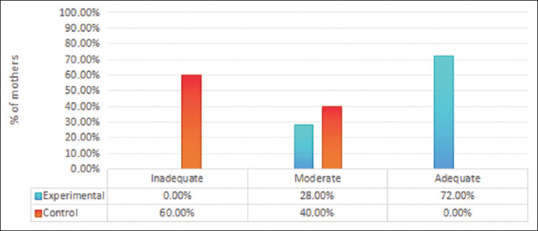
The pre-test scores for both groups were similar. However, post-intervention, the experimental group showed a significant improvement in knowledge, with coherence scores increasing from 13.90 to 23.54, compared to minimal improvements in the control group. Demographic factors, such as age, education, and occupation, were significantly correlated with the improvement in the experimental group.
The study demonstrated that community-based educational interventions significantly enhance maternal knowledge about vitamin A, thereby reducing the risk of vitamin A deficiency and improving vision health among preschool children. These findings highlight the importance of such interventions in preventing hypervitaminosis and promoting optimal child health.
维生素A缺乏症(VAD)是发展中国家儿童失明的主要原因,即使在亚临床水平,也对常见的早期疾病的发病率和死亡率有重大影响。采取有效干预措施应对维生素A缺乏症至关重要,尤其是在意识水平较低的社区。
本研究旨在评估基于社区的教育干预对提高母亲关于维生素A及其在预防儿童失明和相关健康问题中作用的知识的影响。
该研究于2024年3月至4月在金奈的乔莱进行,为期四周。共招募了100名学龄前儿童的母亲,将相等数量的母亲分配到实验组(接受基于社区的教育干预)和对照组(接受标准治疗)。使用半结构化问卷和PRASHAT视力残疾检查表收集数据。使用SPSS 22版进行统计分析。
两组的预测试分数相似。然而,干预后,实验组的知识有显著提高,连贯分数从13.90提高到23.54,而对照组的提高最小。年龄、教育程度和职业等人口统计学因素与实验组的改善显著相关。
该研究表明,基于社区的教育干预显著提高了母亲关于维生素A的知识,从而降低了维生素A缺乏症的风险,并改善了学龄前儿童的视力健康。这些发现凸显了此类干预在预防维生素A过多症和促进儿童最佳健康方面的重要性。