Toledo Thais Mingatos de, Valerio Hellen Paula, Melo Amanda Teixeira de, Gomes Renata Nascimento, Melo Thatiana Corrêa de, Buri Marcus Vinicius, Souza Marcelo Medina de, Santos Deivid Martins, Vigerelli Hugo, Flores Miryam Paola Alvarez, Palmisano Giuseppe, Chudzinski-Tavassi Ana Marisa
Centre of Excellence in New Target Discovery, Instituto Butantan, São Paulo, Brazil.
Laboratory of Glycoproteomics, Departamento de Parasitologia, Instituto de Ciências Biomédicas, Universidade de São Paulo, São Paulo, Brazil.
Cell Commun Signal. 2025 Jun 13;23(1):282. doi: 10.1186/s12964-025-02291-z.
Chondrocyte homeostasis is vital for maintaining the extracellular matrix (ECM) and overall cartilage health. In osteoarthritis (OA), for example, oxidative stress resulting from redox imbalances can disrupt chondrocyte homeostasis, leading to cartilage degradation. Hydrogen peroxide (HO), a reactive oxygen species (ROS), is a key mediator of oxidative stress and contributes to chondrocyte apoptosis and ECM degradation. Previous studies have explored individual protein responses to oxidative stress; however, a comprehensive proteomic analysis in chondrocytes has not been conducted. In this study, we aimed to assess the global proteomic alterations in chondrocytes exposed to HO using a shotgun proteomics approach, which enables the detection of a broad spectrum of proteomic changes.
Chondrocytes were treated with HO for 1, 4, and 16 h followed by protein extraction and processing, including denaturation, alkylation, and trypsin digestion. The peptides were then acidified, desalted, dried, and resuspended for LC-MS/MS. Proteomics data were analyzed using MaxQuant software to identify and quantify proteins. Secretome analysis was performed to examine protein secretion changes under oxidative stress. The statistical significance of all proteomics and secretome data was assessed using a two-tailed Student's t-test with a permutation-based FDR and an S0 parameter of 0.1 in the Perseus software. Other methods, including quantitative PCR, western blotting, and immunofluorescence, were employed to complement the proteomic analysis.
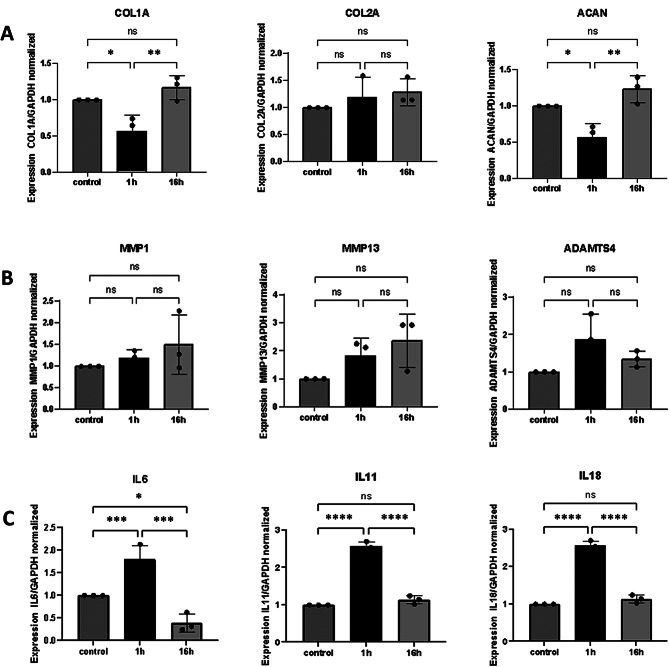
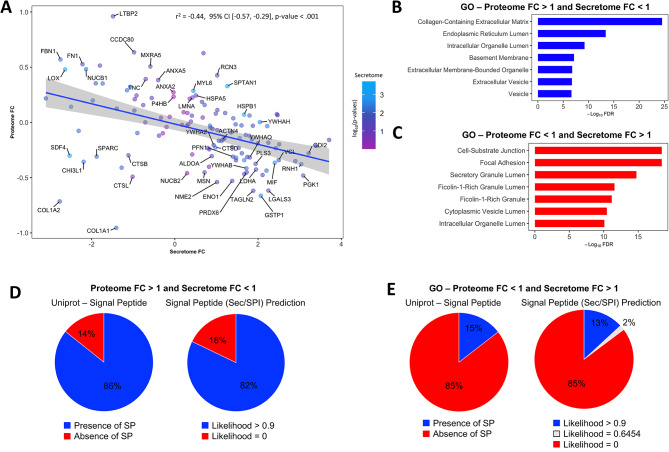
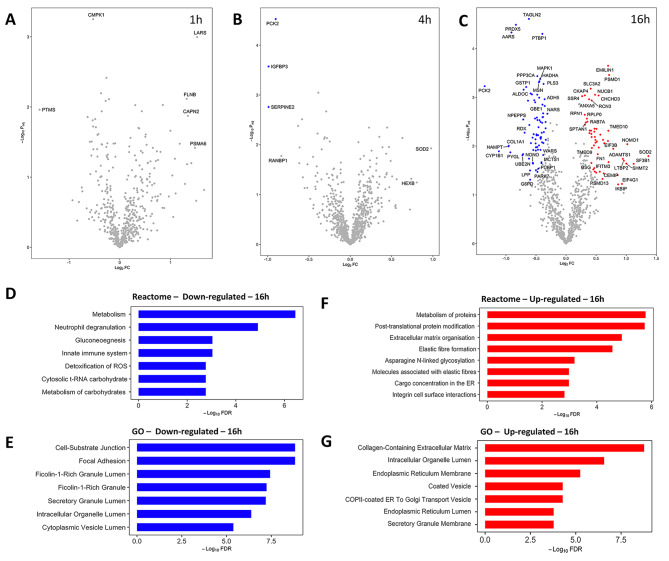
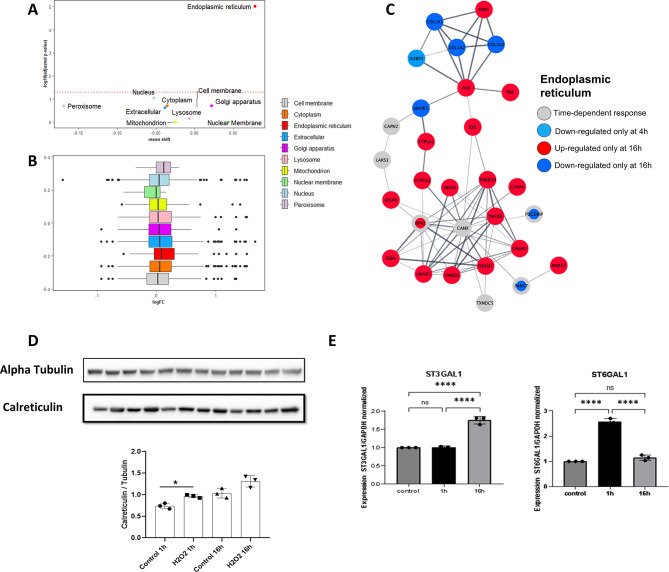
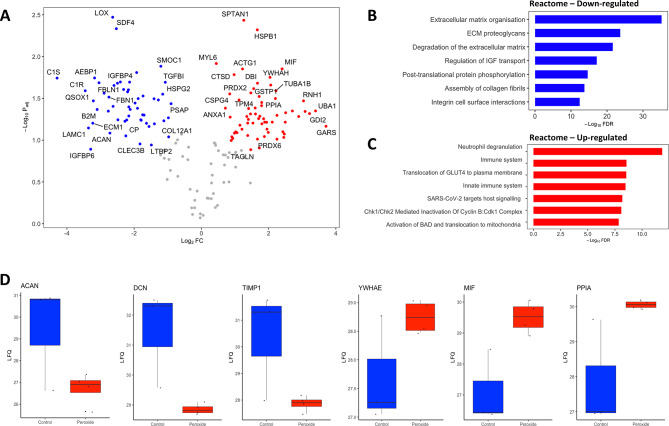
Our findings revealed that oxidative stress primarily affected the endoplasmic reticulum (ER), causing notable alterations in the expression of ER-associated proteins, redox-responsive enzymes, chaperones, and sialyltransferases. These changes increased intracellular accumulation of ECM proteins and decreased secretion into the extracellular environment, indicating impaired protein trafficking and secretion. Additionally, immune-related pathways were activated in the long term, with a short-term upregulation of inflammatory markers, such as interleukin (IL)-6 and IL-18, although the levels of matrix metalloproteinases (MMPs) remained stable, indicating that not only complex inflammatory stimuli, but also oxidative stress responses can disrupt ECM homeostasis.
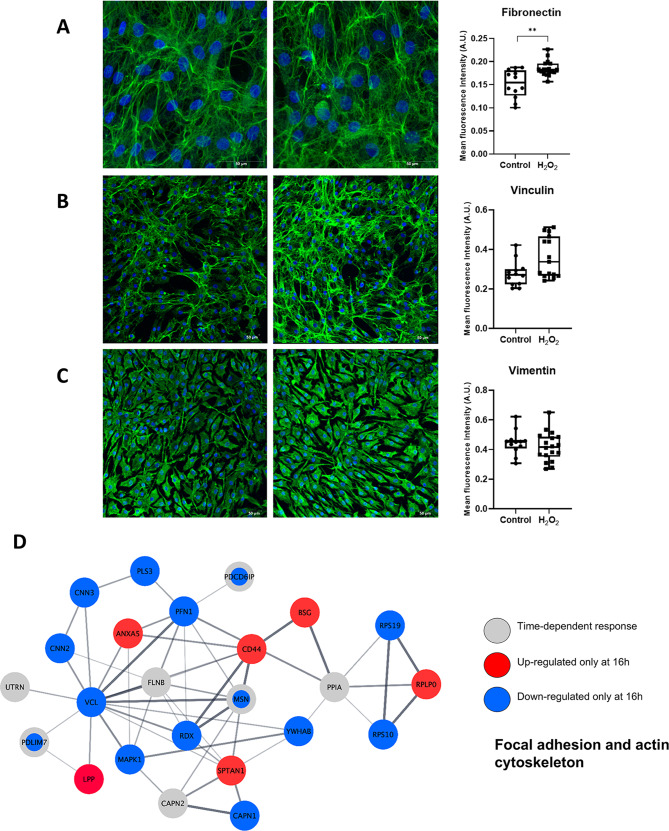
Our study demonstrates a detailed proteomic view of the stress response of HOtreated chondrocytes, highlighting the significant changes in ER function, cytoskeletal remodeling, protein secretion, and immune responses. These changes suggest that oxidative stress impacts ECM balance and can contribute to cartilage disorders, such as OA, through different mechanisms than what is usually observed with inflammatory stimulus, offering new insights into the molecular mechanisms underlying oxidative stress in chondrocytes.
软骨细胞稳态对于维持细胞外基质(ECM)和整体软骨健康至关重要。例如,在骨关节炎(OA)中,氧化还原失衡导致的氧化应激可破坏软骨细胞稳态,进而导致软骨降解。过氧化氢(HO)作为一种活性氧(ROS),是氧化应激的关键介质,可导致软骨细胞凋亡和ECM降解。以往研究探讨了单个蛋白质对氧化应激的反应;然而,尚未对软骨细胞进行全面的蛋白质组学分析。在本研究中,我们旨在使用鸟枪法蛋白质组学方法评估暴露于HO的软骨细胞中的整体蛋白质组变化,该方法能够检测广泛的蛋白质组变化。
用HO处理软骨细胞1、4和16小时,随后进行蛋白质提取和处理,包括变性、烷基化和胰蛋白酶消化。然后将肽酸化、脱盐、干燥并重新悬浮用于液相色谱-串联质谱(LC-MS/MS)分析。使用MaxQuant软件分析蛋白质组学数据以鉴定和定量蛋白质。进行分泌蛋白质组分析以检查氧化应激下的蛋白质分泌变化。使用双侧学生t检验评估所有蛋白质组学和分泌蛋白质组数据的统计学显著性,在Perseus软件中基于排列的错误发现率(FDR)和S0参数为0.1。采用其他方法,包括定量PCR、蛋白质免疫印迹和免疫荧光,以补充蛋白质组学分析。
我们的研究结果表明,氧化应激主要影响内质网(ER),导致与ER相关的蛋白质、氧化还原反应酶、伴侣蛋白和唾液酸转移酶的表达发生显著变化。这些变化增加了ECM蛋白在细胞内的积累,并减少了其向细胞外环境的分泌,表明蛋白质运输和分泌受损。此外,长期激活免疫相关途径,炎症标志物如白细胞介素(IL)-6和IL-18短期上调,尽管基质金属蛋白酶(MMP)水平保持稳定,这表明不仅复杂的炎症刺激,而且氧化应激反应也可破坏ECM稳态。
我们的研究展示了HO处理的软骨细胞应激反应的详细蛋白质组学情况,突出了ER功能、细胞骨架重塑、蛋白质分泌和免疫反应的显著变化。这些变化表明,氧化应激影响ECM平衡,并可能通过与通常观察到的炎症刺激不同的机制导致软骨疾病,如OA,为软骨细胞氧化应激的分子机制提供了新的见解。