Huang Hao, Zhang Lei, Zhang Ding, Lu Sitong, Lin Jiaqi, Huang Jingyao, Ni Zibo, Pan Jien, Hu Xingxing, Lin Ying, Hu Dongsheng, Zhang Ming, Hu Fulan
Department of Preventive Medicine, Zhuhai Campus of Zunyi Medical University, Zhuhai, 519000, Guangdong Province, PR China.
Department of Epidemiology, School of Public Health, Nantong University, Nantong, 226019, Jiangsu Province, PR China.
Int J Cardiol Cardiovasc Risk Prev. 2025 May 29;26:200442. doi: 10.1016/j.ijcrp.2025.200442. eCollection 2025 Sep.
The impact of tea consumption, particularly the differences between sweetened and unsweetened tea, on the risk of cardiovascular disease (CVD) remains underexplored. This study investigates the associations between the consumption of unsweetened, sugar-sweetened, and artificially sweetened tea and the incidence of CVD.
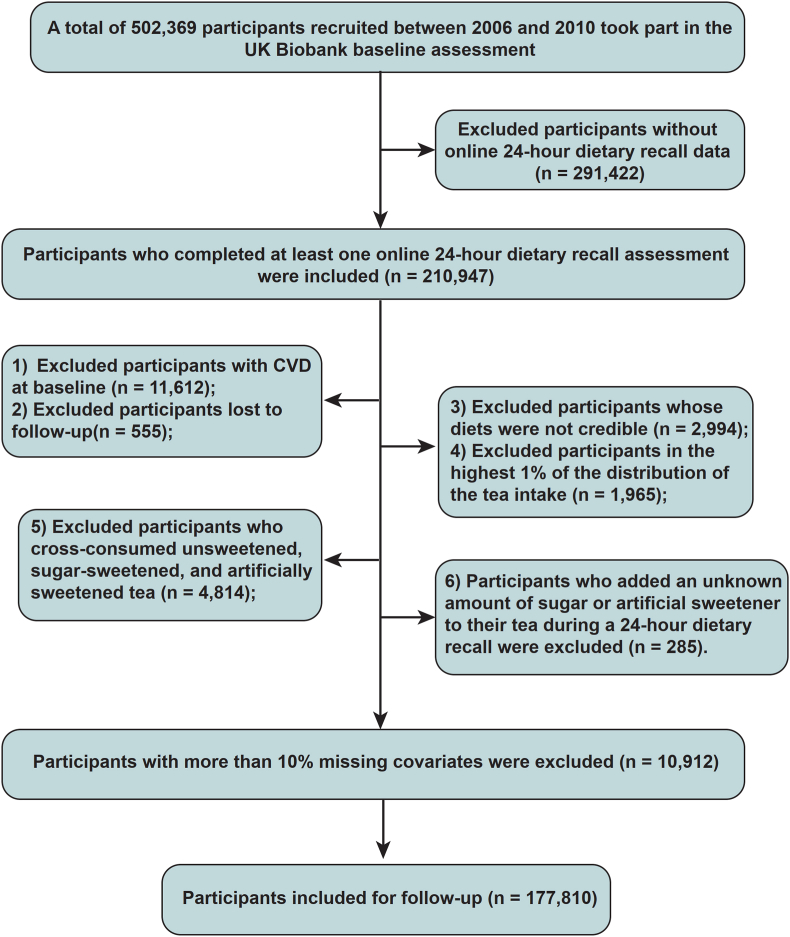
We included 177,810 participants from the UK Biobank, with a median follow-up period of 12.7 years. Cox proportional hazards models were utilized to assess the associations between tea intake and the risk of CVD, coronary artery disease (CAD), stroke, and heart failure (HF) incidents. Additionally, we investigated potential interactions with polygenic risk scores (PRS) for CVD.
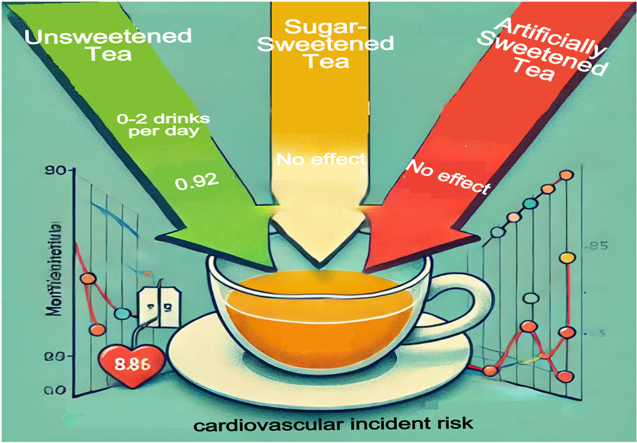
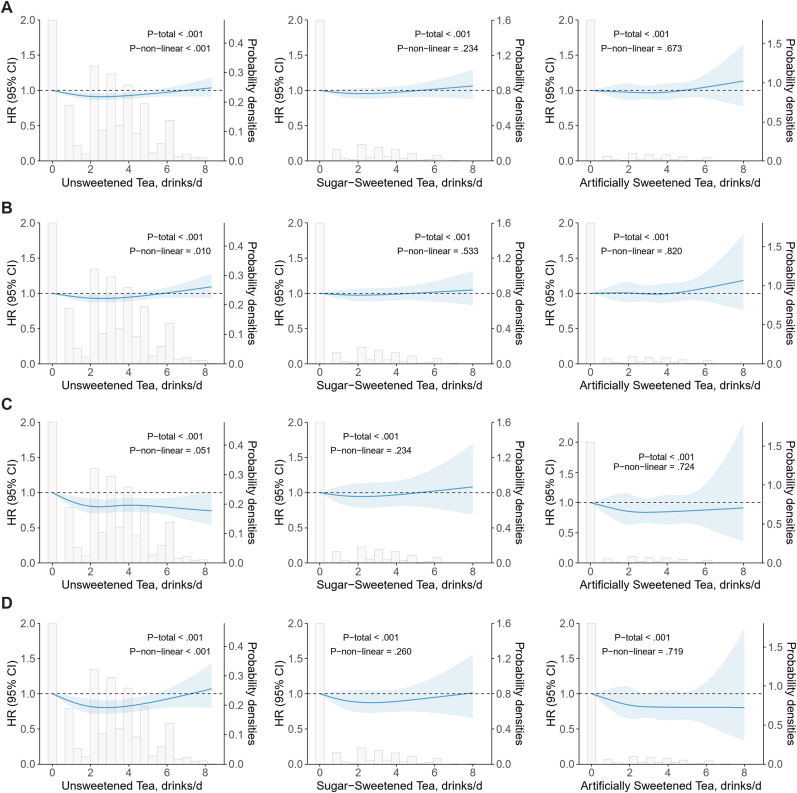
During the follow-up period, 15,003 cases of incident CVD were recorded. A U-shaped association was identified between unsweetened tea consumption and CVD risk, with the lowest risk observed at a consumption level of 0-2 drinks/day (HR: 0.92, 95 % CI: 0.87-0.97). In contrast, no significant associations were found for sugar-sweetened or artificially sweetened tea. The reduced CVD risk associated with unsweetened tea was consistent across various subtypes, including CAD, stroke, and HF. Additionally, no significant interactions were observed between tea consumption and PRS.
Consuming unsweetened tea is associated with a reduced risk of incident CVD, CAD, stroke, and HF. In contrast, no significant associations were observed for sugar-sweetened or artificially sweetened tea. These findings indicate that unsweetened tea may contribute positively to the prevention of CVD, independent of genetic risk factors. Further research is needed to validate these results and explore the underlying mechanisms.
茶的消费,尤其是加糖茶和不加糖茶之间的差异,对心血管疾病(CVD)风险的影响仍未得到充分研究。本研究调查了饮用不加糖茶、加糖茶和人工甜味茶与心血管疾病发病率之间的关联。
我们纳入了英国生物银行的177,810名参与者,中位随访期为12.7年。采用Cox比例风险模型评估茶摄入量与心血管疾病、冠状动脉疾病(CAD)、中风和心力衰竭(HF)事件风险之间的关联。此外,我们还研究了与心血管疾病多基因风险评分(PRS)的潜在相互作用。
在随访期间,记录了15,003例心血管疾病事件。发现饮用不加糖茶与心血管疾病风险之间呈U形关联,在每天饮用0 - 2杯的消费水平下风险最低(HR:0.92,95%CI:0.87 - 0.97)。相比之下,加糖茶或人工甜味茶未发现显著关联。与不加糖茶相关的心血管疾病风险降低在包括CAD、中风和HF在内的各种亚型中是一致的。此外,茶消费与PRS之间未观察到显著相互作用。
饮用不加糖茶与心血管疾病、CAD、中风和HF的发病风险降低有关。相比之下,加糖茶或人工甜味茶未发现显著关联。这些发现表明,不加糖茶可能对心血管疾病的预防有积极作用,且独立于遗传风险因素。需要进一步研究来验证这些结果并探索潜在机制。