Trivigno Silvia Maria Grazia, Assinger Alice, Schrottmaier Waltraud Cornelia
Institute of Vascular Biology and Thrombosis Research, Centre of Physiology and Pharmacology, Medical University of Vienna, Vienna, Austria.
University School for Advanced Studies, Istituto Universitario di Studi Superiori (IUSS), Pavia, Italy.
Res Pract Thromb Haemost. 2025 May 8;9(4):102883. doi: 10.1016/j.rpth.2025.102883. eCollection 2025 May.
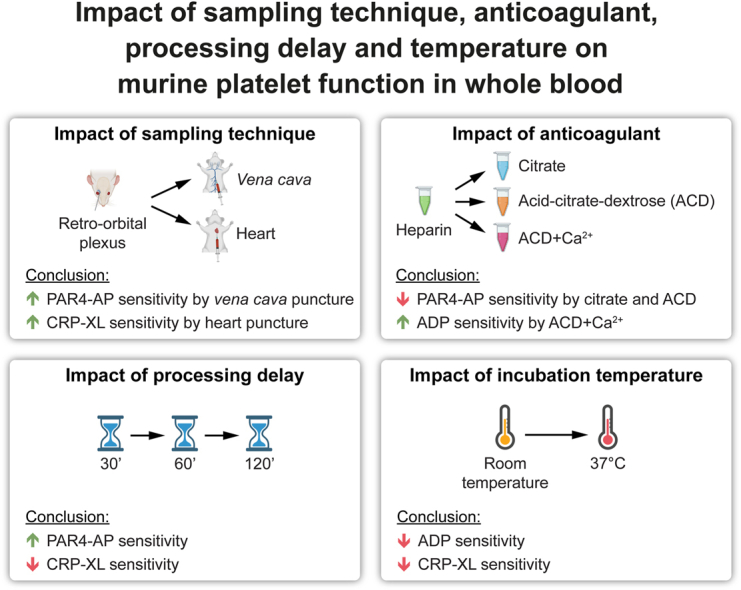
Platelets are highly sensitive to subtle changes in their microenvironment, making functional analyses challenging and prone to variation. Advances in understanding how experimental procedures influence human platelet activation have improved the accuracy and comparability of diagnostic and research data. However, despite the pivotal role of murine models, the effects of methodological variations on murine platelets remain incompletely understood.
To elucidate how blood draw techniques, anticoagulation, processing delay, and assay temperature affect murine platelets.
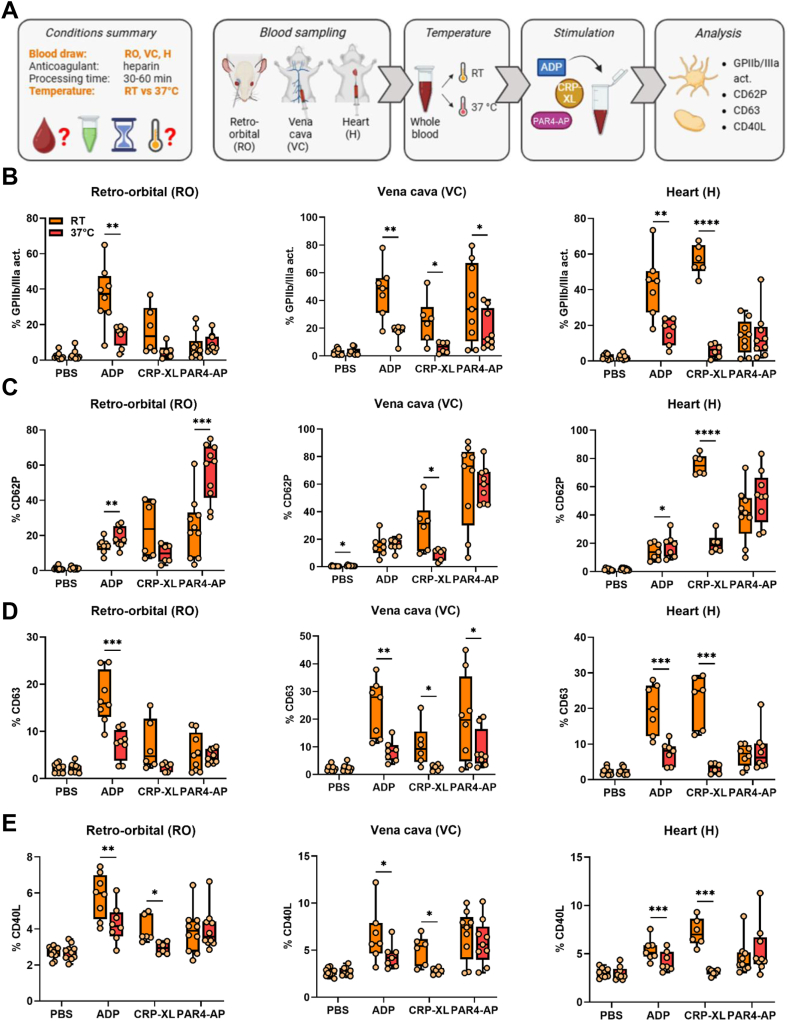
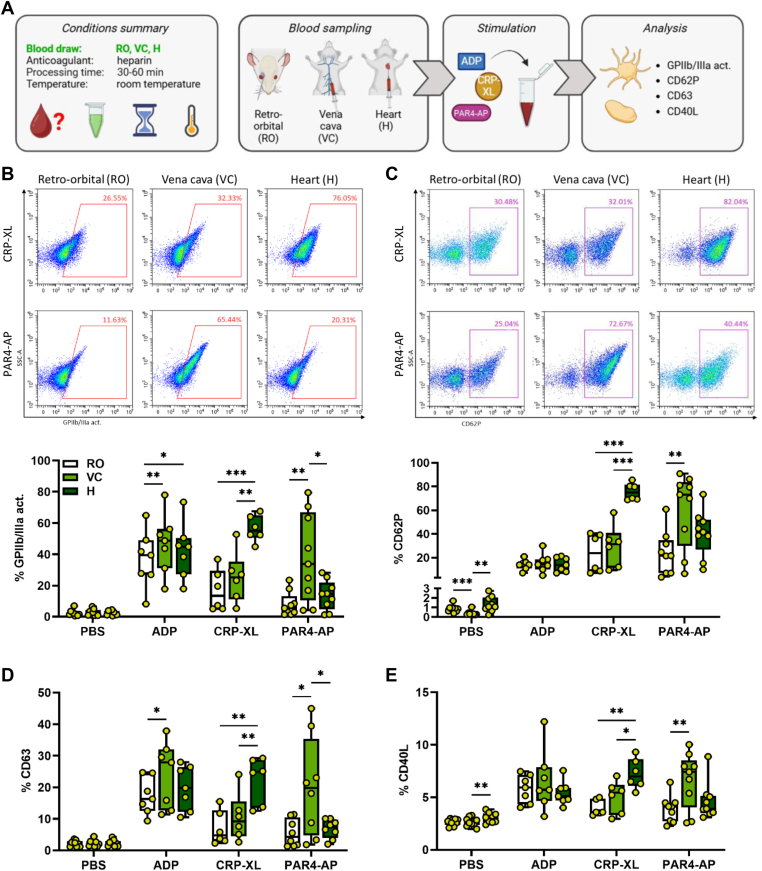
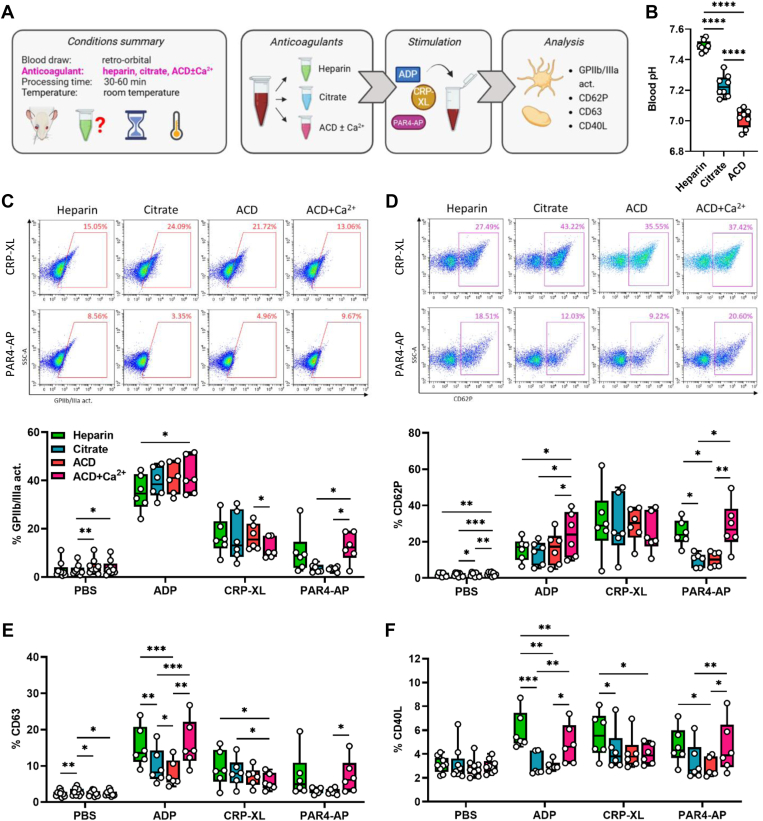
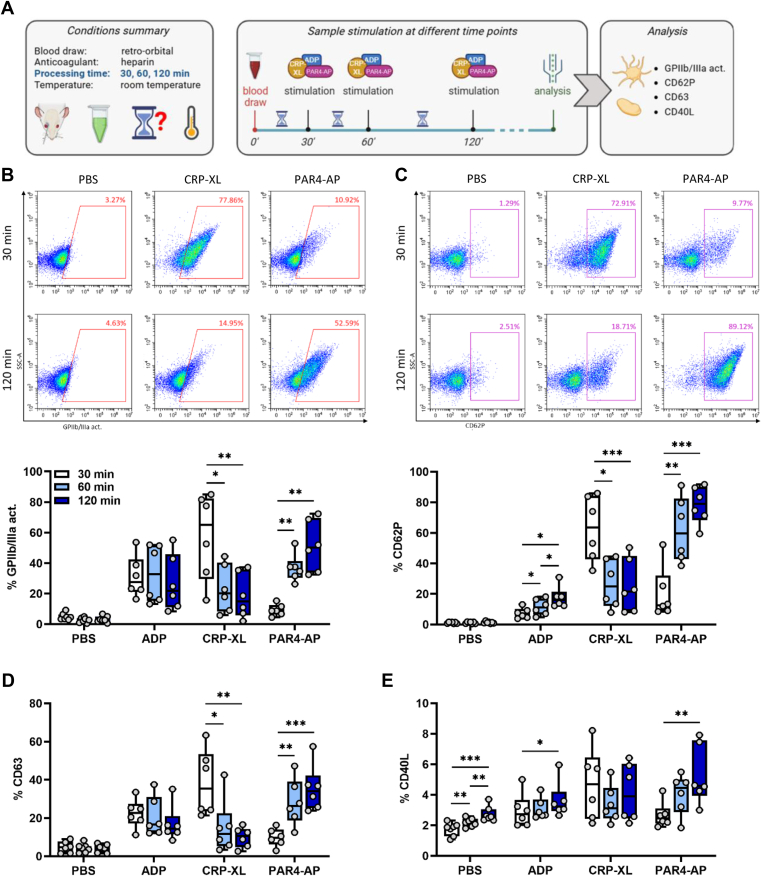
Blood was obtained by retro-orbital, vena cava, or cardiac puncture and anticoagulated with heparin, citrate, or acid-citrate-dextrose ± recalcification. After 30 to 120 minutes, blood was stimulated at room temperature or 37 °C with adenosine diphosphate (ADP), protease-activated receptor 4-activating peptide (PAR4-AP), or cross-linked collagen-related peptide (CRP-XL), and platelets were analyzed by flow cytometry for CD62P, CD63, CD40L, and activated glycoprotein IIb/IIIa.
Blood sampling had minimal impact on ADP-induced platelet activation. However, platelets isolated via vena cava or cardiac puncture exhibited heightened responsiveness to PAR4-AP and CRP-XL, respectively, compared with retro-orbital sampling. Citrate and acid-citrate-dextrose significantly impaired PAR4-AP responses compared with heparin, whereas CRP-XL sensitivity was anticoagulant-independent. Processing delays as brief as 60 minutes significantly altered platelet reactivity to CRP-XL and PAR4-AP, with further delays producing minimal additional impact. Finally, ADP- and CRP-XL-induced platelet activation was significantly reduced at 37 °C compared with room temperature.
Common variations in murine platelet handling influence responsiveness of platelets in an agonist-specific manner, highlighting the critical need for meticulous assay optimization to ensure experimental consistency and comparability.
血小板对其微环境中的细微变化高度敏感,这使得功能分析具有挑战性且容易出现变异。在理解实验程序如何影响人类血小板活化方面取得的进展提高了诊断和研究数据的准确性和可比性。然而,尽管小鼠模型具有关键作用,但方法学变异对小鼠血小板的影响仍未完全了解。
阐明采血技术、抗凝、处理延迟和检测温度如何影响小鼠血小板。
通过眶后、腔静脉或心脏穿刺获取血液,并用肝素、枸橼酸盐或酸-枸橼酸盐-葡萄糖±重新钙化进行抗凝。30至120分钟后,在室温或37°C下用二磷酸腺苷(ADP)、蛋白酶激活受体4激活肽(PAR4-AP)或交联胶原相关肽(CRP-XL)刺激血液,并用流式细胞术分析血小板的CD62P、CD63、CD40L和活化糖蛋白IIb/IIIa。
采血对ADP诱导的血小板活化影响最小。然而,与眶后采血相比,通过腔静脉或心脏穿刺分离的血小板分别对PAR4-AP和CRP-XL表现出更高的反应性。与肝素相比,枸橼酸盐和酸-枸橼酸盐-葡萄糖显著损害PAR4-AP反应,而CRP-XL敏感性与抗凝剂无关。短至60分钟的处理延迟显著改变了血小板对CRP-XL和PAR4-AP的反应性,进一步延迟产生的额外影响最小。最后,与室温相比,37°C时ADP和CRP-XL诱导的血小板活化显著降低。
小鼠血小板处理中的常见变异以激动剂特异性方式影响血小板反应性,突出了精心优化检测以确保实验一致性和可比性的迫切需求。