Malla Ashwini, Saleh Fayez M
Department of Biotechnology, PSG College of Arts and Science, Coimbatore, Tamil Nadu, India.
Department of Medical Microbiology, Faculty of Medicine, University of Tabuk, Tabuk, Saudi Arabia.
Front Public Health. 2025 May 30;13:1572100. doi: 10.3389/fpubh.2025.1572100. eCollection 2025.
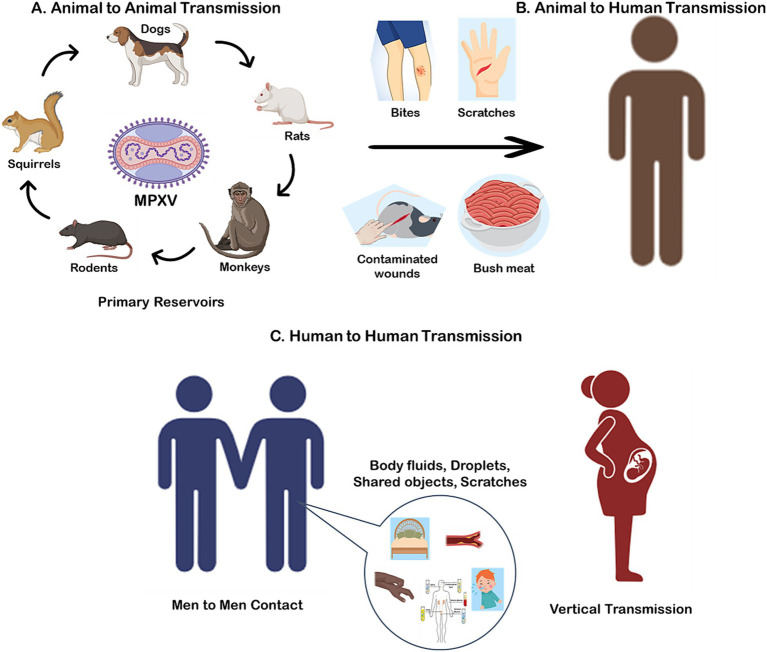
The resurgence of the monkeypox virus (MPXV), a zoonotic Orthopoxvirus historically regarded as endemic to the tropical rainforests of Central and West Africa, represents a significant and evolving global health challenge. Waning Orthopoxvirus immunity following the cessation of smallpox vaccination and inequitable vaccine access have increased susceptibility, especially in resource-limited settings. Combined with urbanization, environmental degradation, global travel, and human-wildlife interactions, these factors have driven MPXV beyond its traditional regions. Notably, recent outbreaks in non-endemic countries have exhibited a distinct epidemiological shift, with a higher incidence among men who have sex with men, often in the absence of travel history to endemic areas, underscoring evolving transmission dynamics. This review provides a comprehensive examination of MPXV's epidemiology, clinical features, and transmission mechanisms, highlighting the complexities of its containment. Key challenges-including surveillance gaps, vaccine inequities, and limited access to diagnostics and therapeutics-are compounded by unresolved controversies over MPXV's natural reservoirs and respiratory transmissibility, as well as critical research gaps in zoonotic spillover mechanisms and long-term immunity. Addressing these issues demands global collaboration to leverage next-generation vaccines and antivirals, paired with an integrated public health response: enhanced surveillance, targeted education, and equitable resource allocation. Sustaining these efforts is vital to curbing MPXV's resurgence and preventing its entrenchment as a global health threat.
猴痘病毒(MPXV)卷土重来,这种人畜共患的正痘病毒在历史上被视为中非和西非热带雨林的地方病,如今已成为一项重大且不断演变的全球卫生挑战。天花疫苗接种停止后,正痘病毒免疫力下降,以及疫苗获取的不平等,增加了易感性,尤其是在资源有限的环境中。再加上城市化、环境退化、全球旅行和人类与野生动物的相互作用,这些因素已使猴痘病毒传播至其传统区域之外。值得注意的是,近期在非流行国家爆发的疫情呈现出明显的流行病学转变,在男男性行为者中发病率较高,而且往往没有前往流行地区的旅行史,这凸显了不断演变的传播动态。本综述全面审视了猴痘病毒的流行病学、临床特征和传播机制,强调了控制该病毒的复杂性。主要挑战包括监测缺口、疫苗不平等以及诊断和治疗手段获取有限,而关于猴痘病毒的天然宿主和呼吸道传播性的争议尚未解决,以及人畜共患病溢出机制和长期免疫力方面的关键研究空白,使这些挑战更加复杂。解决这些问题需要全球合作,以利用下一代疫苗和抗病毒药物,同时采取综合公共卫生应对措施:加强监测、开展针对性教育和公平分配资源。持续开展这些努力对于遏制猴痘病毒的卷土重来以及防止其成为全球卫生威胁至关重要。