Ochigbo Grace Onyeche, Ahn Sangwook, Belhumeur Kobe Albert, Poissant Jocelyn, Rosa Brielle Vastola
Faculty of Veterinary Medicine, University of Calgary, 3280 Hospital Drive NW, Calgary, AB, T2N 4Z6, Canada.
Faculty of Science, University of Calgary, 2500 University Drive NW, Calgary, AB, T2N 1N4, Canada.
Int J Parasitol Parasites Wildl. 2025 May 28;27:101091. doi: 10.1016/j.ijppaw.2025.101091. eCollection 2025 Aug.
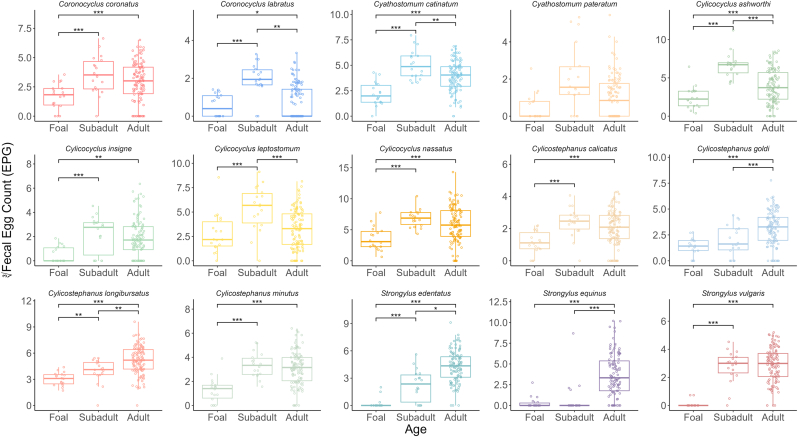
Unmanaged feral horses, naïve to dewormers, offer a unique opportunity to study natural communities of equine parasites. These communities may include parasites that are rare in managed populations, and these may be transmitted to domestic horses in areas where there is contact between feral and domestic equine populations. There have been only a few studies of gastrointestinal parasite populations in horses, and very few from North American equine populations. This study aimed to gain insights into parasite biology through identification of the strongyle parasite species infecting feral horses in Alberta, Canada, and to test for species-specific infection patterns across season and horse age. Fecal samples (N = 149) were collected from unique individuals in the Sundre Equine Management Zone (EMZ), Alberta, across two years: 2021 (N = 62) and 2022 (N = 87). In 2021, samples were collected in summer (N = 31; 8 foals, 5 subadults, 18 adults) and fall (N = 31; 5 foals, 1 subadult, 25 adults). In 2022, samples were collected in spring (N = 36; 4 subadults, 32 adults), summer (N = 41; 4 foals, 8 subadults, 29 adults), and fall (N = 20; 1 foal, 2 subadults, 17 adults). Fecal egg counts showed that these horses shed high numbers of strongyle eggs relative to domestic horse populations (mean = 1337.01 ± 961.81 epg), and nemabiome analyses identified a total of 34 strongyle species. Species richness and aggregate strongyle FECs were highest in subadults and during the summer, while lowest in foals and during the fall. There was a high prevalence of large strongyle species, especially (85.91 %), with strongyle species-specific prevalence and FECs strongly associated with age and season. Understanding the factors driving species-specific parasite infection provides important information on strongyle parasite ecology and may aid the development of targeted parasite control strategies.
未接触过驱虫药的野生马为研究马寄生虫的自然群落提供了独特的机会。这些群落可能包括在人工饲养种群中罕见的寄生虫,并且在野生马和家养马种群有接触的地区,这些寄生虫可能会传播到家养马身上。关于马胃肠道寄生虫种群的研究很少,来自北美马种群的研究更是寥寥无几。本研究旨在通过鉴定感染加拿大艾伯塔省野生马的圆线虫寄生虫种类,深入了解寄生虫生物学特性,并测试不同季节和马年龄的物种特异性感染模式。在两年时间里(2021年,N = 62;2022年,N = 87),从艾伯塔省桑德雷马管理区(EMZ)的不同个体采集了粪便样本(N = 149)。2021年,在夏季(N = 31;8匹幼驹、5匹亚成体、18匹成体)和秋季(N = 31;5匹幼驹、1匹亚成体、25匹成体)采集样本。2022年,在春季(N = 36;4匹亚成体、32匹成体)、夏季(N = 41;4匹幼驹、8匹亚成体、29匹成体)和秋季(N = 20;1匹幼驹、2匹亚成体、17匹成体)采集样本。粪便虫卵计数显示,相对于家养马种群,这些马排出大量的圆线虫卵(平均 = 1337.01 ± 961.81个虫卵/克),线虫群落分析共鉴定出34种圆线虫。亚成体和夏季的物种丰富度和总圆线虫粪便虫卵计数最高,而幼驹和秋季最低。大型圆线虫种类的感染率很高,尤其是 (85.91%),圆线虫物种特异性感染率和粪便虫卵计数与年龄和季节密切相关。了解驱动物种特异性寄生虫感染的因素可为圆线虫寄生虫生态学提供重要信息,并可能有助于制定针对性的寄生虫控制策略。