Larsen Isabella G, Liu Siyuan, Schaffer Lukas, Rau Srishti, Ajumobi Tiffany, Mahony Bridget W, Warling Allysa, Whitman Ethan T, Nadig Ajay, McDermott Cassidy, Xenophontos Anastasia, Wilson Kathleen, Clasen Liv S, Torres Erin N, Blumenthal Jonathan D, Bassett Dani S, Raznahan Armin
Section on Developmental Neurogenomics, National Institute of Mental Health, National Institutes of Health, Bethesda, MD, USA.
Institute for Behavioral Genetics, University of Colorado Boulder, Boulder, CO, USA.
Psychol Med. 2025 Jun 17;55:e166. doi: 10.1017/S0033291725000765.
Psychiatric symptoms are typically highly inter-correlated at the group level. Collectively, these correlations define the architecture of psychopathology - informing taxonomic and mechanistic models in psychiatry. However, to date, it remains unclear if this architecture differs between etiologically distinct subgroups, despite the core relevance of this understanding for personalized medicine. Here, we introduce a new analytic pipeline to probe group differences in the psychopathology architecture - demonstrated through the comparison of two distinct neurogenetic disorders.
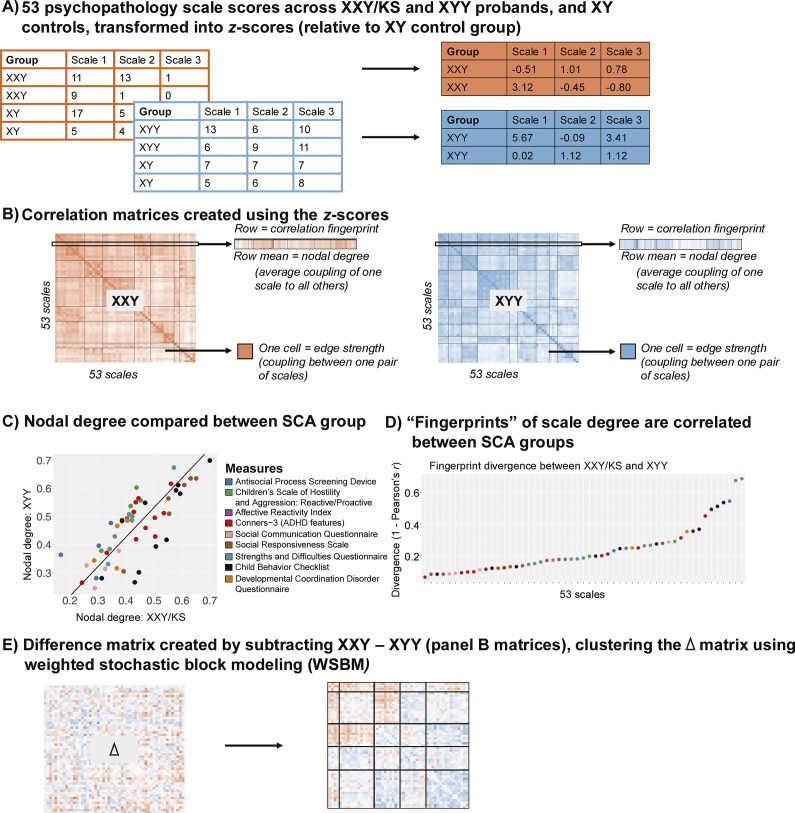
We use a large questionnaire battery in 300 individuals aged 5-25 years ( = 102 XXY/KS, = 64 XYY, = 134 age-matched XY) to characterize the structure of correlations among 53 diverse measures of psychopathology in XXY/KS and XYY syndrome - enabling us to compare the effects of X- versus Y-chromosome dosage on the architecture of psychopathology at multiple, distinctly informative levels.
Behavior correlation matrices describe the architecture of psychopathology in each syndrome. A comparison of matrix rows reveals that social problems and externalizing symptoms are most differentially coupled to other aspects of psychopathology in XXY/KS versus XYY. Clustering the difference between matrices captures coordinated group differences in pairwise coupling between measures of psychopathology: XXY/KS shows greater coherence among externalizing, internalizing, and autism-related features, while XYY syndrome shows greater coherence in dissociality and early neurodevelopmental impairment.
These methods offer new insights into X- and Y-chromosome dosage effects on behavior, and our shared code can now be applied to other clinical groups of interest - helping to hone mechanistic models and inform the tailoring of care.
在群体层面,精神症状通常具有高度的相互关联性。总体而言,这些相关性定义了精神病理学的结构,为精神病学的分类学和机制模型提供了信息。然而,迄今为止,尽管这种理解对个性化医疗具有核心意义,但尚不清楚这种结构在病因不同的亚组之间是否存在差异。在此,我们引入一种新的分析流程来探究精神病理学结构中的群体差异,通过比较两种不同的神经遗传疾病来进行展示。
我们对300名年龄在5至25岁的个体( = 102名XXY/KS患者, = 64名XYY患者, = 134名年龄匹配的XY个体)使用大量问卷,以描述XXY/KS和XYY综合征中53种不同精神病理学测量指标之间的相关结构,从而使我们能够在多个具有明显信息价值的层面上比较X染色体与Y染色体剂量对精神病理学结构的影响。
行为相关矩阵描述了每种综合征的精神病理学结构。对矩阵行的比较显示,在XXY/KS与XYY中,社会问题和外化症状与精神病理学的其他方面的耦合差异最大。对矩阵之间的差异进行聚类可捕捉精神病理学测量指标之间成对耦合中的协同群体差异:XXY/KS在外化、内化和自闭症相关特征之间表现出更大的一致性,而XYY综合征在反社会性和早期神经发育障碍方面表现出更大的一致性。
这些方法为X和Y染色体剂量对行为的影响提供了新的见解,我们共享的代码现在可应用于其他感兴趣的临床群体,有助于完善机制模型并为个性化护理提供依据。