Li Xi, Wang Jingjing, Zhang Yuankui, Zhao Yarong, Liu Wenjun, Shi Yanli
Beijing Biomedicine Technology Center, Zhaofeng Hua Biotechnology (Nanjing) Co., LTD, Beijing, China; CAS Key Laboratory of Pathogenic Microbiology and Immunology, Institute of Microbiology, Chinese Academy of Sciences (CAS), Beijing, China.
Beijing Biomedicine Technology Center, Zhaofeng Hua Biotechnology (Nanjing) Co., LTD, Beijing, China.
Virus Res. 2025 Aug;358:199600. doi: 10.1016/j.virusres.2025.199600. Epub 2025 Jun 15.
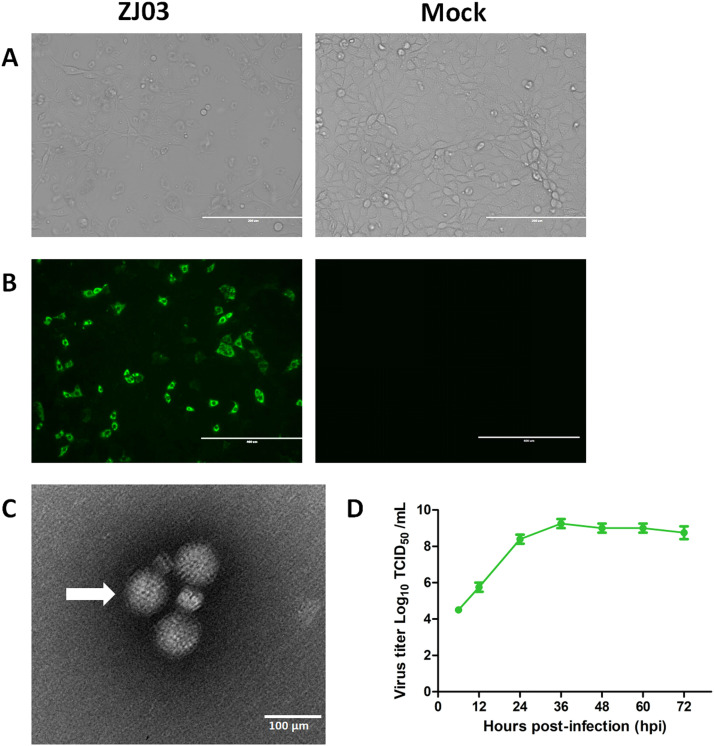
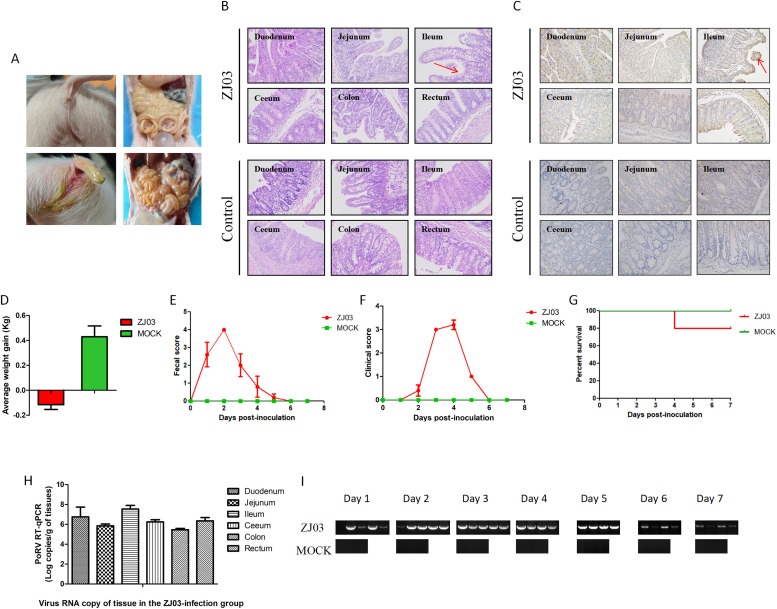
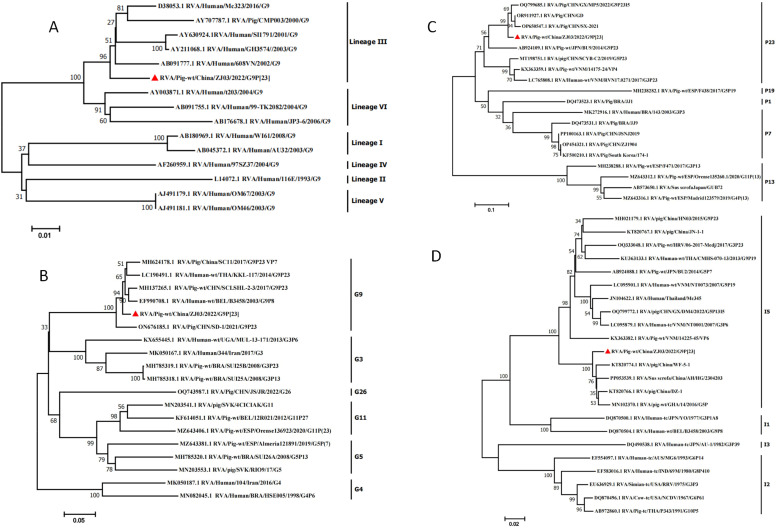
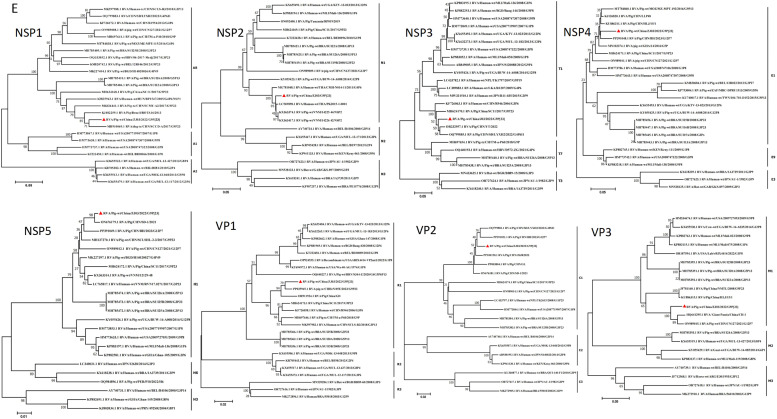
Porcine rotavirus A (RVA) has emerged as an increasingly consequential zoonotic pathogen, causing severe intestinal disorders across diverse mammalian species, including humans. During of an outbreak that struck nursing piglets with diarrhea, a porcine G9P[23] rotavirus, named as RVA/Pig-wt/China/ZJ03/2022/G9P[23] (hereafter referred to as ZJ03), was identified. To further elucidate the evolutionary diversity of ZJ03, a comprehensive analysis of all genome segments was conducted. The genome constellation was identified as G9-P[23]-I5-R1-C1-M1-A8-N1-T1-E1-H1. Nucleotide sequence identity and phylogenetic analyses indicated that the VP3 and NSP1 genes of ZJ03 are most closely related to the corresponding genes of the giant panda strain and the dog strain, respectively, showing the highest homology at 95.73 % identity and 94.64 %. The remaining genes demonstrated the most intimate relationship with porcine strains. Their highest homology levels ranged from 95.98 % to 99.49 % similarity. Therefore, evidence suggests interspecies transmission and genetic reassortment events between porcine, canine, and giant panda rotavirus strains. To evaluate the pathogenicity of ZJ03 strain, we experimentally infected 3-day-old piglets oral inoculation with the PoRV ZJ03 strain at a dose of 2 × 10^5.5 TCID/ml per piglet. The infection resulted in severe diarrhea in all piglets, which occurred at 48 h post-infection (hpi), accompanied by sustained viral shedding and characteristic small intestinal villous atrophy, indicating significant damage to the intestinal epithelium. In vitro, ZJ03 exhibited efficient replication kinetics in MA104 cells, reaching peak titers of 10^9.25 TCID/mL at 36 h post-infection. This study reports the first documented case of a novel porcine G9P[23] rotavirus with gene segments linked to canine and giant panda strains in mainland China, characterized by high viral titer and virulence. The findings highlight the emergence of a previously unrecorded RVA strain with significant virological and ecological implications.
猪轮状病毒A(RVA)已成为一种越来越重要的人畜共患病原体,可在包括人类在内的多种哺乳动物中引发严重的肠道疾病。在一次侵袭哺乳仔猪腹泻的疫情期间,鉴定出一株猪G9P[23]轮状病毒,命名为RVA/Pig-wt/China/ZJ03/2022/G9P[23](以下简称ZJ03)。为进一步阐明ZJ03的进化多样性,对所有基因组片段进行了全面分析。基因组组合被鉴定为G9-P[23]-I5-R1-C1-M1-A8-N1-T1-E1-H1。核苷酸序列同一性和系统发育分析表明,ZJ03的VP3和NSP1基因分别与大熊猫毒株和犬毒株的相应基因关系最为密切,同一性分别为95.73%和94.64%时显示出最高同源性。其余基因与猪毒株关系最为密切。它们的最高同源性水平在95.98%至99.49%之间。因此,有证据表明猪、犬和大熊猫轮状病毒毒株之间存在种间传播和基因重配事件。为评估ZJ03毒株的致病性,我们以每头仔猪2×10^5.5 TCID/ml的剂量经口接种3日龄仔猪,用PoRV ZJ03毒株进行实验性感染。感染导致所有仔猪出现严重腹泻,在感染后48小时(hpi)出现,伴有持续的病毒排出和特征性的小肠绒毛萎缩,表明对肠上皮有显著损伤。在体外,ZJ0)在MA104细胞中表现出高效的复制动力学,在感染后36小时达到10^9.25 TCID/mL的峰值滴度。本研究报告了中国大陆首例记录在案的新型猪G9P[23]轮状病毒,其基因片段与犬和大熊猫毒株相关,具有高病毒滴度和毒力的特征。这些发现突出了一种以前未记录的RVA毒株的出现,具有重要的病毒学和生态学意义。