Urabe Shoichiro, Shimazaki Junya, Izutani Tomohisa, Hata Tsuyoshi, Uemura Mamoru, Eguchi Hidetoshi, Doki Yuichiro, Nakajima Kiyokazu
Department of Next Generation Endoscopic Intervention (Project ENGINE), Graduate School of Medicine, Osaka University, Suite 0802, BioSystems Bldg., 1-3, Yamadaoka, Suita, 565-0871, Osaka, Japan.
Department of Gastroenterological Surgery, Graduate School of Medicine, Osaka University, 2-2, E-2, Yamadaoka, Suita, 565-0871, Osaka, Japan.
Scand J Trauma Resusc Emerg Med. 2025 Jun 17;33(1):106. doi: 10.1186/s13049-025-01423-1.
Resuscitative thoracotomy (RT) is a critical intervention for patients in traumatic cardiac arrest or hemorrhagic shock, where survival is highly dependent on the time required to perform the procedure. Despite its urgency, RT is still conducted using traditional thoracic retractors originally designed for scheduled surgeries, which pose challenges in emergency settings. To address these limitations, we developed a novel thoracic retractor optimized for RT and evaluated its performance compared to a conventional model.
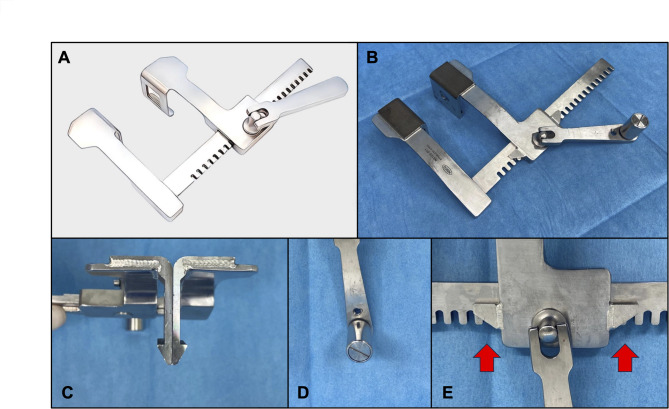
The novel retractor was designed with an arrow-shaped hook for improved intercostal insertion and a continuously rotatable handle to enhance procedural efficiency. A comparative study using excised porcine thoraxes was conducted to assess its performance. Six cm incisions were made in the intercostal spaces bilaterally before retractor insertion. Evaluators inserted the device, performed three handle rotations, and repeated the procedure using the other retractor on the contralateral side. The primary outcome was the time required for three rotations, while secondary outcomes included ease of insertion, ease of rotation, and hook stability, rated on a 6-point scale by evaluators.
Ten surgeons (n = 10) performed thoracotomy using both the novel and conventional retractors. Comparison of the time required for three handle rotations between the novel and conventional retractors demonstrated a statistically significant reduction with the novel retractor. The median time to complete three rotations was 16.0 [11.7-19.1] seconds with the novel retractor, compared to 7.0 [5.3-8.5] seconds with the conventional model (P < 0.01). The ease of insertion was rated significantly higher with the novel retractor compared to the conventional model (6.0 [5.5-6.0] vs. 2.5 [2.0-3.0], P < 0.01). The ease of rotation was also rated significantly higher with the novel retractor than with the conventional model (5.5 [5.0-6.0] vs. 2.5 [1.0-3.5], P < 0.01). In the evaluation of the hook stability, no significant difference was observed between the novel and conventional retractors (P = 1.0).
The novel thoracic retractor enables faster and easier thoracotomy compared to conventional model. Given the strong association between time and RT prognosis, this device is well-suited for RT procedures requiring rapid execution.
复苏性开胸手术(RT)是对创伤性心脏骤停或失血性休克患者的关键干预措施,其生存率高度依赖于实施该手术所需的时间。尽管情况紧急,但RT仍使用最初为常规手术设计的传统胸廓牵开器进行,这在紧急情况下带来了挑战。为解决这些局限性,我们开发了一种针对RT优化的新型胸廓牵开器,并与传统型号相比评估了其性能。
新型牵开器设计有用于改善肋间插入的箭头形钩子和可连续旋转的手柄以提高手术效率。使用切除的猪胸廓进行了一项对比研究以评估其性能。在插入牵开器之前,在双侧肋间空间做6厘米的切口。评估人员插入该装置,进行三次手柄旋转,然后使用对侧的另一个牵开器重复该操作。主要结果是三次旋转所需的时间,次要结果包括插入的难易程度、旋转的难易程度和钩子稳定性,由评估人员按6分制进行评分。
十位外科医生(n = 10)使用新型和传统牵开器进行了开胸手术。新型牵开器和传统牵开器三次手柄旋转所需时间的比较显示,新型牵开器有统计学上的显著减少。新型牵开器完成三次旋转的中位时间为16.0[11.7 - 19.1]秒,而传统型号为7.0[5.3 - 8.5]秒(P < 0.01)。与传统型号相比,新型牵开器的插入难易程度评分显著更高(6.0[5.5 - 6.0]对2.5[2.0 - 3.0],P < 0.01)。新型牵开器的旋转难易程度评分也显著高于传统型号(5.5[5.0 - 6.0]对2.5[1.0 - 3.5],P < 0.01)。在钩子稳定性评估中,新型和传统牵开器之间未观察到显著差异(P = 1.0)。
与传统型号相比,新型胸廓牵开器能使开胸手术更快、更容易。鉴于时间与RT预后之间的紧密关联,该装置非常适合需要快速实施的RT手术。