Rawlings Gregg H, Stark Abbie, Armstrong Iain, Costin Vlad, Thompson Andrew R
Clinical and Applied Psychology Unit University of Sheffield Sheffield UK.
Cardiff and Vale University Health Board and Cardiff University Glamorgan UK.
Pulm Circ. 2025 Jun 17;15(2):e70101. doi: 10.1002/pul2.70101. eCollection 2025 Apr.
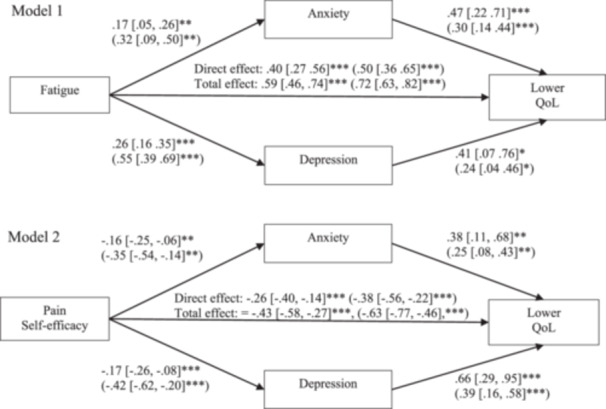
While anxiety and depression are commonly reported in pulmonary hypertension (PH), limited evidence exists on how these conditions interact with the pathophysiological symptoms of PH. Fatigue and, to a lesser degree, pain are key symptoms of PH; however, they have rarely been examined as separate experiences associated with PH. Using a cross-sectional research design, 68 adults with PH recruited from global Pulmonary Hypertensions Associations completed a series of self-report measures assessing fatigue, pain self-efficacy, anxiety, depression, and health-related quality of life (HRQoL). Aiming to understand the nuances of PH symptomatology, we first looked at responses on individual items from fatigue and pain measures, respectively. Then, to examine relationships between self-reported symptoms, we tested potential pathways from fatigue and pain to HRQoL through depression and anxiety. All symptoms were correlated, suggesting individuals with greater anxiety and depression also experienced more fatigue, and lower pain self-efficacy and HRQoL. Parallel mediation analyses showed that fatigue and pain had a direct effect on HRQoL, as well as an indirect effect via anxiety and depression. Explorative serial mediation models suggested the indirect path from fatigue to HRQoL was significant when depression was ordered first followed by anxiety; whereas for pain self-efficacy, the path was significant when anxiety was followed by depression. Results add to the evidence demonstrating the high co-occurrence of mental health difficulties in PH and the important role they play in pathophysiological symptomatology. Analyses support providing holistic care for this clinical group to help identify various therapeutic targets suggestive of predicting HRQoL.
虽然焦虑和抑郁在肺动脉高压(PH)中很常见,但关于这些状况如何与PH的病理生理症状相互作用的证据有限。疲劳以及程度较轻的疼痛是PH的关键症状;然而,它们很少被作为与PH相关的单独体验进行研究。采用横断面研究设计,从全球肺动脉高压协会招募的68名成年PH患者完成了一系列自我报告测量,评估疲劳、疼痛自我效能感、焦虑、抑郁以及健康相关生活质量(HRQoL)。为了了解PH症状学的细微差别,我们首先分别查看了疲劳和疼痛测量中各个项目的回答。然后,为了研究自我报告症状之间的关系,我们测试了从疲劳和疼痛通过抑郁和焦虑到HRQoL的潜在路径。所有症状都相互关联,这表明焦虑和抑郁程度较高的个体也经历了更多的疲劳,以及更低的疼痛自我效能感和HRQoL。平行中介分析表明,疲劳和疼痛对HRQoL有直接影响,同时也通过焦虑和抑郁产生间接影响。探索性序列中介模型表明,当抑郁排在焦虑之前时,从疲劳到HRQoL的间接路径是显著的;而对于疼痛自我效能感,当焦虑排在抑郁之后时,该路径是显著的。研究结果进一步证明了PH患者中精神健康问题的高共现性以及它们在病理生理症状学中所起的重要作用。分析支持为这一临床群体提供整体护理,以帮助确定各种有助于预测HRQoL的治疗靶点。